QUESTION IMAGE
Question
- isotopes vs. atomic mass
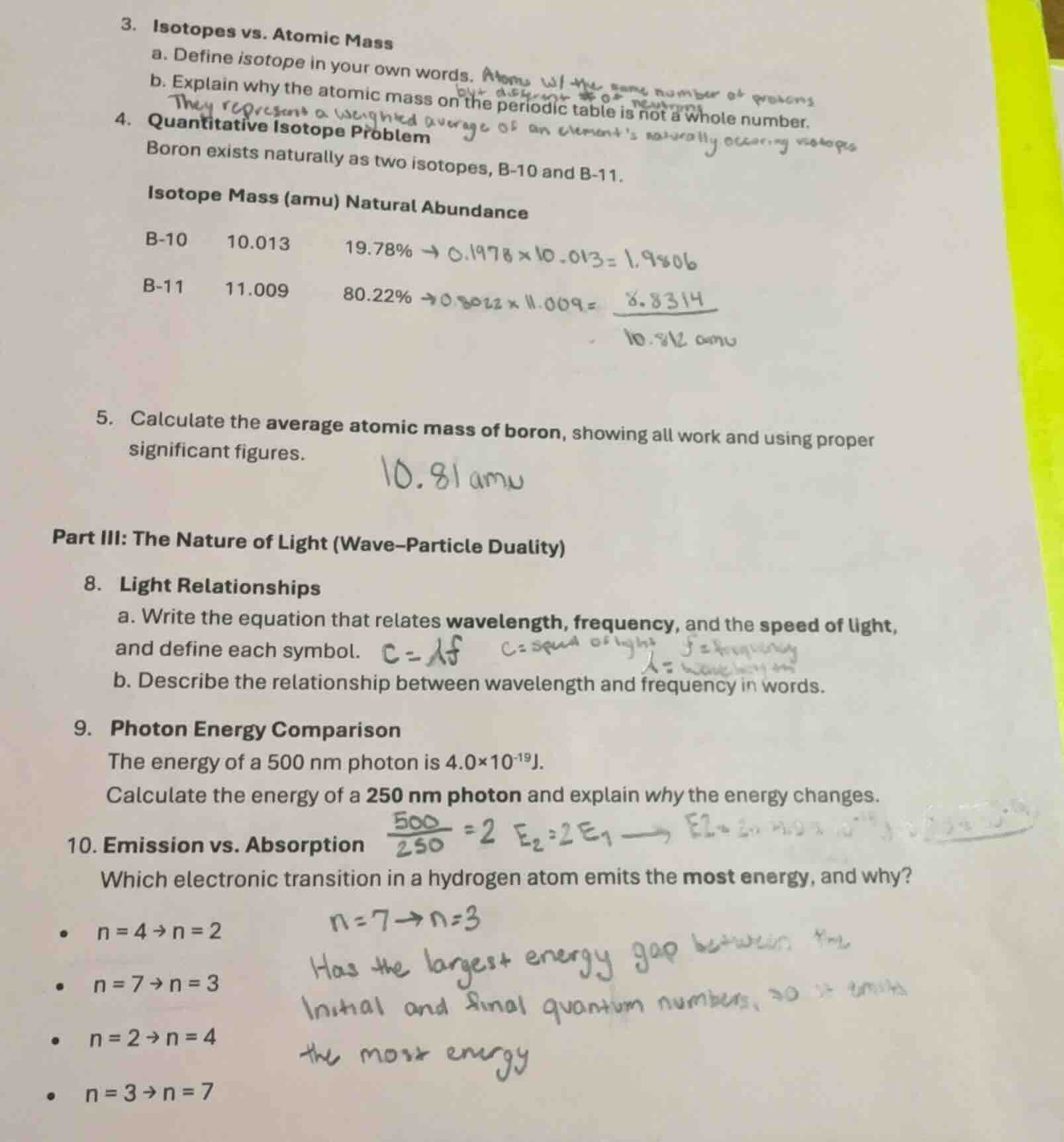
a. define isotope in your own words.
b. explain why the atomic mass on the periodic table is not a whole number.
- quantitative isotope problem
boron exists naturally as two isotopes, b - 10 and b - 11.
isotope mass (amu) natural abundance
b - 10 10.013 19.78%
b - 11 11.009 80.22%
- calculate the average atomic mass of boron, showing all work and using proper significant figures.
part iii: the nature of light (wave - particle duality)
- light relationships
a. write the equation that relates wavelength, frequency, and the speed of light, and define each symbol.
b. describe the relationship between wavelength and frequency in words.
- photon energy comparison
the energy of a 500 nm photon is 4.0×10⁻¹⁹j.
calculate the energy of a 250 nm photon and explain why the energy changes.
- emission vs. absorption
which electronic transition in a hydrogen atom emits the most energy, and why?
- n = 4→n = 2
- n = 7→n = 3
- n = 2→n = 4
- n = 3→n = 7
Step1: Convert % to decimals
B-10: $19.78\% = 0.1978$; B-11: $80.22\% = 0.8022$
Step2: Calculate weighted mass for B-10
$\text{Weighted mass}_1 = 0.1978 \times 10.013 = 1.9806$
Step3: Calculate weighted mass for B-11
$\text{Weighted mass}_2 = 0.8022 \times 11.009 = 8.8314$
Step4: Sum weighted masses
$\text{Average mass} = 1.9806 + 8.8314 = 10.812$
Step5: Round to sig figs
Round to 4 significant figures: $10.81$
3a.
Isotopes are atoms of the same element (same proton count) that have different numbers of neutrons, so they have different atomic masses.
3b.
Atomic mass on the periodic table is a weighted average of the masses of an element's naturally occurring isotopes, accounting for their relative abundances, so it is rarely a whole number.
8a.
The equation is $c = \lambda f$, where:
- $c$ = speed of light in a vacuum ($3.00 \times 10^8$ m/s)
- $\lambda$ = wavelength of the light (distance per wave)
- $f$ = frequency of the light (waves per second)
8b.
Wavelength and frequency are inversely proportional: as wavelength increases, frequency decreases, and vice versa (since the speed of light is constant).
9.
Photon energy is inversely proportional to wavelength ($E = \frac{hc}{\lambda}$). A 250 nm photon is half the wavelength of a 500 nm photon, so its energy is double. Calculation: $E_2 = 2 \times 4.0 \times 10^{-19}\text{J} = 8.0 \times 10^{-19}\text{J}$. The energy increases because shorter wavelengths correspond to higher frequency, and higher frequency photons carry more energy.
10.
The transition $n=4 \to n=2$ emits the most energy. In hydrogen atoms, energy levels are closer together at higher $n$ values. The energy gap between $n=4$ and $n=2$ is larger than the gap between $n=7$ and $n=3$. The transitions $n=2 \to n=4$ and $n=3 \to n=7$ are absorption (not emission) transitions, so they do not emit energy.

Snap & solve any problem in the app
Get step-by-step solutions on Sovi AI
Photo-based solutions with guided steps
Explore more problems and detailed explanations
$10.81$ amu
---