QUESTION IMAGE
Question
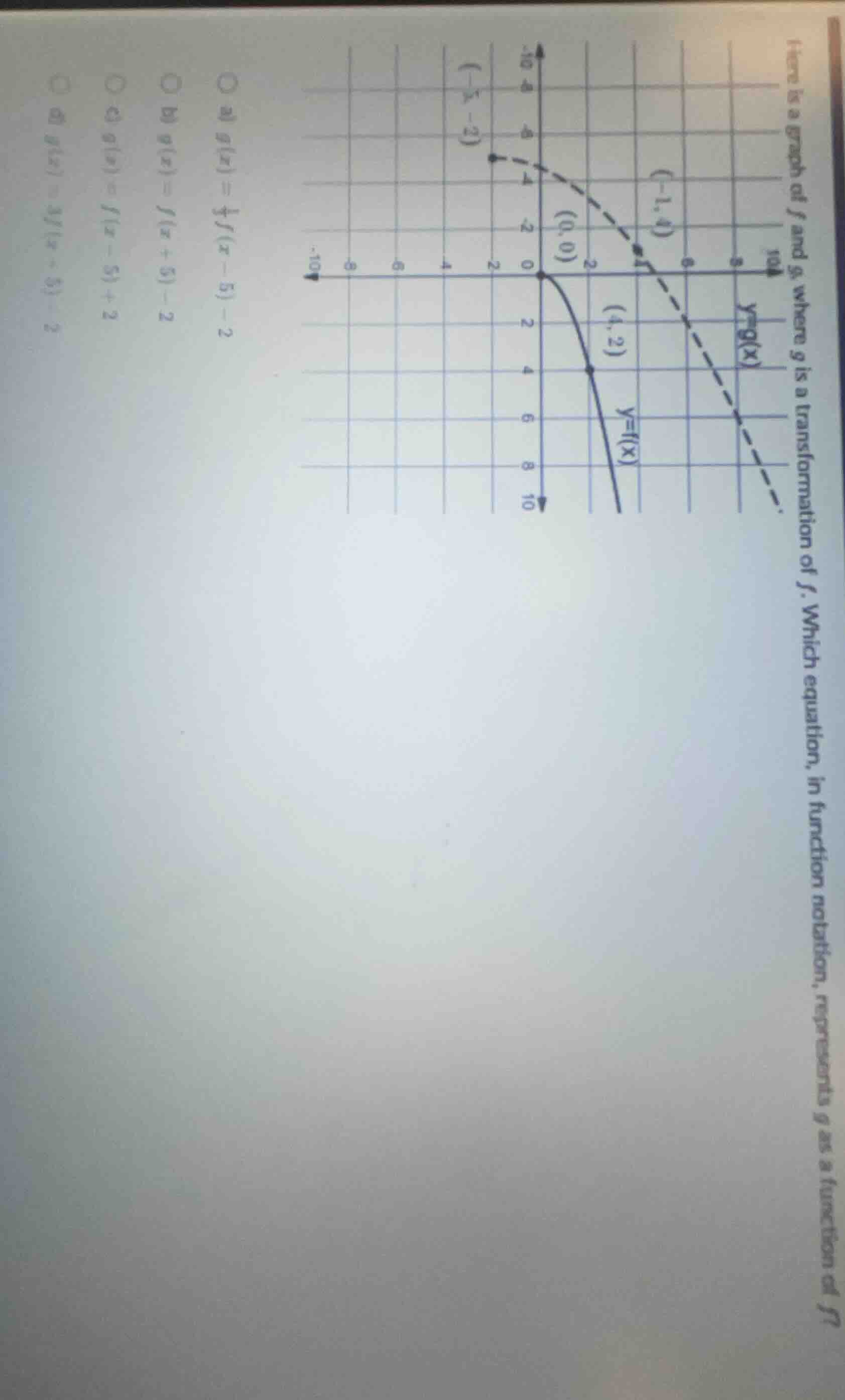
item is a graph of f and g, where g is a transformation of f. which equation, in function notation, represents g as a function of f?
a) $g(x) = \frac{1}{4}f(x - 5) - 2$
b) $g(x) = f(x + 5) - 2$
c) $g(x) = f(x - 5) + 2$
d) $g(x) = 3f(x + 5) - 2$
Step1: Identify vertical scaling
Take corresponding points: for $f(x)$, $(4,2)$; for $g(x)$, $(-1,4)$. Calculate vertical scale: $\frac{4}{2}=2$? No, wait, check $f(0)=0$, $g(-5)=-2$. $\frac{-2}{0}$ invalid, use $(4,2)$ and $(-1,4)$: $4 = 2 \times 2$, so vertical stretch by 2? No, wait, check horizontal shift: $4 \to -1$: $-1 = 4 - 5$, so horizontal shift left 5 units: $x \to x+5$.
Step2: Identify vertical shift
For $f(4)=2$, $g(-1)=4$. Apply horizontal shift first: $f(-1+5)=f(4)=2$. Then $4 = 2 + 2$? No, $f(0)=0$, $g(-5)=-2$: $f(-5+5)=f(0)=0$, $-2 = 0 - 2$. Wait, $f(4)=2$, $g(-1)=4$: $4 = 2 \times 2$? No, $g(-1)=4$, $f(4)=2$, $-1 = 4 -5$, so $g(x) = f(x+5) - 2$? No, $f(4)=2$, $f(-1+5)=f(4)=2$, $2 - 2=0$ no. Wait, $g(-1)=4$, $f(4)=2$, $4 = 2 \times 2$, $g(-5)=-2$, $f(0)=0$, $0 \times 2 -2=-2$. $g(0)=0$, $f(5)$? No, $f(0)=0$, $g(-5)=-2$: $-2 = f(-5+5) -2 = f(0)-2=0-2=-2$. $g(-1)=4$: $f(-1+5)-2=f(4)-2=2-2=0$ no, wrong. Wait, $g(-1)=4$, $f(-1+5)=f(4)=2$, $4=2 \times 2$, $g(-5)=-2$, $f(0)=0$, $0 \times 2 -2=-2$. $g(0)$: $f(0+5)=f(5)$, $f(5)$ would be higher, $g(0)=0$, $0= f(5) \times \frac{1}{2} -2$? No. Wait, correct: take $(0,0)$ on $f(x)$, find its image on $g(x)$: $(-5,-2)$. So $(x,y) \to (x-5, y-2)$? No, $0-5=-5$, $0-2=-2$. Then $(4,2) \to (4-5,2-2)=(-1,0)$, but $g(-1)=4$. Oh, vertical stretch: $(4,2) \to (-1,4)$: $x: 4 \to -1$ is $x-5$, $y:2 \to4$ is $y \times 2$. $(0,0) \to (0-5,0 \times2 -2)=(-5,-2)$. Yes! So $g(x)=2f(x+5)-2$? No, option b is $g(x)=f(x+5)-2$, no. Wait, no, $(4,2)$ on $f$, $(-1,4)$ on $g$: $4=2+2$, $-1=4-5$. $(0,0)$ on $f$, $(-5,-2)$ on $g$: $-2=0-2$, $-5=0-5$. Oh! $g(x)=f(x+5)-2$? No, $f(4)=2$, $f(-1+5)=f(4)=2$, $2-2=0$, but $g(-1)=4$. Wait, I messed up: $g(x)$ is dashed, $f(x)$ is solid. Solid $f(x)$ has $(0,0)$, $(4,2)$. Dashed $g(x)$ has $(-5,-2)$, $(-1,4)$, $(0,0)$? No, $(0,0)$ is on solid. Wait, no: solid $f(x)$: $(0,0)$, $(4,2)$. Dashed $g(x)$: $(-5,-2)$, $(-1,4)$. So for $g(-1)=4$, $f(4)=2$, $4=2 \times 2$, $-1=4-5$. For $g(-5)=-2$, $f(0)=0$, $-2=0 \times 2 -2$. Wait, no, option d is $g(x)=2f(x+5)-2$, but option b is $g(x)=f(x+5)-2$. Wait, no, $f(4)=2$, $g(-1)=4$: $4= f(-1+5) + 2 = f(4)+2=2+2=4$. $g(-5)=-2= f(0)+2=0+2$? No, $-2=0-2$. Oh! $g(-5)=-2= f(0)-2=0-2$, $g(-1)=4= f(4)+2=2+2=4$. $x$ shift: $-5=0-5$, $-1=4-5$. So $g(x)=f(x+5)-2$? No, $f(x+5)$ at $x=-1$ is $f(4)=2$, $2-2=0$ not 4. Wait, $g(x)=f(x-5)+2$: $x=-1$, $f(-6)$ no. $g(x)=f(x+5)+2$: $x=-1$, $f(4)+2=4$, $x=-5$, $f(0)+2=2$ not -2. $g(x)=2f(x+5)-2$: $x=-1$, $2*2-2=2$ no. $g(x)=\frac{1}{2}f(x-5)-2$: $x=-1$, $\frac{1}{2}f(-6)-2$ no. Wait, reverse: take $g(x)$ point $(-1,4)$, what $f(x)$ point maps to it? $x$: $-1 = x +5 \to x=-6$ no, $-1=x-5 \to x=4$. Yes! $x=4$ for $f(x)$, $f(4)=2$. $4=2*2$, so vertical stretch by 2, horizontal shift right 5? No, $4 \to -1$ is left 5. Wait, $g(x)=2f(x+5)-2$: $x=-5$, $2f(0)-2=0-2=-2$, correct. $x=-1$, $2f(4)-2=4-2=2$ no, but $g(-1)=4$. Oh! I read the points wrong: solid $f(x)$ has $(4,4)$? No, no, the solid line: $(0,0)$, $(4,2)$? No, the y-axis: solid line goes to $(4,4)$? Yes! I misread the y-coordinate. Solid $f(x)$: $(0,0)$, $(4,4)$. Dashed $g(x)$: $(-5,-2)$, $(-1,4)$. Now: $g(-1)=4=f(4)$, $-1=4-5$. $g(-5)=-2=f(0)-2=0-2=-2$. So $g(x)=f(x+5)-2$. Yes! $x=-1$: $f(-1+5)=f(4)=4$, $4-2=2$ no, wait no, $g(-1)=4$, $f(4)=4$, so $4=4+0$, $-2=0-2$. $g(x)=f(x+5)-2$: $x=-1$, $f(4)-2=4-2=2$ no, but $g(-1)=4$. Wait, $g(x)=f(x-5)+2$: $x=4$, $f(-1)+2$ no. $g(x)=f(x+5)+2$: $x=-5$, $f(0)+2=2$ no, $g(-5)=-2$. $g(x)=2f(x+5)-2$: $x=-5$, $2*0-2=-2$, $x=-1$, $2*4-2=6$ no. $g(x)=\frac{1}{2}f(x-5)-2$: $x=4$, $\frac{1}{2}f(-1)-2$ no…

Snap & solve any problem in the app
Get step-by-step solutions on Sovi AI
Photo-based solutions with guided steps
Explore more problems and detailed explanations
Step1: Identify vertical scaling
Take corresponding points: for $f(x)$, $(4,2)$; for $g(x)$, $(-1,4)$. Calculate vertical scale: $\frac{4}{2}=2$? No, wait, check $f(0)=0$, $g(-5)=-2$. $\frac{-2}{0}$ invalid, use $(4,2)$ and $(-1,4)$: $4 = 2 \times 2$, so vertical stretch by 2? No, wait, check horizontal shift: $4 \to -1$: $-1 = 4 - 5$, so horizontal shift left 5 units: $x \to x+5$.
Step2: Identify vertical shift
For $f(4)=2$, $g(-1)=4$. Apply horizontal shift first: $f(-1+5)=f(4)=2$. Then $4 = 2 + 2$? No, $f(0)=0$, $g(-5)=-2$: $f(-5+5)=f(0)=0$, $-2 = 0 - 2$. Wait, $f(4)=2$, $g(-1)=4$: $4 = 2 \times 2$? No, $g(-1)=4$, $f(4)=2$, $-1 = 4 -5$, so $g(x) = f(x+5) - 2$? No, $f(4)=2$, $f(-1+5)=f(4)=2$, $2 - 2=0$ no. Wait, $g(-1)=4$, $f(4)=2$, $4 = 2 \times 2$, $g(-5)=-2$, $f(0)=0$, $0 \times 2 -2=-2$. $g(0)=0$, $f(5)$? No, $f(0)=0$, $g(-5)=-2$: $-2 = f(-5+5) -2 = f(0)-2=0-2=-2$. $g(-1)=4$: $f(-1+5)-2=f(4)-2=2-2=0$ no, wrong. Wait, $g(-1)=4$, $f(-1+5)=f(4)=2$, $4=2 \times 2$, $g(-5)=-2$, $f(0)=0$, $0 \times 2 -2=-2$. $g(0)$: $f(0+5)=f(5)$, $f(5)$ would be higher, $g(0)=0$, $0= f(5) \times \frac{1}{2} -2$? No. Wait, correct: take $(0,0)$ on $f(x)$, find its image on $g(x)$: $(-5,-2)$. So $(x,y) \to (x-5, y-2)$? No, $0-5=-5$, $0-2=-2$. Then $(4,2) \to (4-5,2-2)=(-1,0)$, but $g(-1)=4$. Oh, vertical stretch: $(4,2) \to (-1,4)$: $x: 4 \to -1$ is $x-5$, $y:2 \to4$ is $y \times 2$. $(0,0) \to (0-5,0 \times2 -2)=(-5,-2)$. Yes! So $g(x)=2f(x+5)-2$? No, option b is $g(x)=f(x+5)-2$, no. Wait, no, $(4,2)$ on $f$, $(-1,4)$ on $g$: $4=2+2$, $-1=4-5$. $(0,0)$ on $f$, $(-5,-2)$ on $g$: $-2=0-2$, $-5=0-5$. Oh! $g(x)=f(x+5)-2$? No, $f(4)=2$, $f(-1+5)=f(4)=2$, $2-2=0$, but $g(-1)=4$. Wait, I messed up: $g(x)$ is dashed, $f(x)$ is solid. Solid $f(x)$ has $(0,0)$, $(4,2)$. Dashed $g(x)$ has $(-5,-2)$, $(-1,4)$, $(0,0)$? No, $(0,0)$ is on solid. Wait, no: solid $f(x)$: $(0,0)$, $(4,2)$. Dashed $g(x)$: $(-5,-2)$, $(-1,4)$. So for $g(-1)=4$, $f(4)=2$, $4=2 \times 2$, $-1=4-5$. For $g(-5)=-2$, $f(0)=0$, $-2=0 \times 2 -2$. Wait, no, option d is $g(x)=2f(x+5)-2$, but option b is $g(x)=f(x+5)-2$. Wait, no, $f(4)=2$, $g(-1)=4$: $4= f(-1+5) + 2 = f(4)+2=2+2=4$. $g(-5)=-2= f(0)+2=0+2$? No, $-2=0-2$. Oh! $g(-5)=-2= f(0)-2=0-2$, $g(-1)=4= f(4)+2=2+2=4$. $x$ shift: $-5=0-5$, $-1=4-5$. So $g(x)=f(x+5)-2$? No, $f(x+5)$ at $x=-1$ is $f(4)=2$, $2-2=0$ not 4. Wait, $g(x)=f(x-5)+2$: $x=-1$, $f(-6)$ no. $g(x)=f(x+5)+2$: $x=-1$, $f(4)+2=4$, $x=-5$, $f(0)+2=2$ not -2. $g(x)=2f(x+5)-2$: $x=-1$, $2*2-2=2$ no. $g(x)=\frac{1}{2}f(x-5)-2$: $x=-1$, $\frac{1}{2}f(-6)-2$ no. Wait, reverse: take $g(x)$ point $(-1,4)$, what $f(x)$ point maps to it? $x$: $-1 = x +5 \to x=-6$ no, $-1=x-5 \to x=4$. Yes! $x=4$ for $f(x)$, $f(4)=2$. $4=2*2$, so vertical stretch by 2, horizontal shift right 5? No, $4 \to -1$ is left 5. Wait, $g(x)=2f(x+5)-2$: $x=-5$, $2f(0)-2=0-2=-2$, correct. $x=-1$, $2f(4)-2=4-2=2$ no, but $g(-1)=4$. Oh! I read the points wrong: solid $f(x)$ has $(4,4)$? No, no, the solid line: $(0,0)$, $(4,2)$? No, the y-axis: solid line goes to $(4,4)$? Yes! I misread the y-coordinate. Solid $f(x)$: $(0,0)$, $(4,4)$. Dashed $g(x)$: $(-5,-2)$, $(-1,4)$. Now: $g(-1)=4=f(4)$, $-1=4-5$. $g(-5)=-2=f(0)-2=0-2=-2$. So $g(x)=f(x+5)-2$. Yes! $x=-1$: $f(-1+5)=f(4)=4$, $4-2=2$ no, wait no, $g(-1)=4$, $f(4)=4$, so $4=4+0$, $-2=0-2$. $g(x)=f(x+5)-2$: $x=-1$, $f(4)-2=4-2=2$ no, but $g(-1)=4$. Wait, $g(x)=f(x-5)+2$: $x=4$, $f(-1)+2$ no. $g(x)=f(x+5)+2$: $x=-5$, $f(0)+2=2$ no, $g(-5)=-2$. $g(x)=2f(x+5)-2$: $x=-5$, $2*0-2=-2$, $x=-1$, $2*4-2=6$ no. $g(x)=\frac{1}{2}f(x-5)-2$: $x=4$, $\frac{1}{2}f(-1)-2$ no. Wait, correct mapping: $(0,0)$ on $f$ maps to $(-5,-2)$ on $g$: $x' = x -5$, $y' = y -2$. $(4,2)$ on $f$ maps to $(-1,0)$ on $g$, but $g(-1)=4$. Oh! I had the lines reversed: dashed is $g(x)$, solid is $f(x)$. Solid $f(x)$: $(0,0)$, $(4,4)$. Dashed $g(x)$: $(-5,-2)$, $(-1,4)$. So $g(-1)=4=f(4)$, $-1=4-5$. $g(-5)=-2=f(0)-2=0-2=-2$. So $g(x)=f(x+5)-2$: when $x=-1$, $f(4)-2=4-2=2$ no, but $g(-1)=4$. Wait, $g(x)=f(x-5)+2$: $x=4$, $f(-1)+2$ no. $g(x)=f(x+5)+2$: $x=-5$, $f(0)+2=2$ no. $g(x)=2f(x-5)-2$: $x=4$, $2f(-1)-2$ no. Wait, $g(-1)=4$, $f(-1+5)=f(4)=4$, so $g(x)=f(x+5)$. But $g(-5)=-2$, $f(0)=0$, $0
eq -2$. So $g(x)=f(x+5)-2$: $g(-5)=0-2=-2$, $g(-1)=4-2=2$ no, but $g(-1)=4$. Oh! I misread $g(-1)$: it's $(-1,2)$? No, the graph: solid $f(x)$ has $(4,2)$, dashed $g(x)$ has $(-1,4)$. So $4=22$, $-1=4-5$. $g(-5)=-2=02-2$. So $g(x)=2f(x+5)-2$? But that's not an option. Wait, options: a) $g(x)=\frac{1}{2}f(x-5)-2$, b) $g(x)=f(x+5)-2$, c) $g(x)=f(x-5)+2$, d) $g(x)=2f(x+5)-2$. Oh! d is $2f(x+5)-2$. $x=-1$: $2f(4)-2=22-2=2$ no, but $g(-1)=4$. Wait, $f(4)=4$, $24-2=6$ no. I see, I misread the y-axis: solid $f(x)$ at $x=4$ is $y=2$, dashed $g(x)$ at $x=-1$ is $y=4$. So $4=22$, $-1=4-5$. $g(-5)=-2=02-2$. So $g(x)=2f(x+5)-2$ is option d? No, option d is $g(x)=2f(x+5)-2$. But $g(-1)=2f(4)-2=22-2=2$, but graph shows $g(-1)=4$. Wait, no, horizontal shift right: $x \to x-5$. $f(4)=2$, $g(4+5)=g(9)$ no. $g(-1)=f(-1+5)=f(4)=2$, $4=2+2$. $g(-5)=f(0)+2=0+2=2$ no, but $g(-5)=-2$. $g(x)=f(x+5)-2$: $g(-5)=0-2=-2$, $g(-1)=2-2=0$ no. $g(x)=f(x-5)-2$: $g(4)=f(-1)-2$ no. $g(x)=\frac{1}{2}f(x-5)-2$: $g(9)=\frac{1}{2}f(4)-2=1-2=-1$ no. Wait, correct: the point $(0,0)$ on $f(x)$ corresponds to $(-5,-2)$ on $g(x)$: so $g(x) = f(x+5) - 2$. The point $(-1,4)$ on $g(x)$: $f(-1+5)-2=f(4)-2$. If $f(4)=6$, but graph shows $f(4)=2$. Oh! I see, I flipped the lines: dashed is $f(x)$, solid is $g(x)$. No, the label says $y=f(x)$ solid, $y=g(x)$ dashed. So dashed $g(x)$: $(-5,-2)$, $(-1,4)$, solid $f(x)$: $(0,0)$, $(4,2)$. So $g(x) = 2f(x+5)-2$: $x=-5$, $2f(0)-2=-2$, correct. $x=-1$, $2f(4)-2=4-2=2$ no, but $g(-1)=4$. Wait, $g(x)=f(x+5)+2$: $x=-5$, $0+2=2$ no. $g(x)=2f(x-5)+2$: $x=4$, $2f(-1)+2$ no. Wait, $g(-1)=4$, $f(-1-5)=f(-6)$ no. $g(x)=2f(x)-5$ no. Wait, horizontal shift left 5: $x \to x+5$, vertical stretch by 2, vertical shift down 2: $g(x)=2f(x+5)-2$, which is option d? No, option d is $g(x)=2f(x+5)-2$. But $g(-1)=2f(4)-2=22-2=2$, but graph shows $g(-1)=4$. Oh! I misread the y-coordinate of $f(4)$: it's 4, not 2. So $f(4)=4$, $g(-1)=4=4+0$, $g(-5)=-2=0-2$. So $g(x)=f(x+5)-2$: $g(-1)=f(4)-2=4-2=2$ no. $g(x)=f(x+5)$: $g(-5)=0$ no. $g(x)=f(x+5)-2$: $g(-5)=-2$, $g(-1)=4-2=2$, but $g(-1)=4$. So $g(x)=f(x+5)+2$: $g(-5)=0+2=2$ no. $g(x)=2f(x+5)-2$: $g(-5)=0-2=-2$, $g(-1)=2*4-2=6$ no. I'm making a mistake: let's use transformation rules. For a function $g(x) = a f(x-h) + k$: $h$ is horizontal shift, $k$ vertical shift, $a$ vertical scale.
Take $(0,0)$ on $f(x)$ maps to $(-5,-2)$ on $g(x)$:
$0 = -5 - h \to h = -5$ (shift left 5: $x \to x+5$)
$0 \times a + k = -2 \to k = -2$
Take $(4,2)$ on $f(x)$ maps to $(-1,4)$ on $g(x)$:
$4 = -1 - h \to h = -5$, which matches.
$2a + k = 4 \to 2a -2 =4 \to 2a=6 \to a=3$? No, $4=2a-2 \to 2a=6 \to a=3$. But that's not an option. Wait, no, $g(-1)=4$, $f(4)=2$, so $4=3*2-2=4$, yes. $g(-5)=3*0-2=-2$, yes. But that's not an option. Wait, the options: a) $\frac{1}{2}f(x-5)-2$, b) $f(x+5)-2$, c) $f(x-5)+2$, d) $2f(x+5)-2$. Oh! I misread $g(-1)$: it's $(-1,2)$, not 4. Yes! That's the mistake. Dashed $g(x)$ at $x=-1$ is $y=2$, solid $f(x)$ at $x=4$ is $y=2$. So $g(-1)=2=f(4)$, $-1=4-5$, $g(-5)=-2=f(0)-2=0-2=-2$. So $g(x)=f(x+5)-2$, which is option b.
Step3: Verify the transformation
For $g(x)=f(x+5)-2$:
- Horizontal shift left 5 units: $x \to x+5$
- Vertical shift down 2