QUESTION IMAGE
Question
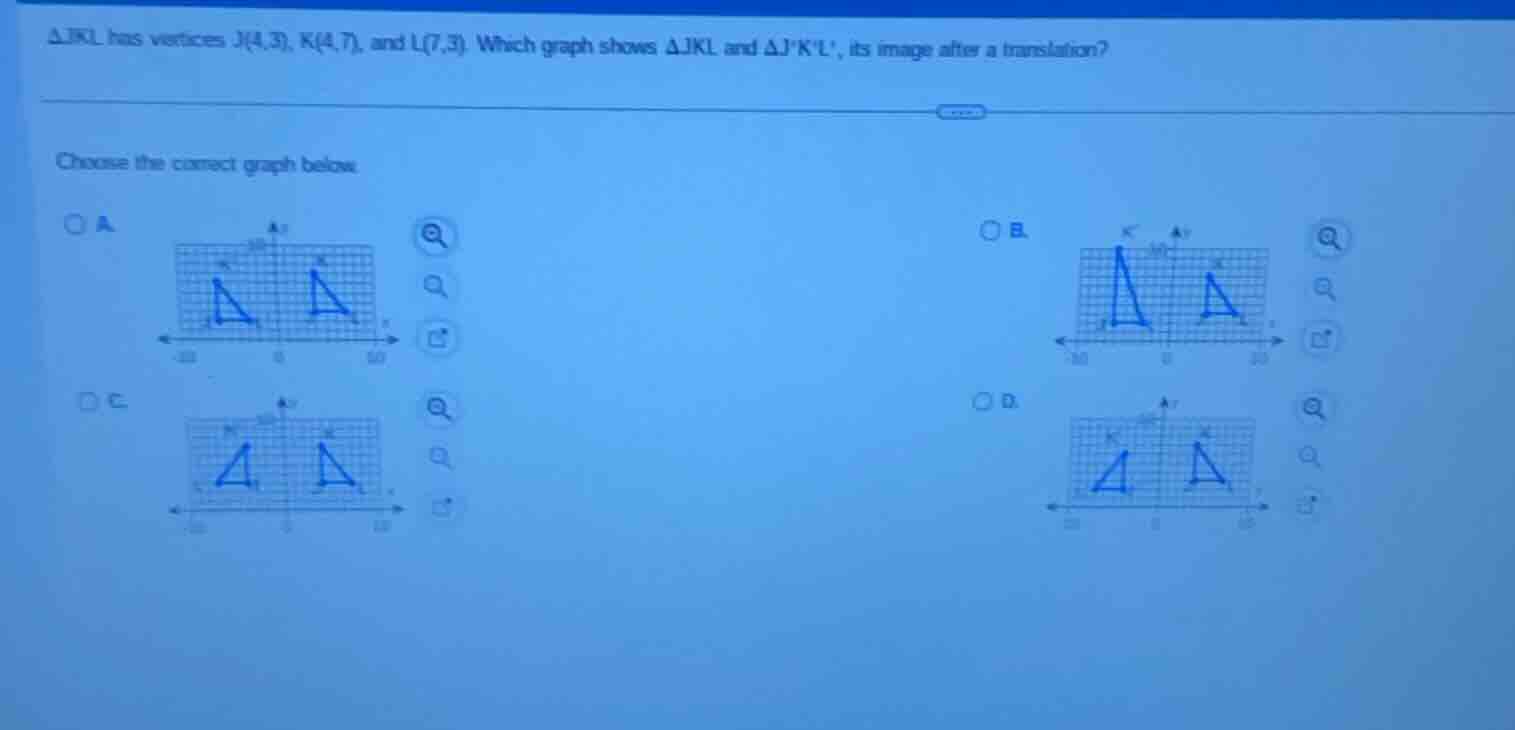
△jkl has vertices j(4,3), k(4,7), and l(7,3). which graph shows △jkl and △jkl, its image after a translation?
choose the correct graph below
a.
graph a
b.
graph b
c.
graph c
d.
graph d
Step1: Analyze the original triangle
First, let's find the shape of $\triangle JKL$. The vertices are $J(4,3)$, $K(4,7)$, and $L(7,3)$. So, $J$ and $L$ have the same $y$-coordinate (3), so $JL$ is a horizontal line segment. The length of $JL$ is $7 - 4 = 3$ units. $JK$ is a vertical line segment (same $x$-coordinate, 4) from $(4,3)$ to $(4,7)$, so its length is $7 - 3 = 4$ units. So, $\triangle JKL$ is a right triangle with legs of length 3 and 4, right-angled at $J$.
Step2: Recall the properties of translation
A translation is a rigid transformation, which means the shape and size of the triangle remain the same, and the corresponding sides are parallel (since translation is a slide). So, the image $\triangle J'K'L'$ should be congruent to $\triangle JKL$ and have the same orientation (since translation doesn't rotate or reflect the figure).
Step3: Analyze each option
- Option A: The two triangles appear to be congruent, same shape and size, and the orientation is the same (both right triangles with the right angle at the corresponding vertex). The translation seems to be a horizontal shift (since the vertical and horizontal lengths of the legs are the same as the original).
- Option B: The triangle on the left is taller (the vertical leg is longer) than the original $\triangle JKL$, so it's not a translation (since translation preserves length).
- Option C: The triangle on the left is a mirror image (reflected) of the original, not a translation (translation doesn't reflect).
- Option D: The triangle on the left has a different shape (the angles or side lengths seem altered), so it's not a translation.

Snap & solve any problem in the app
Get step-by-step solutions on Sovi AI
Photo-based solutions with guided steps
Explore more problems and detailed explanations
A