QUESTION IMAGE
Question
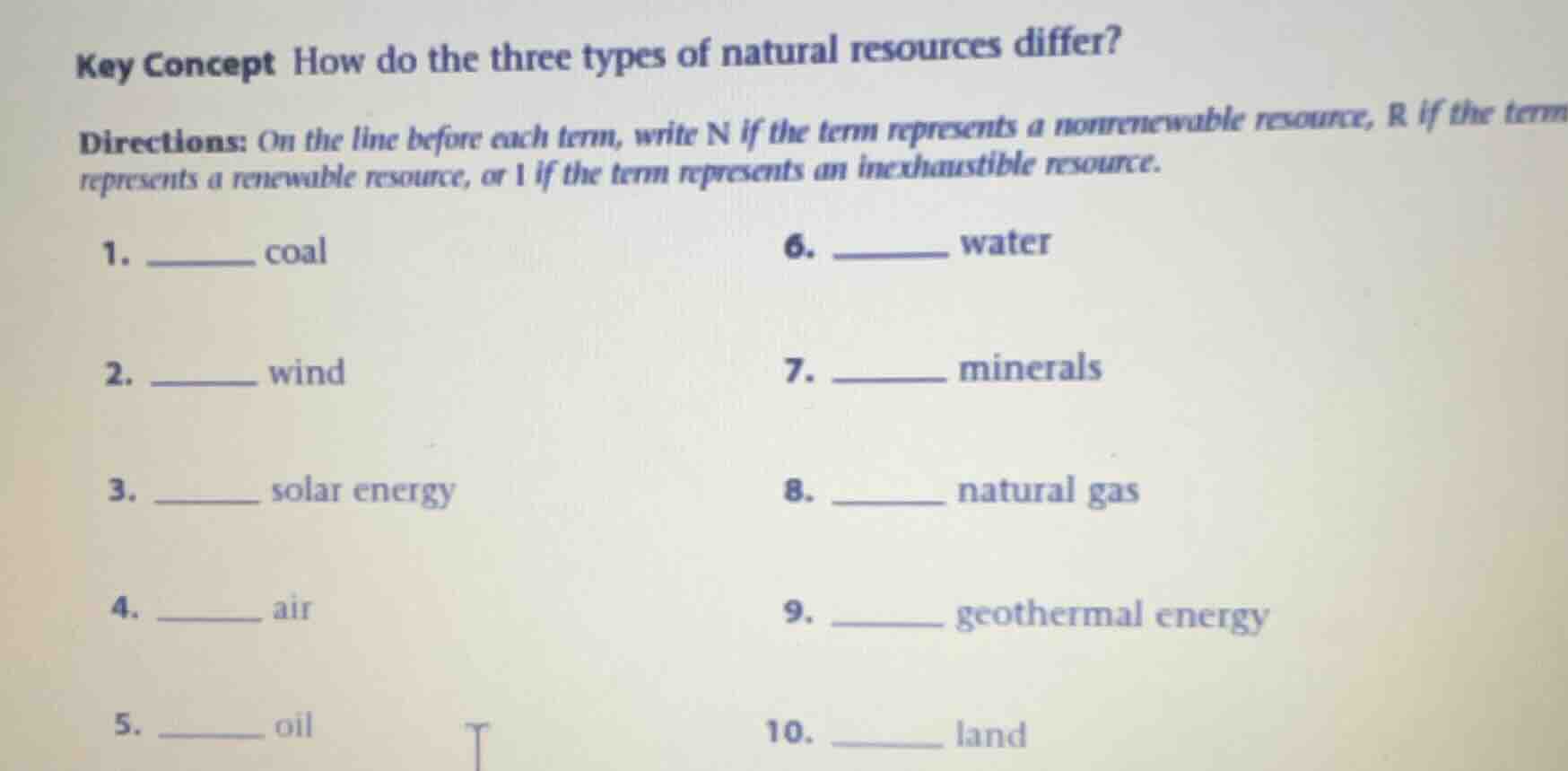
key concept how do the three types of natural resources differ? directions: on the line before each term, write n if the term represents a nonrenewable resource, r if the term represents a renewable resource, or i if the term represents an inexhaustible resource. 1. ____ coal 2. __ wind 3. __ solar energy 4. __ air 5. __ oil 6. __ water 7. __ minerals 8. __ natural gas 9. __ geothermal energy 10. ____ land
To solve this, we first recall the definitions:
- Nonrenewable (N): Resources that take millions of years to form and are finite (e.g., fossil fuels, minerals).
- Renewable (R): Resources that can be replenished naturally over time (e.g., water, land, plants).
- Inexhaustible (I): Resources that are unlimited or nearly so (e.g., solar, wind, air).
1. coal
Coal is a fossil fuel, formed over millions of years, and is finite. So, \( \boldsymbol{N} \).
2. wind
Wind energy is derived from atmospheric movements, which are endless. So, \( \boldsymbol{I} \).
3. solar energy
Solar energy comes from the sun, which is an unlimited source. So, \( \boldsymbol{I} \).
4. air
Air is constantly renewed by natural processes and is unlimited. So, \( \boldsymbol{I} \).
5. oil
Oil is a fossil fuel, finite and formed over millions of years. So, \( \boldsymbol{N} \).
6. water
Water is naturally recycled (hydrologic cycle) and can be replenished. So, \( \boldsymbol{R} \).
7. minerals
Minerals (e.g., iron, copper) are formed over millions of years and are finite. So, \( \boldsymbol{N} \).
8. natural gas
Natural gas is a fossil fuel, finite and formed over millions of years. So, \( \boldsymbol{N} \).
9. geothermal energy
Geothermal energy is derived from Earth’s internal heat, which is essentially unlimited. So, \( \boldsymbol{I} \).
10. land
Land can be restored or reused (e.g., through ecological processes) and is renewable. So, \( \boldsymbol{R} \).
Final Answers:
- \( \boldsymbol{N} \)
- \( \boldsymbol{I} \)
- \( \boldsymbol{I} \)
- \( \boldsymbol{I} \)
- \( \boldsymbol{N} \)
- \( \boldsymbol{R} \)
- \( \boldsymbol{N} \)
- \( \boldsymbol{N} \)
- \( \boldsymbol{I} \)
- \( \boldsymbol{R} \)

Snap & solve any problem in the app
Get step-by-step solutions on Sovi AI
Photo-based solutions with guided steps
Explore more problems and detailed explanations
To solve this, we first recall the definitions:
- Nonrenewable (N): Resources that take millions of years to form and are finite (e.g., fossil fuels, minerals).
- Renewable (R): Resources that can be replenished naturally over time (e.g., water, land, plants).
- Inexhaustible (I): Resources that are unlimited or nearly so (e.g., solar, wind, air).
1. coal
Coal is a fossil fuel, formed over millions of years, and is finite. So, \( \boldsymbol{N} \).
2. wind
Wind energy is derived from atmospheric movements, which are endless. So, \( \boldsymbol{I} \).
3. solar energy
Solar energy comes from the sun, which is an unlimited source. So, \( \boldsymbol{I} \).
4. air
Air is constantly renewed by natural processes and is unlimited. So, \( \boldsymbol{I} \).
5. oil
Oil is a fossil fuel, finite and formed over millions of years. So, \( \boldsymbol{N} \).
6. water
Water is naturally recycled (hydrologic cycle) and can be replenished. So, \( \boldsymbol{R} \).
7. minerals
Minerals (e.g., iron, copper) are formed over millions of years and are finite. So, \( \boldsymbol{N} \).
8. natural gas
Natural gas is a fossil fuel, finite and formed over millions of years. So, \( \boldsymbol{N} \).
9. geothermal energy
Geothermal energy is derived from Earth’s internal heat, which is essentially unlimited. So, \( \boldsymbol{I} \).
10. land
Land can be restored or reused (e.g., through ecological processes) and is renewable. So, \( \boldsymbol{R} \).
Final Answers:
- \( \boldsymbol{N} \)
- \( \boldsymbol{I} \)
- \( \boldsymbol{I} \)
- \( \boldsymbol{I} \)
- \( \boldsymbol{N} \)
- \( \boldsymbol{R} \)
- \( \boldsymbol{N} \)
- \( \boldsymbol{N} \)
- \( \boldsymbol{I} \)
- \( \boldsymbol{R} \)