QUESTION IMAGE
Question
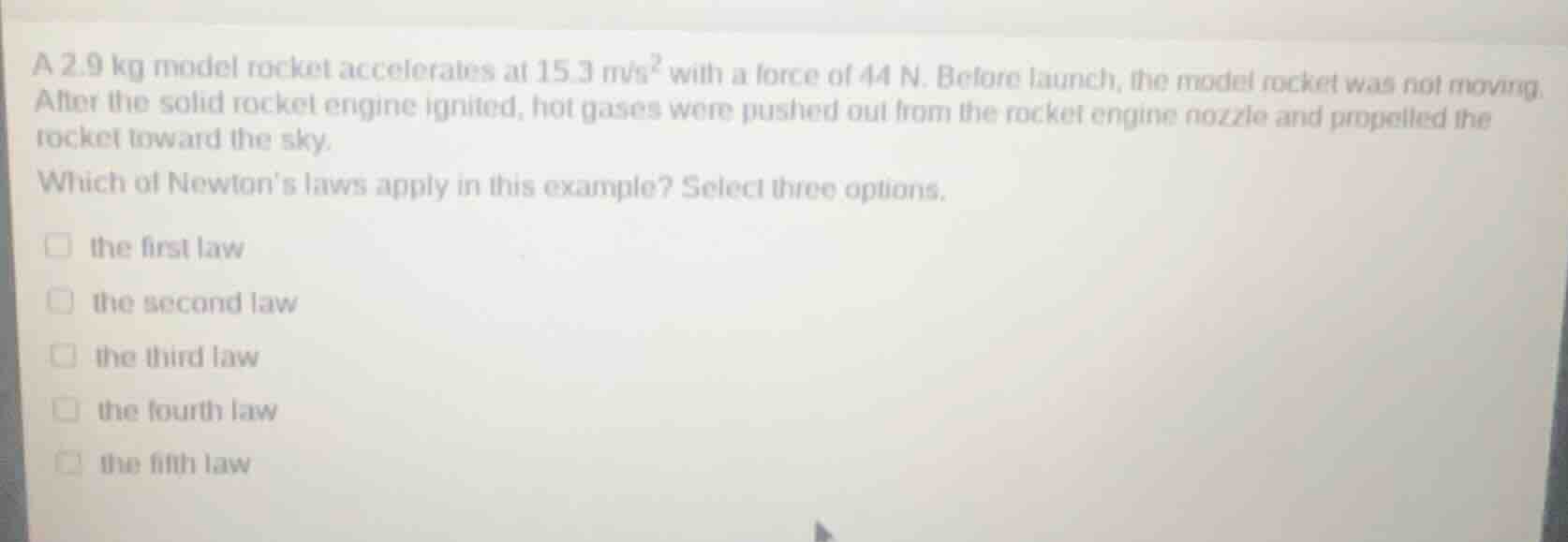
a 2.9 kg model rocket accelerates at 15.3 m/s² with a force of 44 n. before launch, the model rocket was not moving. after the solid rocket engine ignited, hot gases were pushed out from the rocket engine nozzle and propelled the rocket toward the sky. which of newton’s laws apply in this example? select three options. the first law the second law the third law the fourth law the fifth law
Brief Explanations
- Newton's First Law: The rocket was stationary (at rest) before launch, remaining so until the engine force acted, matching the law of inertia (objects stay at rest/motion unless acted on by a net force).
- Newton's Second Law: The given values (mass $2.9\ \text{kg}$, acceleration $15.3\ \text{m/s}^2$, force $44\ \text{N}$) align with $F=ma$ ($2.9 \times 15.3 \approx 44.37\ \text{N}$, close to the stated 44 N), describing force, mass, and acceleration relationship.
- Newton's Third Law: The engine pushes hot gases out (action force), and the gases exert an equal, opposite force on the rocket to propel it upward, fitting the action-reaction principle.
- Newton did not propose a fourth or fifth law, so these are invalid.

Snap & solve any problem in the app
Get step-by-step solutions on Sovi AI
Photo-based solutions with guided steps
Explore more problems and detailed explanations
- the first law
- the second law
- the third law