QUESTION IMAGE
Question
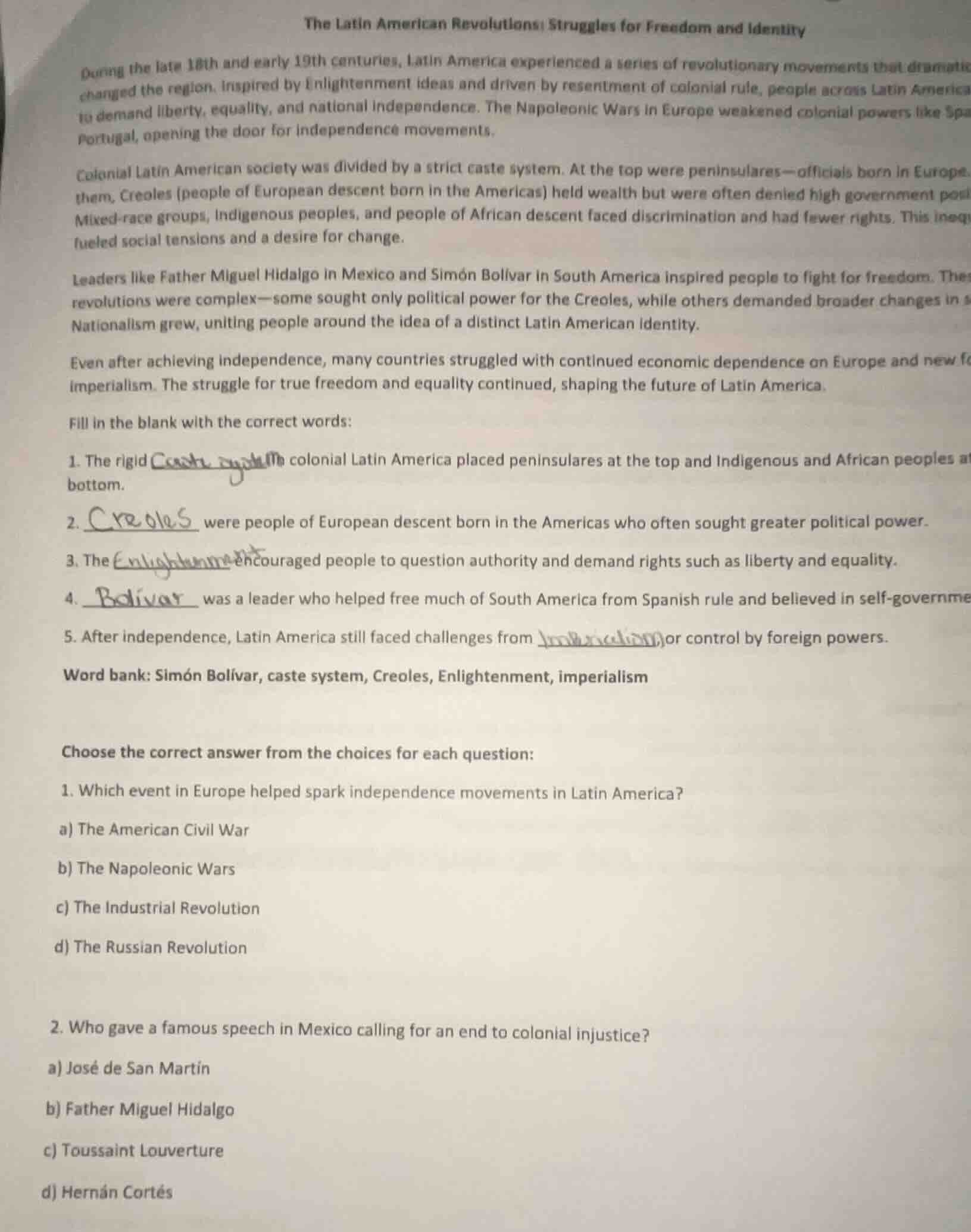
the latin american revolutions: struggles for freedom and identity
during the late 18th and early 19th centuries, latin america experienced a series of revolutionary movements that dramatically changed the region. inspired by enlightenment ideas and driven by resentment of colonial rule, people across latin america began to demand liberty, equality, and national independence. the napoleonic wars in europe weakened colonial powers like spain and portugal, opening the door for independence movements.
colonial latin american society was divided by a strict caste system. at the top were peninsulares—officials born in europe. below them, creoles (people of european descent born in the americas) held wealth but were often denied high government positions. mixed - race groups, indigenous peoples, and people of african descent faced discrimination and had fewer rights. this inequality fueled social tensions and a desire for change.
leaders like father miguel hidalgo in mexico and simón bolívar in south america inspired people to fight for freedom. these revolutions were complex—some sought only political power for the creoles, while others demanded broader changes in society. nationalism grew, uniting people around the idea of a distinct latin american identity.
even after achieving independence, many countries struggled with continued economic dependence on europe and new forms of imperialism. the struggle for true freedom and equality continued, shaping the future of latin america.
fill in the blank with the correct words:
- the rigid ______ in colonial latin america placed peninsulares at the top and indigenous and african peoples at the bottom.
- ______ were people of european descent born in the americas who often sought greater political power.
- the ______ encouraged people to question authority and demand rights such as liberty and equality.
- ______ was a leader who helped free much of south america from spanish rule and believed in self - government.
- after independence, latin america still faced challenges from ______, or control by foreign powers.
word bank: simón bolívar, caste system, creoles, enlightenment, imperialism
choose the correct answer from the choices for each question:
- which event in europe helped spark independence movements in latin america?
a) the american civil war
b) the napoleonic wars
c) the industrial revolution
d) the russian revolution
- who gave a famous speech in mexico calling for an end to colonial injustice?
a) josé de san martín
b) father miguel hidalgo
c) toussaint louverture
d) hernán cortés
Fill in the blanks:
- From the text "Colonial Latin American society was divided by a strict caste system. At the top were peninsulares...", so the answer is "caste system".
- From the text "Creoles (people of European descent born in the Americas) held wealth but were often denied high government post...", so the answer is "Creoles".
- From the text "inspired by Enlightenment ideas and driven by resentment of colonial rule...", so the answer is "Enlightenment".
- From the text "Simón Bolívar in South America inspired people to fight for freedom... helped free much of South America from Spanish rule", so the answer is "Simón Bolívar".
- From the text "many countries struggled with continued economic dependence on Europe and new forms of imperialism", so the answer is "imperialism".
Multiple-choice questions:
- Brief Explanations: The text says "The Napoleonic Wars in Europe weakened colonial powers... opening the door for independence movements". The American Civil War was in the US, the Industrial Revolution was about industry, and the Russian Revolution was later. So the correct event is the Napoleonic Wars.

Snap & solve any problem in the app
Get step-by-step solutions on Sovi AI
Photo-based solutions with guided steps
Explore more problems and detailed explanations
**: b) The Napoleonic Wars
- Brief Explanations: The text mentions "Leaders like Father Miguel Hidalgo in Mexico... inspired people to fight for freedom". José de San Martín was in South America, Toussaint Louverture was in Haiti, and Hernán Cortés was a colonizer. So Father Miguel Hidalgo is the one who gave the speech in Mexico.