QUESTION IMAGE
Question
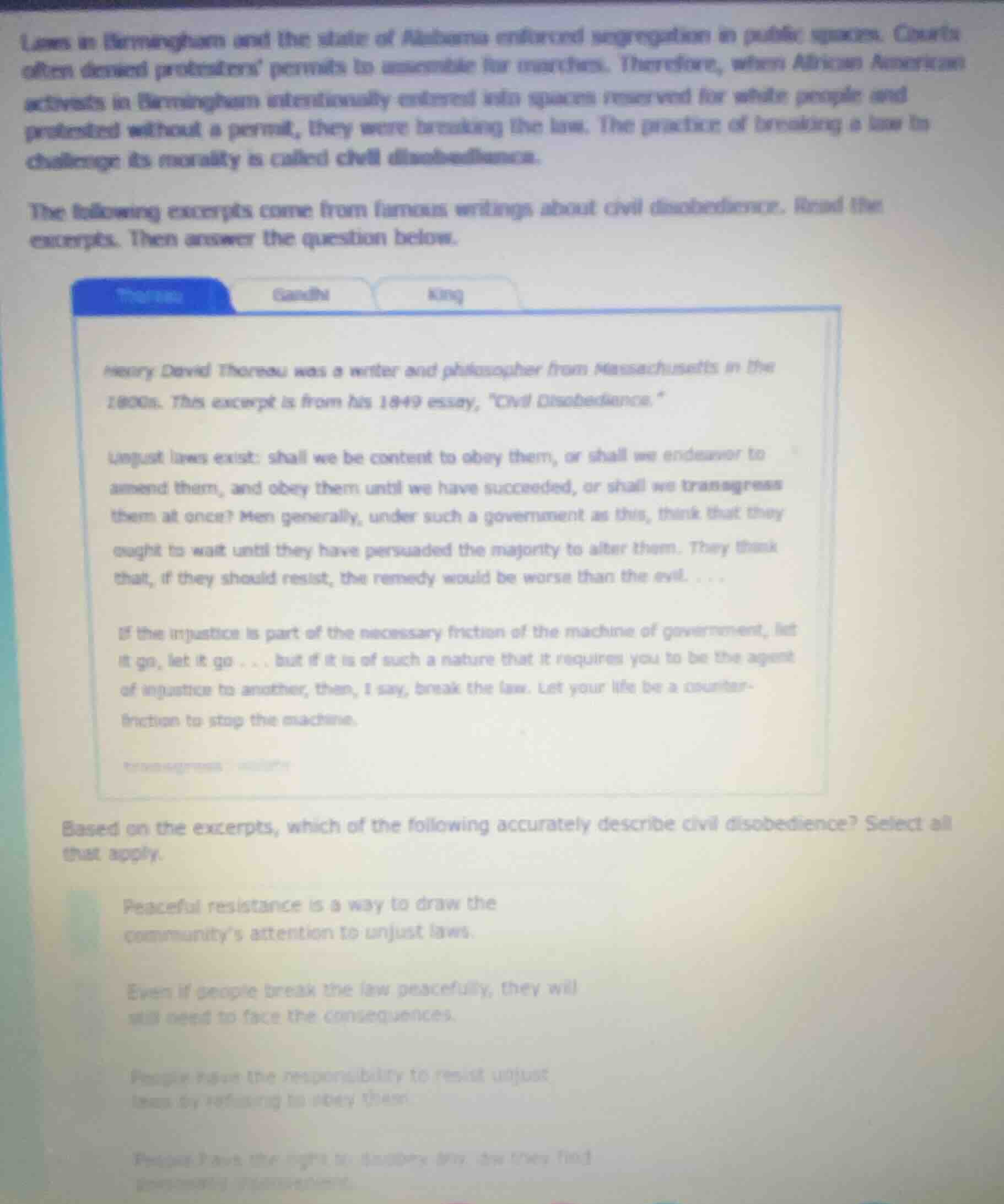
laws in birmingham and the state of alabama enforced segregation in public spaces. courts often denied protesters’ permits to assemble for marches. therefore, when african american activists in birmingham intentionally entered into spaces reserved for white people and protested without a permit, they were breaking the law. the practice of breaking a law to challenge its morality is called civil disobedience.
the following excerpts come from famous writings about civil disobedience. read the excerpts. then answer the question below.
thoreau
gandhi
king
henry david thoreau was a writer and philosopher from massachusetts in the 1800s. this excerpt is from his 1849 essay, “civil disobedience.”
unjust laws exist: shall we be content to obey them, or shall we endeavor to amend them, and obey them until we have succeeded, or shall we transgress them at once? men generally, under such a government as this, think that they ought to wait until they have persuaded the majority to alter them. they think that, if they should resist, the remedy would be worse than the evil. . . .
if the injustice is part of the necessary friction of the machine of government, let it go, let it go . . . but if it is of such a nature that it requires you to be the agent of injustice to another, then, i say, break the law. let your life be a counter - friction to stop the machine.
transcript ends here
based on the excerpts, which of the following accurately describe civil disobedience? select all that apply.
peaceful resistance is a way to draw the
community’s attention to unjust laws.
even if people break the law peacefully, they will
still need to face the consequences.
people have the responsibility to resist unjust
laws by refusing to obey them.
part of an option is blurred: perhaps? have the right to disobey laws that they find
immoral? unjust?
- The opening text defines civil disobedience as breaking a law to challenge its morality, paired with Thoreau's argument that unjust laws requiring you to enable injustice should be broken, framing this as a counter to harmful systems (aligning with peaceful resistance to highlight injustice).
- Thoreau's excerpt states people have a duty to resist unjust laws that force them to be agents of injustice, directly supporting the idea of refusing to obey such laws.
- The opening context notes activists broke segregation laws and faced legal consequences, and civil disobedience accepts that breaking laws (even peacefully) carries accountability.
- The texts only justify breaking unjust laws, not any law someone dislikes, so that option is incorrect.

Snap & solve any problem in the app
Get step-by-step solutions on Sovi AI
Photo-based solutions with guided steps
Explore more problems and detailed explanations
- Peaceful resistance is a way to draw the community's attention to unjust laws.
- Even if people break the law peacefully, they will still need to face the consequences.
- People have the responsibility to resist unjust laws by refusing to obey them.