QUESTION IMAGE
Question
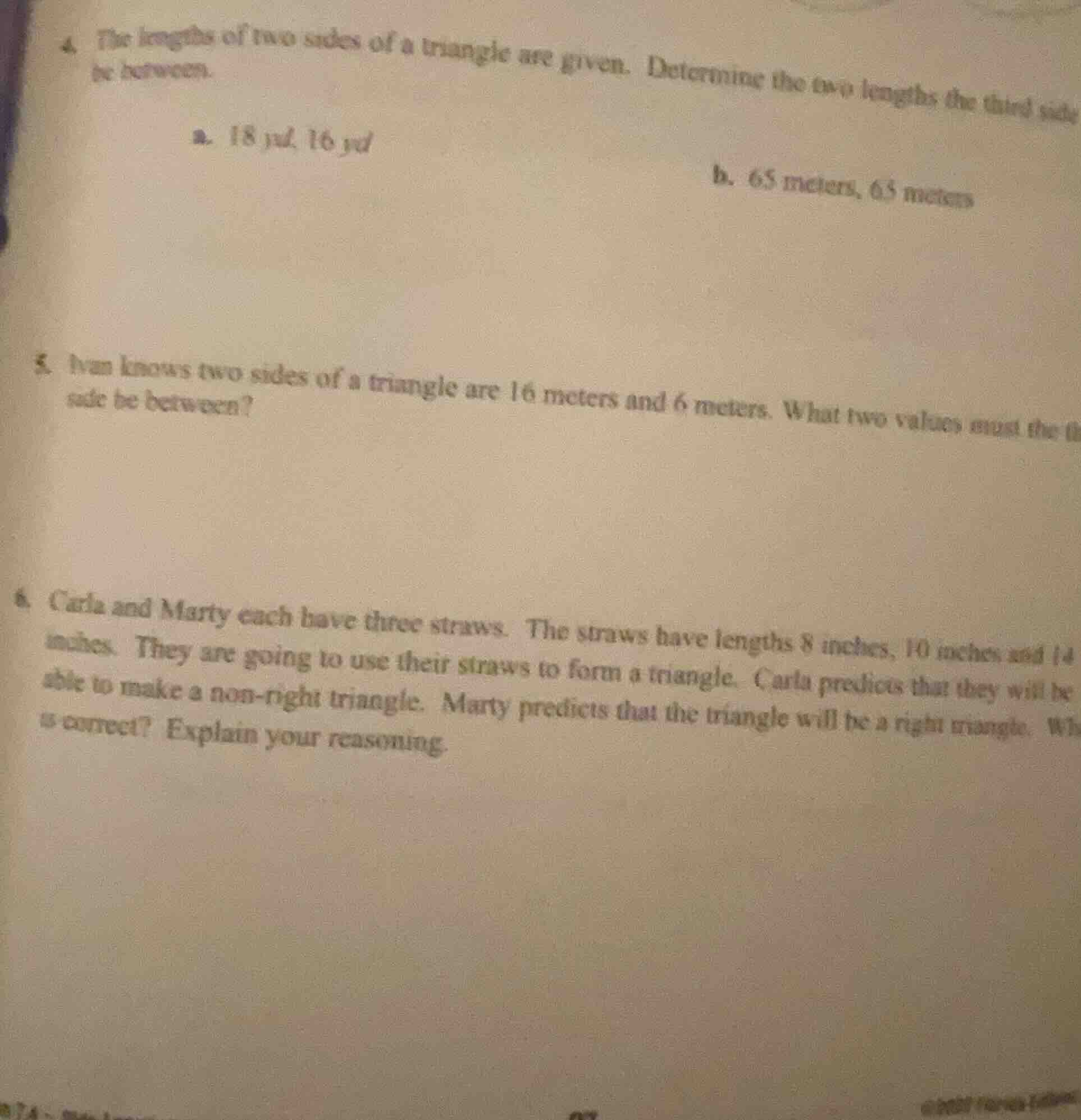
- the lengths of two sides of a triangle are given. determine the two lengths the third side be between.
a. 18 yd, 16 yd
b. 6.5 meters, 6.5 meters
- ivan knows two sides of a triangle are 16 meters and 6 meters. what two values must the third side be between?
- carla and marty each have three straws. the straws have lengths 8 inches, 10 inches and 14 inches. they are going to use their straws to form a triangle. carla predicts that they will be able to make a non - right triangle. marty predicts that the triangle will be a right triangle. who is correct? explain your reasoning.
Problem 4a:
Step1: Recall triangle inequality theorem
For a triangle with sides \(a\), \(b\), \(c\), the third side \(c\) must satisfy \(|a - b| < c < a + b\). Here, \(a = 18\) yd, \(b = 16\) yd.
Step2: Calculate the range
First, find the difference: \(|18 - 16| = 2\) yd. Then, find the sum: \(18 + 16 = 34\) yd. So the third side \(c\) satisfies \(2\) yd \(< c < 34\) yd.
Step1: Apply triangle inequality theorem
Let \(a = 65\) m, \(b = 65\) m. The third side \(c\) must satisfy \(|a - b| < c < a + b\).
Step2: Compute the range
Difference: \(|65 - 65| = 0\) m. Sum: \(65 + 65 = 130\) m. So \(0\) m \(< c < 130\) m (but since side length is positive, effectively \(0 < c < 130\), and in context of triangle, \(c>0\) and \(c < 130\), also \(c\) must be positive, so the third side is between \(0\) m (exclusive) and \(130\) m (exclusive), but more precisely, since sides are positive, \(0 < c < 130\), and for a valid triangle, \(c\) must be greater than \(0\) and less than \(130\). However, since the two sides are equal (isosceles triangle), the third side must be greater than \(0\) and less than \(130\) meters.
Step1: Use triangle inequality theorem
Given \(a = 16\) m, \(b = 6\) m. The third side \(c\) satisfies \(|a - b| < c < a + b\).
Step2: Calculate the bounds
Difference: \(|16 - 6| = 10\) m. Sum: \(16 + 6 = 22\) m. So \(10\) m \(< c < 22\) m.

Snap & solve any problem in the app
Get step-by-step solutions on Sovi AI
Photo-based solutions with guided steps
Explore more problems and detailed explanations
The third side is between \(2\) yd and \(34\) yd.