QUESTION IMAGE
Question
lesson 15.1
making sense of your emotions
key terms
emotional intelligence optimism
emotions resilience
empathy
key points
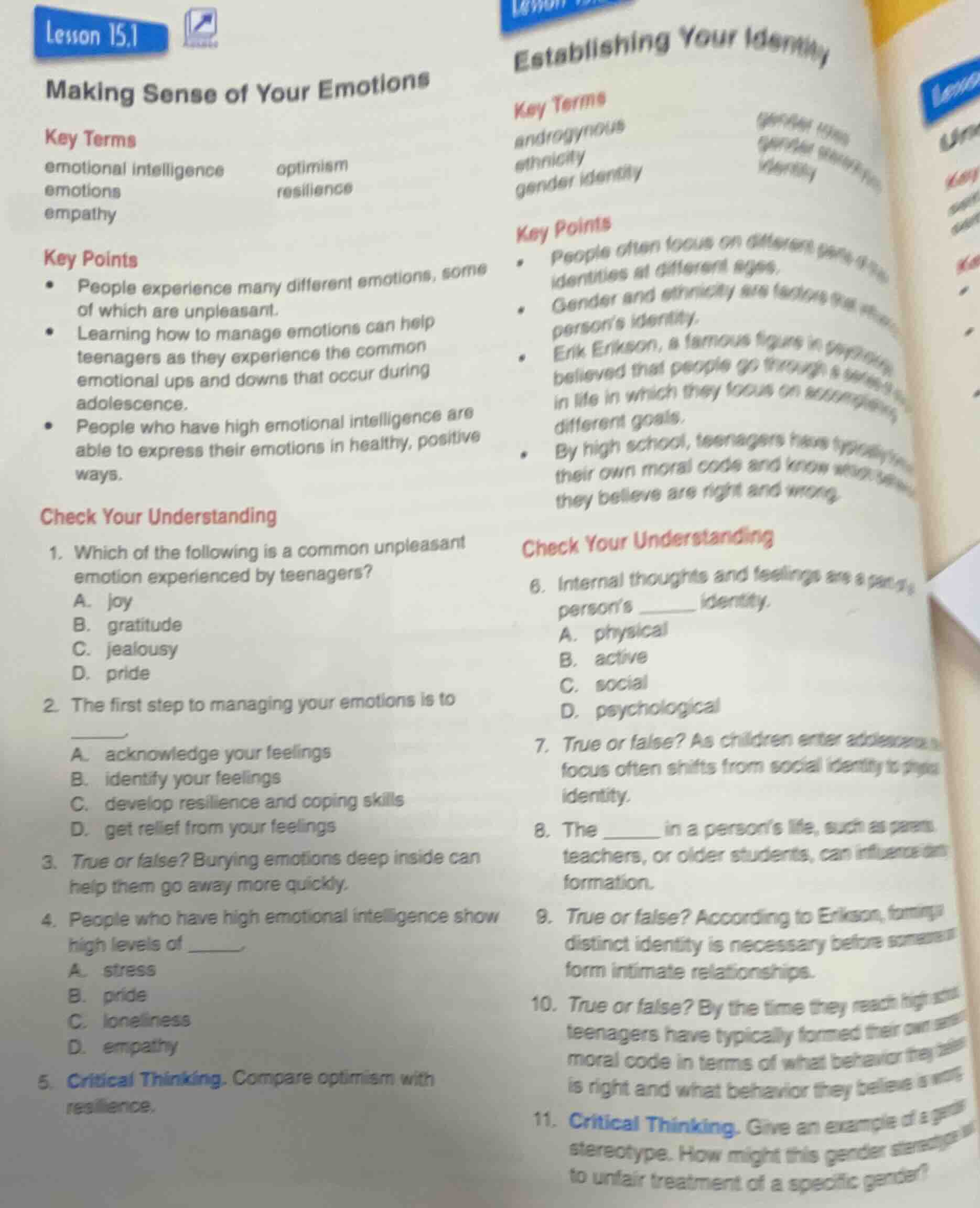
- people experience many different emotions, some of which are unpleasant.
- learning how to manage emotions can help teenagers as they experience the common emotional ups and downs that occur during adolescence.
- people who have high emotional intelligence are able to express their emotions in healthy, positive ways.
check your understanding
- which of the following is a common unpleasant emotion experienced by teenagers?
a. joy
b. gratitude
c. jealousy
d. pride
- the first step to managing your emotions is to ______.
a. acknowledge your feelings
b. identify your feelings
c. develop resilience and coping skills
d. get relief from your feelings
- true or false? burying emotions deep inside can help them go away more quickly.
- people who have high emotional intelligence show high levels of ______.
a. stress
b. pride
c. loneliness
d. empathy
- critical thinking. compare optimism with resilience.
(the right part of the image is about another lesson, here we focus on the left parts questions.)
Brief Explanations
- For question 1: Joy, gratitude, and pride are all positive, pleasant emotions; jealousy is an unpleasant, negative emotion common in teenagers.
- For question 2: The foundational first step to managing emotions is recognizing and naming what you are feeling (identifying feelings).
- For question 3: Suppressing emotions does not make them go away; it often leads to more distress later, so the statement is false.
- For question 4: Empathy (understanding others' emotions) is a core trait of high emotional intelligence; the other options are negative or unrelated states.
- For question 5: Optimism is a general positive outlook expecting good outcomes, while resilience is the ability to recover from hardship.
- For question 6: Internal thoughts and feelings are part of a person's psychological (internal, mental) identity, not physical, active, or social (external/interpersonal) identity.
- For question 7: As children enter adolescence, their focus shifts from physical identity to social identity, so the statement is false.
- For question 8: Significant people/figures in a person's life (like parents, teachers) who influence their identity development are role models.
- For question 9: Erik Erikson's psychosocial stages state that forming a distinct identity (Identity vs. Role Confusion) must happen before the Intimacy vs. Isolation stage, so the statement is true.
- For question 10: The key points state that by high school, teens typically form their own moral code, so the statement is true.
- For question 11: A common gender stereotype is "women are not good at math." This can lead to unfair treatment like being discouraged from advanced math classes, passed over for math-related opportunities, or having their abilities dismissed.

Snap & solve any problem in the app
Get step-by-step solutions on Sovi AI
Photo-based solutions with guided steps
Explore more problems and detailed explanations
- C. jealousy
- B. identify your feelings
- False
- D. empathy
- Optimism is a tendency to maintain a positive outlook and expect favorable outcomes, while resilience is the ability to recover quickly from difficult or stressful situations.
- D. psychological
- False
- role models
- True
- True
- Example: A common gender stereotype is "men are not emotional and should not cry." This can lead to unfair treatment by pressuring boys and men to suppress their feelings, dismissing their mental health struggles, or shaming them for expressing vulnerability, which harms their emotional well-being.