QUESTION IMAGE
Question
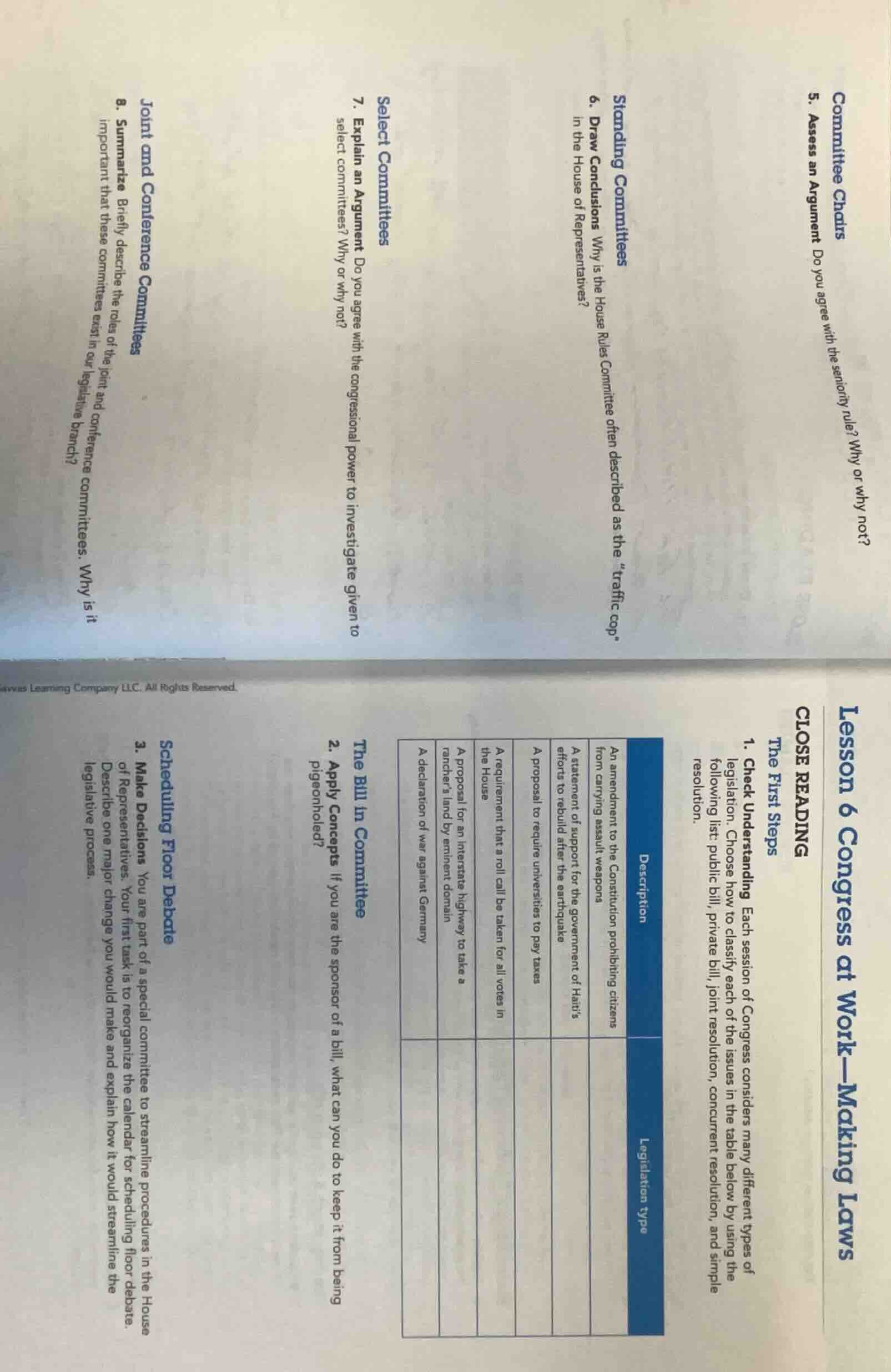
lesson 6 congress at work—making laws close reading the first steps 1. check understanding each session of congress considers many different types of legislation. choose how to classify each of the issues in the table below by using the following list: public bill, private bill, joint resolution, concurrent resolution, and simple resolution. an amendment to the constitution prohibiting citizens from carrying assault weapons a statement of support for the government of haiti’s efforts to rebuild after the earthquake a proposal to require universities to pay taxes a requirement that a roll call be taken for all votes in the house a proposal for an interstate highway to take a rancher’s land by eminent domain a declaration of war against germany description legislation type scheduling floor debate 3. make decisions you are part of a special committee to streamline procedures in the house of representatives. your first task is to reorganize the calendar for scheduling floor debate. describe one major change you would make and explain how it would streamline the legislative process. the bill in committee 2. apply concepts if you are the sponsor of a bill, what can you do to keep it from being pigeonholed? committee chairs 5. assess an argument do you agree with the seniority rule? why or why not? standing committees 6. draw conclusions why is the house rules committee often described as the “traffic cop” in the house of representatives? select committees 7. explain an argument do you agree with the congressional power to investigate given to select committees? why or why not? joint and conference committees 8. summarize briefly describe the roles of the joint and conference committees. why is it important that these committees exist in our legislative branch?
1. Check Understanding
- Constitutional amendments require joint action by Congress and states, fitting joint resolution.
- Non-binding support statements are simple resolutions.
- Tax rules for universities apply to the public, so public bill.
- House procedure rules are concurrent resolutions.
- Highway/land proposals are public bills (affect public).
- War declarations are joint resolutions (bind Congress/executive).
2. Apply Concepts
To prevent a bill from being pigeonholed, you can: gather bipartisan co-sponsors to show broad support, use discharge petitions to force the bill out of committee, or advocate for the bill in public/media to build constituent pressure on committee members.
3. Make Decisions
One major change: Switch to a fixed, two-week scheduling cycle for floor debate, with set slots for different policy areas. This streamlines the process by eliminating last-minute scheduling conflicts, ensuring all committee-reported bills get a guaranteed window for debate, and reducing delays from unplanned agenda changes.
5. Assess an Argument
The seniority rule rewards long-serving members with committee chair positions, which provides institutional knowledge and stability. However, it can prevent newer, more diverse members from taking leadership roles, and may not prioritize policy expertise over tenure. Agreement depends on valuing institutional memory vs. fresh leadership.
6. Draw Conclusions
The House Rules Committee acts as a "traffic cop" because it controls the terms of debate (time limits, amendments allowed) for bills coming to the floor, deciding which bills move forward and how quickly, effectively directing the flow of legislative business.
7. Explain an Argument
Agree: Congress needs investigative power to oversee executive branch actions, uncover waste/corruption, and gather information to draft informed legislation. This power is a key check and balance in the separation of powers.
Disagree: Unfettered investigative power can lead to partisan witch hunts, wasting congressional time and resources on political attacks rather than legislative work.
8. Summarize
- Joint committees: Include members from both the House and Senate, conduct studies or oversee administrative tasks (e.g., printing).
- Conference committees: Temporary panels with members from both chambers, tasked with reconciling differences between House and Senate versions of the same bill.
They are important because they handle cross-chamber coordination, resolve legislative conflicts, and ensure efficient, informed lawmaking by leveraging expertise from both bodies.

Snap & solve any problem in the app
Get step-by-step solutions on Sovi AI
Photo-based solutions with guided steps
Explore more problems and detailed explanations
1.
| Description | Legislation type |
|---|---|
| A statement of support for the government of Haiti's efforts to rebuild after the earthquake | Simple Resolution |
| A proposal to require universities to pay taxes | Public Bill |
| A requirement that a roll call be taken for all votes in the House | Concurrent Resolution |
| A proposal for an interstate highway to take a rancher's land by eminent domain | Public Bill |
| A declaration of war against Germany | Joint Resolution |
- Gather bipartisan support, use discharge petitions, or build public pressure.
- Implement a fixed two-week scheduling cycle; reduces conflicts and guarantees debate time.
- (Example agreement) Agree, for institutional stability; disagree, for lack of fresh leadership.
- It controls floor debate terms and bill flow.
- (Example agreement) Agree, for oversight and informed legislation.
- Joint committees: cross-chamber oversight/studies; Conference committees: reconcile bill differences. They enable cross-chamber coordination and efficient lawmaking.