QUESTION IMAGE
Question
lesson 4: money and debts
goals:
- i understand what positive and negative numbers mean in a situation involving money.
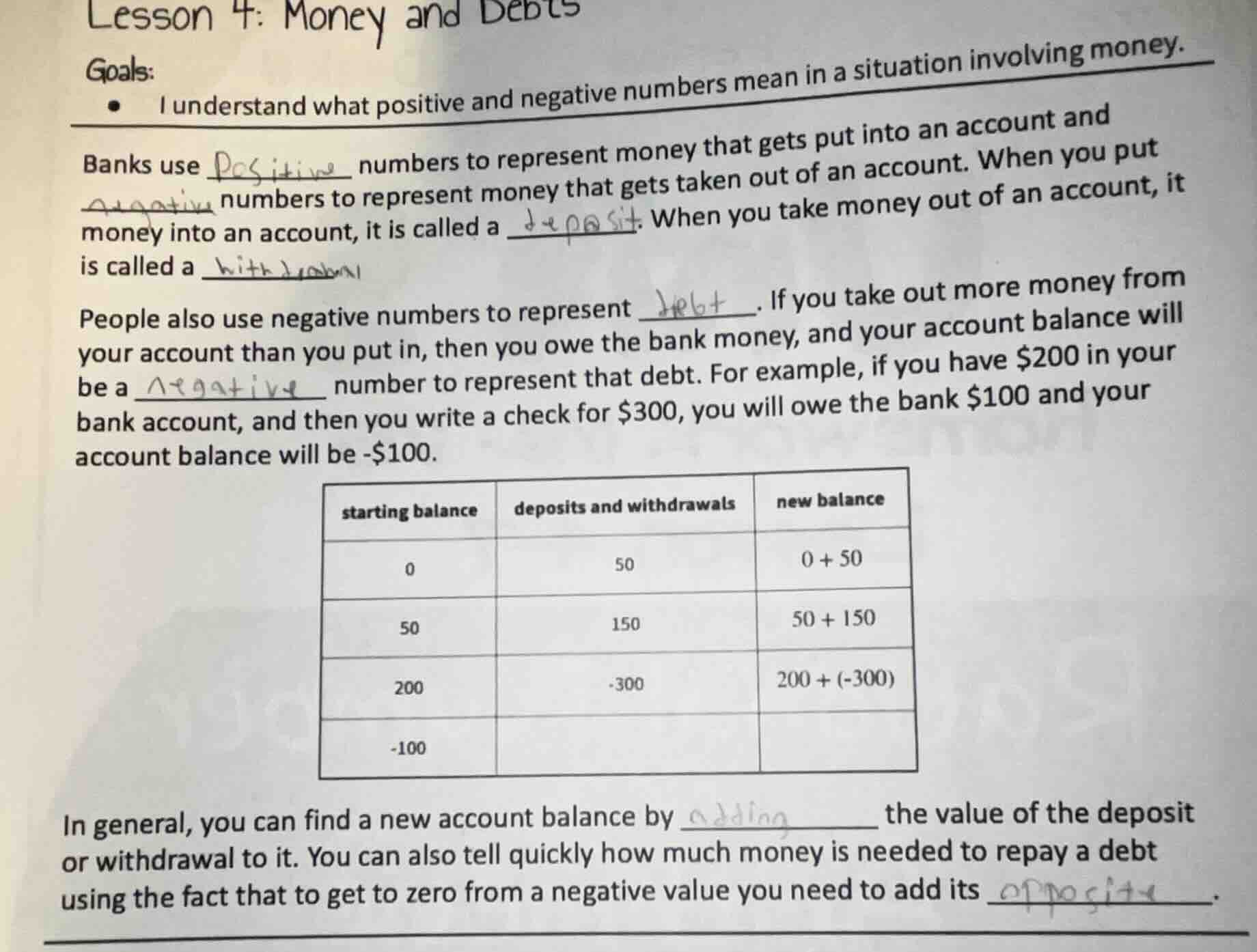
banks use _positive_ numbers to represent money that gets put into an account and
_negative_ numbers to represent money that gets taken out of an account. when you put
money into an account, it is called a _deposit_. when you take money out of an account, it
is called a _withdrawal_
people also use negative numbers to represent _debt_. if you take out more money from
your account than you put in, then you owe the bank money, and your account balance will
be a _negative_ number to represent that debt. for example, if you have $200 in your
bank account, and then you write a check for $300, you will owe the bank $100 and your
account balance will be -$100.
| starting balance | deposits and withdrawals | new balance |
|---|---|---|
| 50 | 150 | 50 + 150 |
| 200 | -300 | 200 + (-300) |
| -100 |
in general, you can find a new account balance by _adding_ the value of the deposit
or withdrawal to it. you can also tell quickly how much money is needed to repay a debt
using the fact that to get to zero from a negative value you need to add its _opposite_.
Step1: Fill first blank (deposit number)
Banks use positive numbers for money added to accounts.
Step2: Fill second blank (withdrawal number)
Banks use negative numbers for money removed from accounts.
Step3: Fill third blank (money in term)
Putting money into an account is a deposit.
Step4: Fill fourth blank (money out term)
Taking money out of an account is a withdrawal.
Step5: Fill fifth blank (negative number meaning)
Negative numbers represent debt in money contexts.
Step6: Fill sixth blank (overdrawn balance type)
Owing money means a negative account balance.
Step7: Calculate table final row
For starting balance -100, the new balance formula follows the pattern: $\text{starting balance} + \text{deposits/withdrawals}$. Since no value is given for deposits/withdrawals, we use the general form, or if we assume a placeholder, but following the table structure: $-100 + x$ (where $x$ is deposits/withdrawals). But if we follow the pattern of the table's structure for the new balance column, it is $\boldsymbol{-100 + (\text{deposits and withdrawals value})}$.
Step8: Fill seventh blank (balance calculation method)
New balance is found by adding deposit/withdrawal to starting balance.
Step9: Fill eighth blank (debt repayment fact)
To reach zero from a negative value, add its opposite.

Snap & solve any problem in the app
Get step-by-step solutions on Sovi AI
Photo-based solutions with guided steps
Explore more problems and detailed explanations
- positive
- negative
- deposit
- withdrawal
- debt
- negative
- For the final table row: $\boldsymbol{-100 + (\text{deposits and withdrawals value})}$ (if a specific value was provided, substitute it in; following the table's pattern)
- adding
- opposite