QUESTION IMAGE
Question
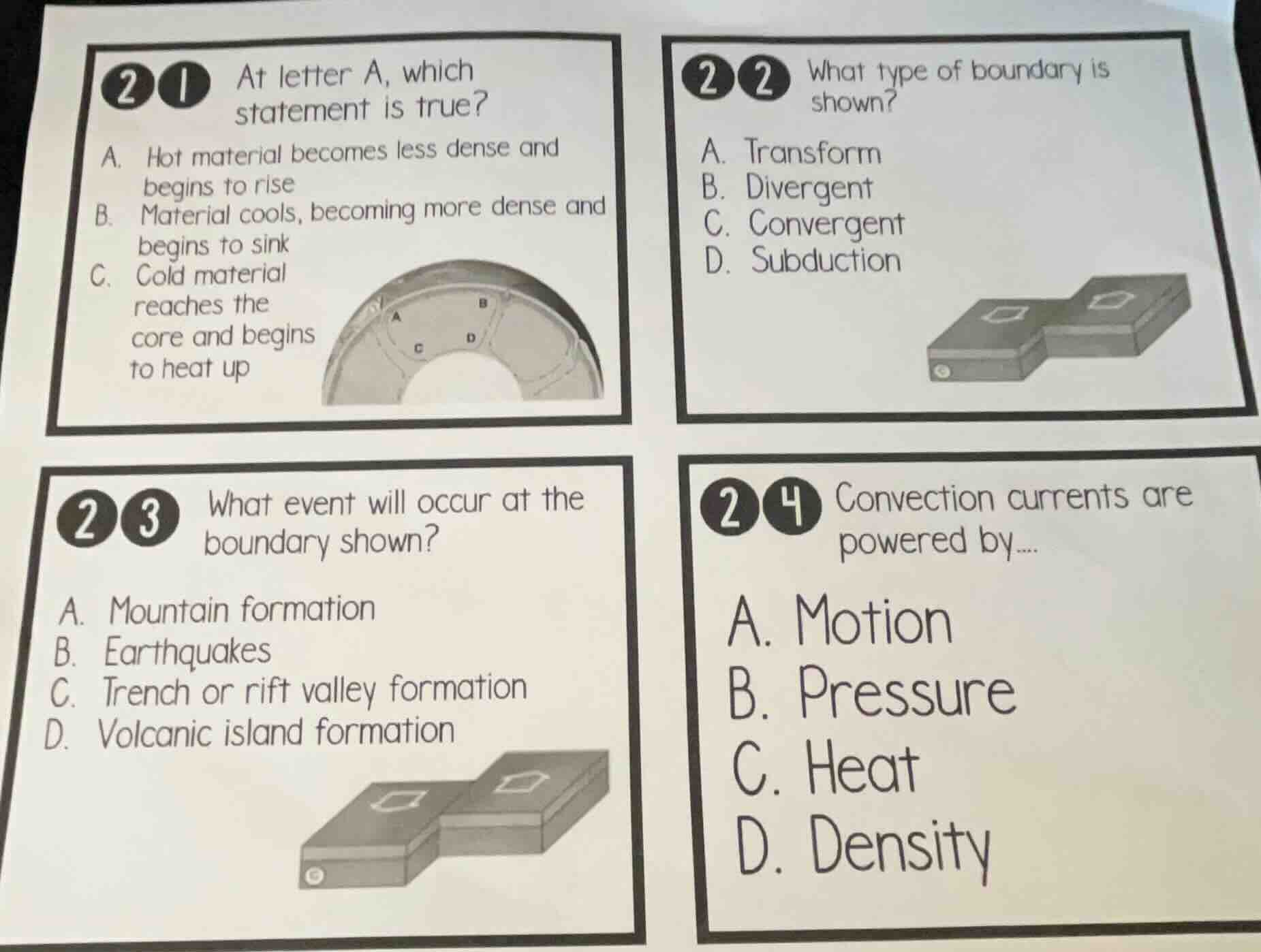
2 1 at letter a, which statement is true? a. hot material becomes less dense and begins to rise b. material cools, becoming more dense and begins to sink c. cold material reaches the core and begins to heat up 2 2 what type of boundary is shown? a. transform b. divergent c. convergent d. subduction 2 3 what event will occur at the boundary shown? a. mountain formation b. earthquakes c. trench or rift valley formation d. volcanic island formation 2 4 convection currents are powered by.... a. motion b. pressure c. heat d. density
2.1
To solve this, we analyze the convection current process. At point A (likely in a convection cell, e.g., mantle convection), when material cools, its density increases, causing it to sink. Option A describes rising hot material (not A’s behavior), Option C is incorrect as cold material doesn’t heat at the core here. So B is correct.
The diagram shows two plates sliding past each other (transform boundary behavior). Divergent (B) is spreading, Convergent (C) is colliding, Subduction (D) is a type of convergent. Transform boundaries involve lateral sliding, matching the diagram.
The diagram (plates sliding past, transform boundary) is associated with earthquakes. Mountain formation (A) is convergent, Trench/rift (C) is divergent/subduction, Volcanic islands (D) are subduction. Transform boundaries cause earthquakes.

Snap & solve any problem in the app
Get step-by-step solutions on Sovi AI
Photo-based solutions with guided steps
Explore more problems and detailed explanations
B. Material cools, becoming more dense and begins to sink