QUESTION IMAGE
Question
life science ls1
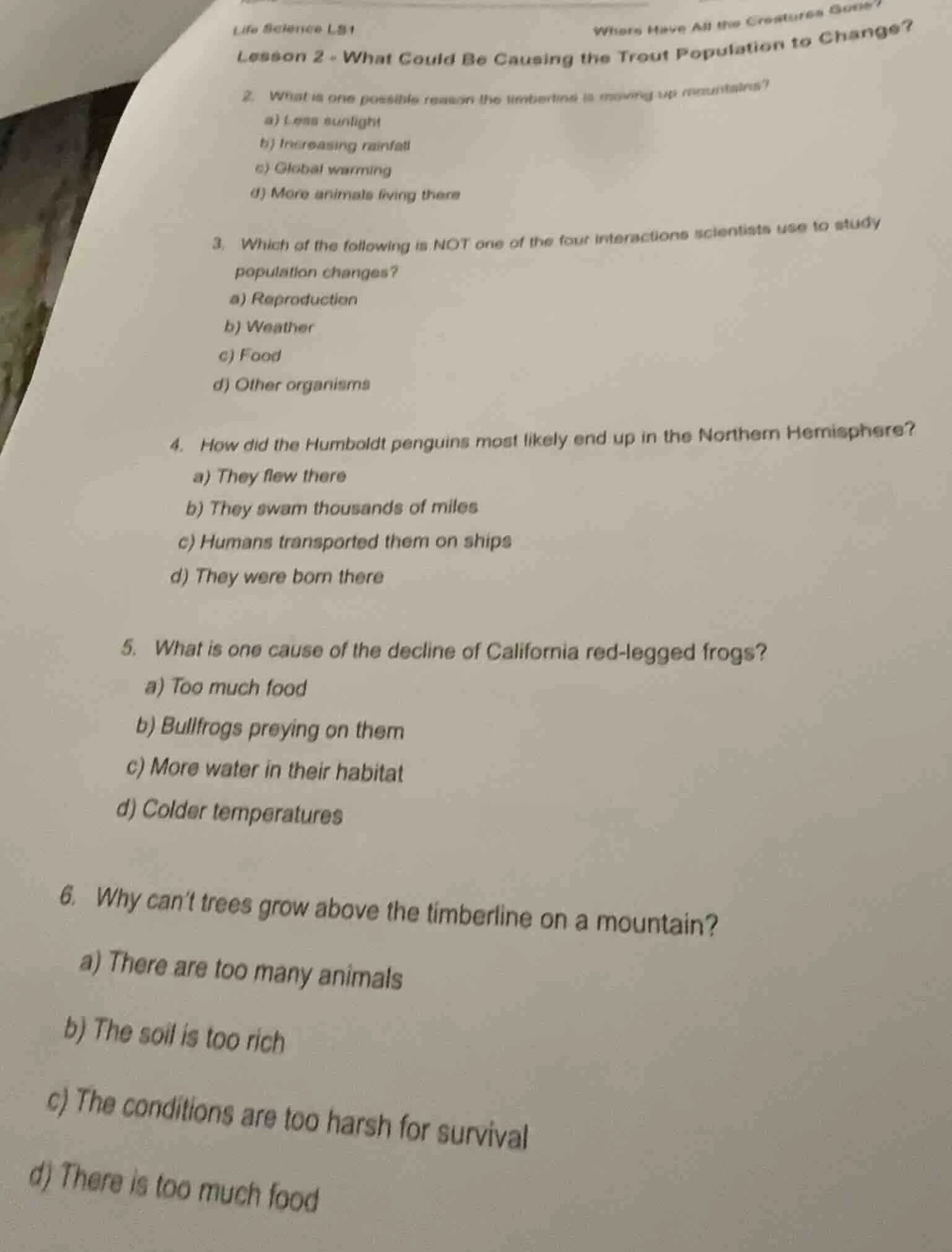
lesson 2 - what could be causing the trout population to change?
- what is one possible reason the timberline is moving up mountains?
a) less sunlight
b) increasing rainfall
c) global warming
d) more animals living there
- which of the following is not one of the four interactions scientists use to study population changes?
a) reproduction
b) weather
c) food
d) other organisms
- how did the humboldt penguins most likely end up in the northern hemisphere?
a) they flew there
b) they swam thousands of miles
c) humans transported them on ships
d) they were born there
- what is one cause of the decline of california red - legged frogs?
a) too much food
b) bullfrogs preying on them
c) more water in their habitat
d) colder temperatures
- why cant trees grow above the timberline on a mountain?
a) there are too many animals
b) the soil is too rich
c) the conditions are too harsh for survival
d) there is too much food
Brief Explanations
- Global warming raises temperatures, allowing timberline (tree growth limit) to shift up mountains as previously too-cold areas become habitable.
- Scientists study population changes via reproduction, food, other organisms, and abiotic factors (not weather as a separate non-core interaction).
- Humboldt penguins are native to the Southern Hemisphere; human transport via ships is the most plausible way they appear in the Northern Hemisphere, as they cannot swim thousands of miles across equatorial warm waters and do not fly long distances.
- Bullfrogs are invasive predators that prey on California red-legged frogs, contributing to their population decline.
- Above the timberline, extreme cold, wind, thin soil, and harsh conditions prevent trees from surviving and growing.

Snap & solve any problem in the app
Get step-by-step solutions on Sovi AI
Photo-based solutions with guided steps
Explore more problems and detailed explanations
- c) Global warming
- b) Weather
- c) Humans transported them on ships
- b) Bullfrogs preying on them
- c) The conditions are too harsh for survival