QUESTION IMAGE
Question
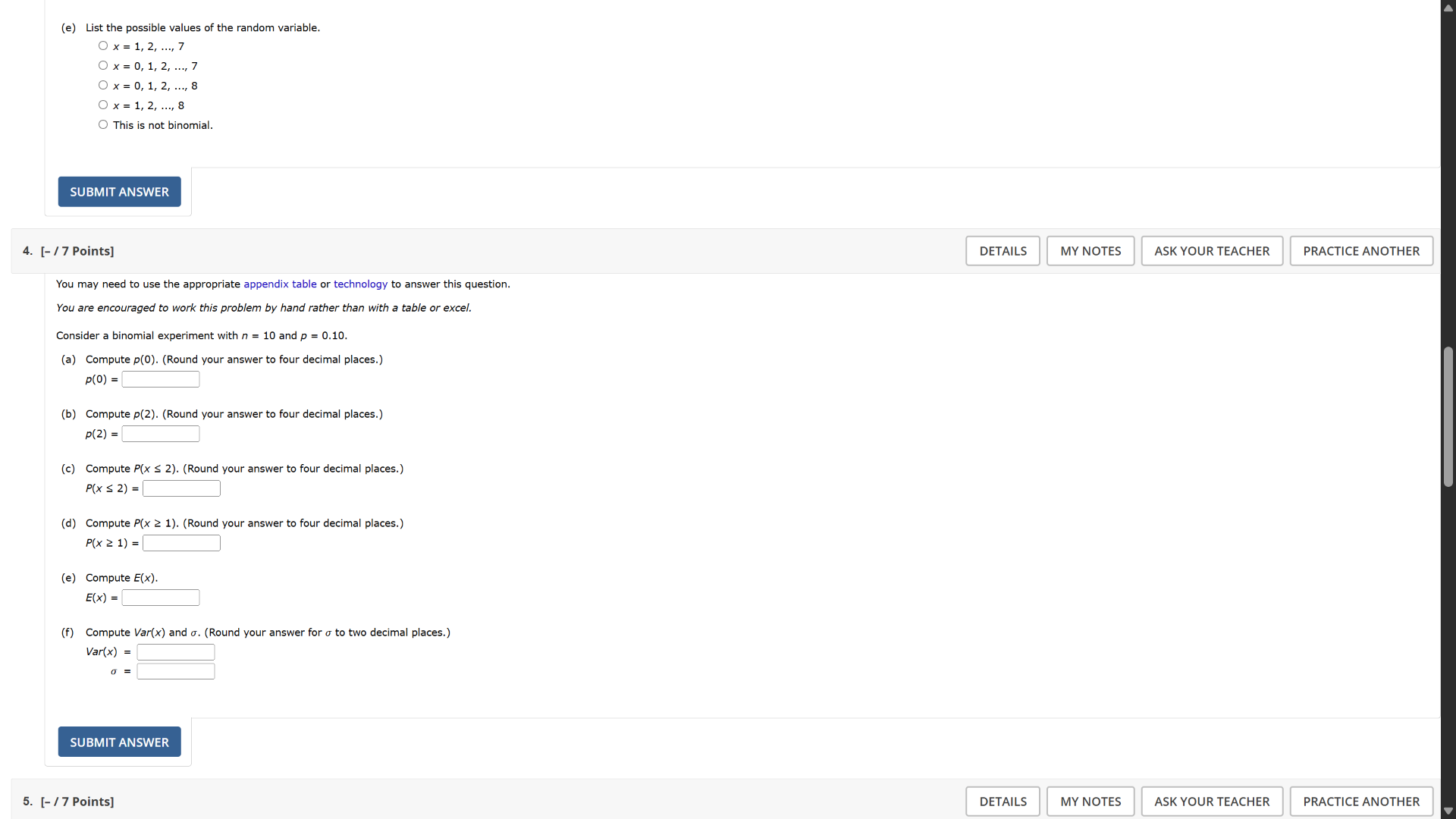
(e) list the possible values of the random variable.
\\( x = 1, 2, \ldots, 7 \\)
\\( x = 0, 1, 2, \ldots, 7 \\)
\\( x = 0, 1, 2, \ldots, 8 \\)
\\( x = 1, 2, \ldots, 8 \\)
this is not binomial.
- -/7 points
you may need to use the appropriate appendix table or technology to answer this question.
you are encouraged to work this problem by hand rather than with a table or excel.
consider a binomial experiment with \\( n = 10 \\) and \\( p = 0.10 \\).
(a) compute \\( p(0) \\). (round your answer to four decimal places.)
\\( p(0) = \\)
(b) compute \\( p(2) \\). (round your answer to four decimal places.)
\\( p(2) = \\)
(c) compute \\( p(x \leq 2) \\). (round your answer to four decimal places.)
\\( p(x \leq 2) = \\)
(d) compute \\( p(x \geq 1) \\). (round your answer to four decimal places.)
\\( p(x \geq 1) = \\)
(e) compute \\( e(x) \\).
\\( e(x) = \\)
(f) compute \\( \text{var}(x) \\) and \\( \sigma \\). (round your answer for \\( \sigma \\) to two decimal places.)
\\( \text{var}(x) = \\)
\\( \sigma = \\)
Part (a)
Step1: Recall binomial probability formula
The binomial probability formula is \( p(x) = \binom{n}{x} p^x (1 - p)^{n - x} \), where \( \binom{n}{x} = \frac{n!}{x!(n - x)!} \), \( n = 10 \), \( p = 0.10 \), and \( x = 0 \).
Step2: Calculate \( \binom{10}{0} \)
\( \binom{10}{0} = \frac{10!}{0!(10 - 0)!} = 1 \) (since \( 0! = 1 \)).
Step3: Substitute into the formula
\( p(0) = \binom{10}{0} (0.10)^0 (1 - 0.10)^{10 - 0} = 1 \times 1 \times (0.90)^{10} \)
\( (0.90)^{10} \approx 0.3486784401 \)
Step4: Round to four decimal places
\( p(0) \approx 0.3487 \)
Step1: Use binomial probability formula
\( p(x) = \binom{n}{x} p^x (1 - p)^{n - x} \), \( n = 10 \), \( p = 0.10 \), \( x = 2 \).
Step2: Calculate \( \binom{10}{2} \)
\( \binom{10}{2} = \frac{10!}{2!(10 - 2)!} = \frac{10 \times 9}{2 \times 1} = 45 \)
Step3: Substitute into the formula
\( p(2) = 45 \times (0.10)^2 \times (0.90)^{10 - 2} \)
\( (0.10)^2 = 0.01 \), \( (0.90)^8 \approx 0.43046721 \)
\( p(2) = 45 \times 0.01 \times 0.43046721 \approx 45 \times 0.0043046721 \approx 0.1937 \)
Step1: Recall \( P(x \leq 2) = p(0) + p(1) + p(2) \)
We already know \( p(0) \approx 0.3487 \) and \( p(2) \approx 0.1937 \). Now calculate \( p(1) \).
Step2: Calculate \( p(1) \)
Using the binomial formula, \( \binom{10}{1} = \frac{10!}{1!(10 - 1)!} = 10 \)
\( p(1) = 10 \times (0.10)^1 \times (0.90)^{9} \)
\( (0.10)^1 = 0.10 \), \( (0.90)^9 \approx 0.387420489 \)
\( p(1) = 10 \times 0.10 \times 0.387420489 \approx 0.3874 \)
Step3: Sum the probabilities
\( P(x \leq 2) = 0.3487 + 0.3874 + 0.1937 \approx 0.9298 \)

Snap & solve any problem in the app
Get step-by-step solutions on Sovi AI
Photo-based solutions with guided steps
Explore more problems and detailed explanations
\( p(0) = \boxed{0.3487} \)