QUESTION IMAGE
Question
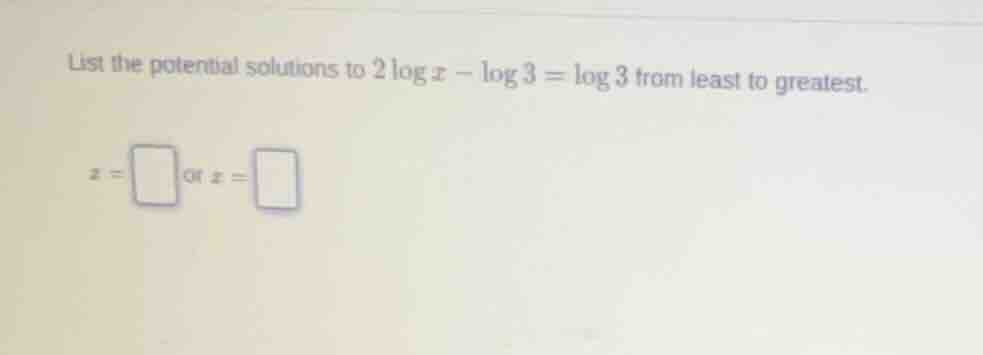
list the potential solutions to $2\log x - \log 3 = \log 3$ from least to greatest.
$x = \square$ or $x = \square$
Step1: Use logarithm power rule
Recall the logarithm power rule: \( n\log a=\log a^n \). Apply it to \( 2\log x \), we get \( 2\log x = \log x^2 \). So the equation \( 2\log x-\log 3=\log 3 \) becomes \( \log x^2-\log 3=\log 3 \).
Step2: Use logarithm quotient rule
Recall the logarithm quotient rule: \( \log a - \log b=\log\frac{a}{b} \). Apply it to \( \log x^2-\log 3 \), we have \( \log\frac{x^2}{3}=\log 3 \).
Step3: Set arguments equal
If \( \log a=\log b \) (assuming the same base), then \( a = b \) (for \( a>0,b>0 \)). So from \( \log\frac{x^2}{3}=\log 3 \), we get \( \frac{x^2}{3}=3 \).
Step4: Solve for \( x^2 \)
Multiply both sides of the equation \( \frac{x^2}{3}=3 \) by 3: \( x^2=3\times3 = 9 \).
Step5: Solve for \( x \)
Take the square root of both sides: \( x=\pm\sqrt{9}=\pm 3 \). But we need to check the domain of the original logarithmic function. The argument of a logarithm must be positive, so for \( \log x \), \( x>0 \). So \( x=- 3 \) is not in the domain. So the only valid solution is \( x = 3 \). Wait, but the problem says "potential solutions", so we consider the algebraic solutions first (before domain check). So the potential solutions come from \( x^2 = 9 \), so \( x=-3 \) or \( x = 3 \).

Snap & solve any problem in the app
Get step-by-step solutions on Sovi AI
Photo-based solutions with guided steps
Explore more problems and detailed explanations
\( x=-3 \) or \( x = 3 \) (when listing from least to greatest, first \( -3 \), then \( 3 \))