QUESTION IMAGE
Question
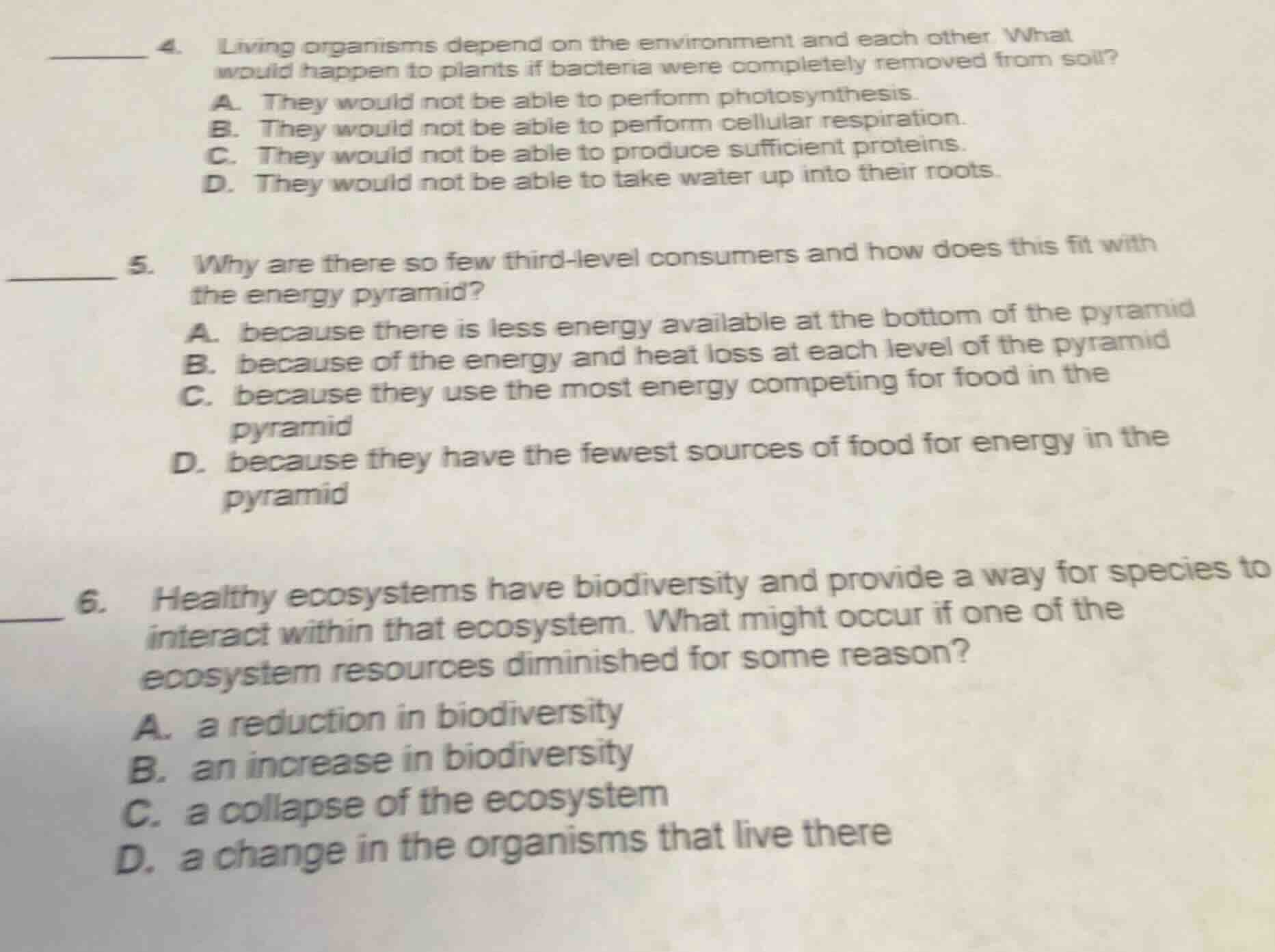
- living organisms depend on the environment and each other. what would happen to plants if bacteria were completely removed from soil?
a. they would not be able to perform photosynthesis.
b. they would not be able to perform cellular respiration.
c. they would not be able to produce sufficient proteins.
d. they would not be able to take water up into their roots.
- why are there so few third - level consumers and how does this fit with the energy pyramid?
a. because there is less energy available at the bottom of the pyramid
b. because of the energy and heat loss at each level of the pyramid
c. because they use the most energy competing for food in the pyramid
d. because they have the fewest sources of food for energy in the pyramid
- healthy ecosystems have biodiversity and provide a way for species to interact within that ecosystem. what might occur if one of the ecosystem resources diminished for some reason?
a. a reduction in biodiversity
b. an increase in biodiversity
c. a collapse of the ecosystem
d. a change in the organisms that live there
Question 4:
Soil bacteria (like nitrogen-fixing bacteria) convert atmospheric nitrogen into forms plants can use to make proteins. Without them, plants lack nitrogen for sufficient protein production. Photosynthesis (A) relies on light/CO₂, cellular respiration (B) is plant-internal, water uptake (D) is via roots/osmosis, none depend on soil bacteria directly.
Question 5:
The 10% energy rule states only ~10% of energy transfers between trophic levels; most is lost as heat. By the third consumer level, very little energy remains, limiting their numbers. Option B matches this energy loss dynamic.
Question 6:
When a key ecosystem resource diminishes, species dependent on it may decline or die out, reducing biodiversity. A full collapse (C) is extreme and not guaranteed, while a change in organisms (D) is a broad outcome, but the most direct and likely immediate effect is reduced biodiversity.

Snap & solve any problem in the app
Get step-by-step solutions on Sovi AI
Photo-based solutions with guided steps
Explore more problems and detailed explanations
- C. They would not be able to produce sufficient proteins.
- B. because of the energy and heat loss at each level of the pyramid
- A. a reduction in biodiversity