QUESTION IMAGE
Question
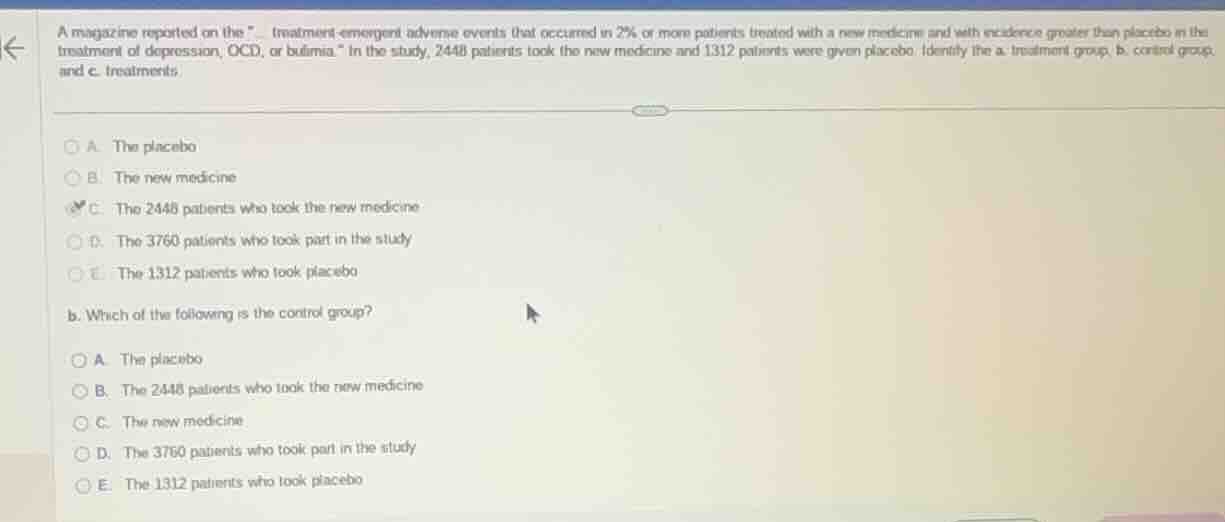
a magazine reported on the \ treatment - emergent adverse events that occurred in 2% or more patients treated with a new medicine and with incidence greater than placebo in the treatment of depression, ocd, or bulimia.\ in the study, 2448 patients took the new medicine and 1312 patients were given placebo. identify the a. treatment group, b. control group, and c. treatments.
a. the placebo
b. the new medicine
c. the 2448 patients who took the new medicine
d. the 3760 patients who took part in the study
e. the 1312 patients who took placebo
b. which of the following is the control group?
a. the placebo
b. the 2448 patients who took the new medicine
c. the new medicine
d. the 3760 patients who took part in the study
e. the 1312 patients who took placebo
Part a (assuming the first question is about the treatment group):
The treatment group in a study is the group that receives the treatment (here, the new medicine). Among the options, option C (The 2448 patients who took the new medicine) is the group that got the new medicine, so it's the treatment group. Option A is the placebo (a substance, not a group), B is the medicine (not a group), D is all participants, E is the control group's patients.
The control group is the group that does not receive the treatment (to compare with the treatment group) and often gets a placebo. Here, the group that took the placebo is the control group. Option E (The 1312 patients who took placebo) is the group that received the placebo (no new medicine), so it's the control group. Option A is the placebo (substance), B is treatment group, C is medicine, D is all participants.

Snap & solve any problem in the app
Get step-by-step solutions on Sovi AI
Photo-based solutions with guided steps
Explore more problems and detailed explanations
C. The 2448 patients who took the new medicine