QUESTION IMAGE
Question
make them float
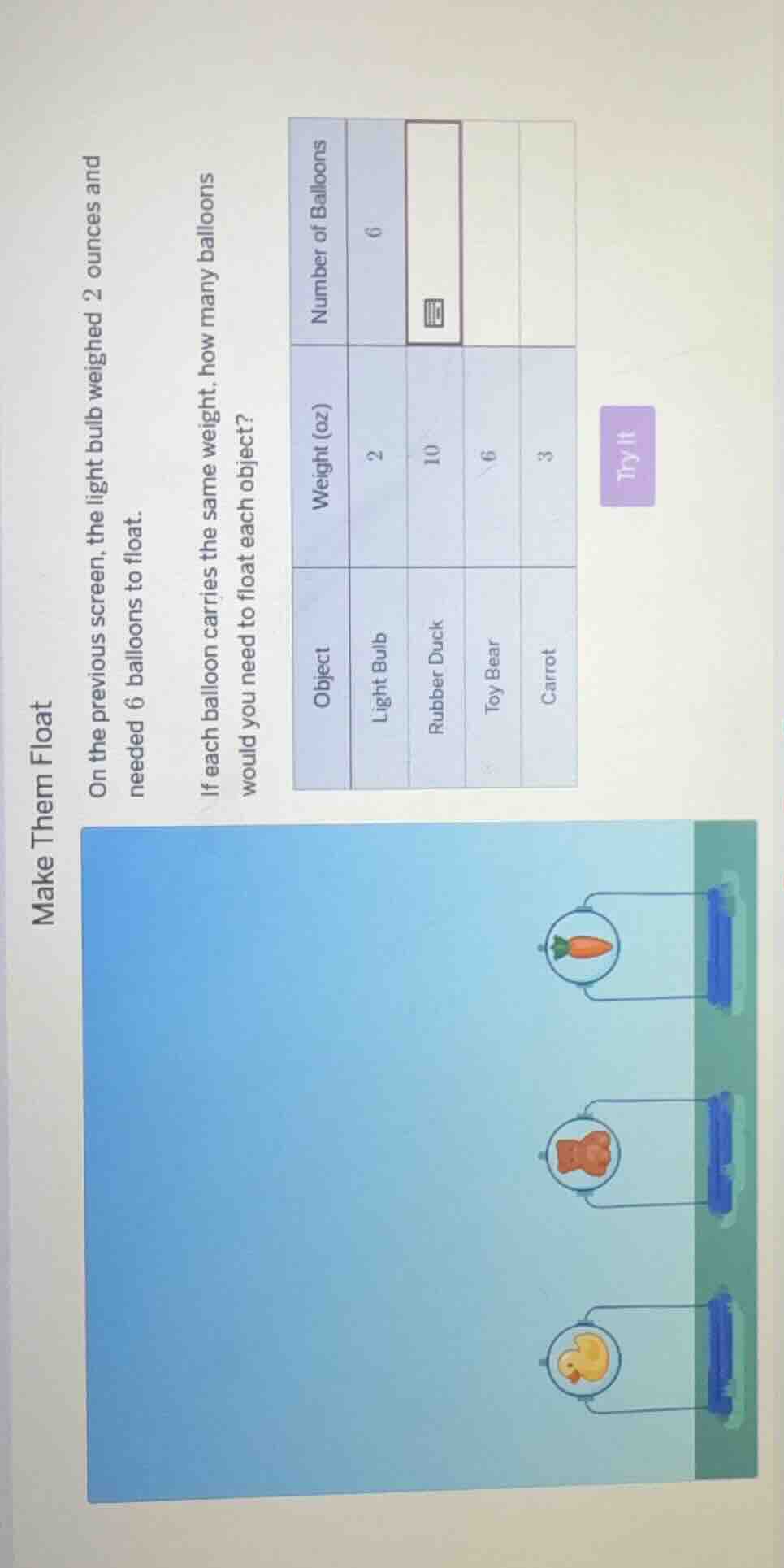
on the previous screen, the light bulb weighed 2 ounces and needed 6 balloons to float.
if each balloon carries the same weight, how many balloons would you need to float each object?
object | weight (oz) | number of balloons
light bulb | 2 | 6
rubber duck | 10 |
toy bear | 6 |
carrot | 3 |
(there is also an image of a rubber duck, toy bear, and carrot in balloons below the table)
Step1: Find weight per balloon
The light bulb weighs 2 oz and needs 6 balloons. So weight per balloon is $2\div6 = \frac{1}{3}$ oz per balloon? Wait, no, wait. Wait, actually, the total lifting capacity of 6 balloons is equal to the weight of the light bulb, which is 2 oz. So each balloon's lifting capacity is $2\div6=\frac{1}{3}$ oz? Wait, no, maybe it's that the number of balloons needed is proportional to the weight. So the ratio of weight to number of balloons is constant. Let's define the relationship: For the light bulb, weight $w_1 = 2$ oz, number of balloons $n_1 = 6$. So the ratio $k=\frac{w_1}{n_1}=\frac{2}{6}=\frac{1}{3}$ oz per balloon? Wait, no, actually, the number of balloons needed $n$ is proportional to the weight $w$, so $n = k\times w$. For the light bulb, $6 = k\times2$, so $k = 3$ balloons per oz. Ah, that makes more sense. So the number of balloons needed is 3 balloons per ounce of weight. Let's check: 2 oz * 3 balloons/oz = 6 balloons, which matches. So the formula is $n = 3\times w$, where $n$ is number of balloons, $w$ is weight in oz.
Step2: Calculate for Rubber Duck (10 oz)
Rubber Duck weight $w_2 = 10$ oz. Number of balloons $n_2 = 3\times10 = 30$? Wait, no, wait, wait. Wait, the light bulb is 2 oz, 6 balloons. So 6 balloons lift 2 oz, so 1 balloon lifts $2\div6=\frac{1}{3}$ oz. So to lift $w$ oz, number of balloons $n = w\div(\frac{1}{3}) = 3w$. Yes, that's the same as before. So for Rubber Duck: $w = 10$ oz, $n = 3\times10 = 30$? Wait, but let's check the Toy Bear: weight 6 oz. $n = 3\times6 = 18$? Carrot: 3 oz, $n = 3\times3 = 9$? Wait, but maybe I got the ratio reversed. Wait, maybe the number of balloons is (weight) (balloons per oz). Since 2 oz needs 6 balloons, so balloons per oz is $6\div2 = 3$ balloons per oz. Yes, that's correct. So 2 oz 3 balloons/oz = 6 balloons. Perfect. So the formula is number of balloons $n = 3\times w$, where $w$ is the weight of the object.
Step3: Rubber Duck (10 oz)
$n = 3\times10 = 30$ balloons.
Step4: Toy Bear (6 oz)
$n = 3\times6 = 18$ balloons.
Step5: Carrot (3 oz)
$n = 3\times3 = 9$ balloons.
Wait, but let's verify again. Light bulb: 2 oz, 6 balloons. 6 balloons / 2 oz = 3 balloons per oz. So for any object, number of balloons = weight (oz) * 3 balloons/oz.
So:
- Rubber Duck: 10 oz * 3 = 30 balloons
- Toy Bear: 6 oz * 3 = 18 balloons
- Carrot: 3 oz * 3 = 9 balloons

Snap & solve any problem in the app
Get step-by-step solutions on Sovi AI
Photo-based solutions with guided steps
Explore more problems and detailed explanations
- Rubber Duck: 30 balloons
- Toy Bear: 18 balloons
- Carrot: 9 balloons