QUESTION IMAGE
Question
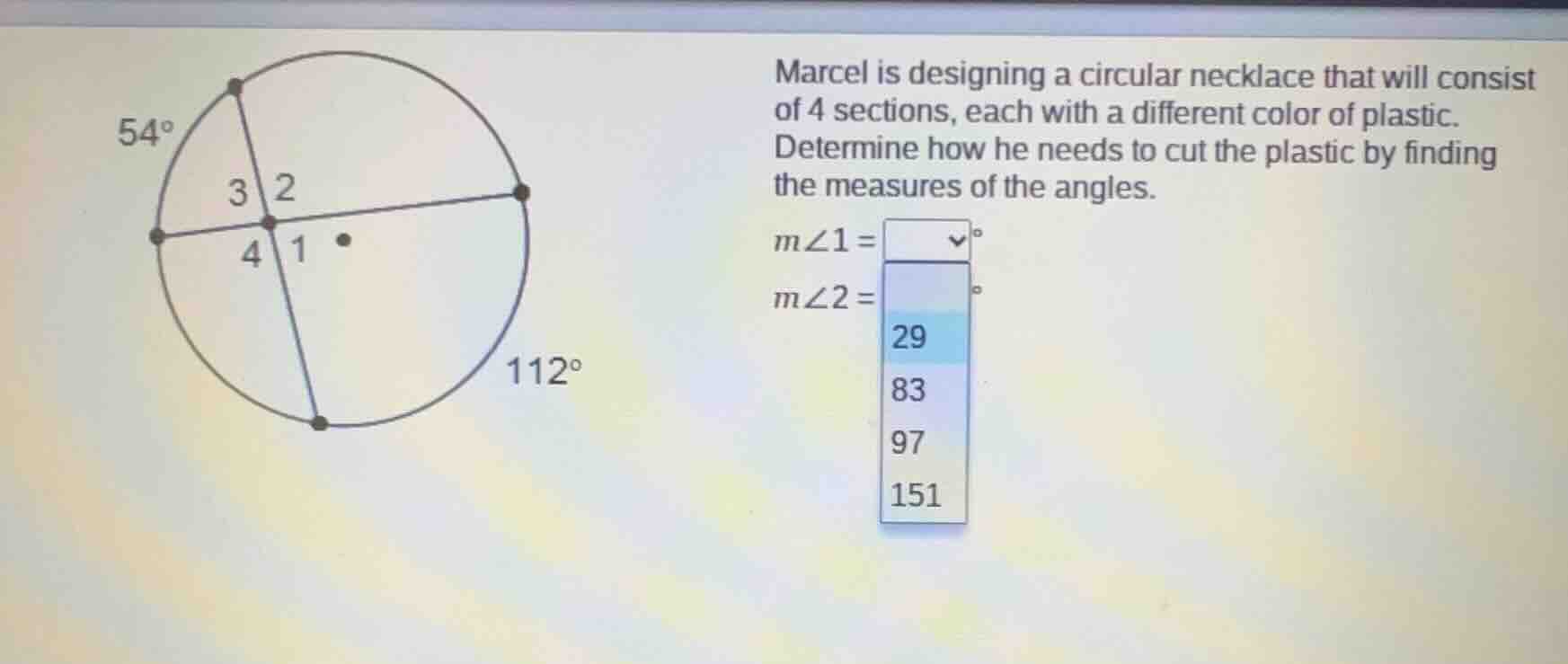
marcel is designing a circular necklace that will consist of 4 sections, each with a different color of plastic. determine how he needs to cut the plastic by finding the measures of the angles. m∠1=° m∠2=° (options: 29, 83, 97, 151) image of a circle with center, two intersecting lines, arcs labeled 54° and 112°, angles labeled 1,2,3,4
Step1: Find the measure of the arc opposite to 112°
The total degrees in a circle is 360°. Let the arc opposite to 112° be \( x \). We know that the sum of arcs around a circle is 360°, and we have arcs 54°, 112°, and their vertical or related arcs. Wait, actually, the central angles correspond to the arcs. Let's first find the arc for angle 1. Wait, maybe better to use the fact that the sum of central angles is 360°, and also that vertical angles and linear pairs. Wait, angle 2: let's see, the arc with 54° and the arc with 112°, and the other arcs. Wait, the circle is 360°, so the sum of all arcs is 360°. Let's denote the arcs: the arc with 54°, the arc with 112°, and two other arcs. Wait, maybe angle 2 is related to the arcs. Wait, the measure of a central angle is equal to the measure of its arc. Wait, no, angle 2 is a central angle? Wait, the diagram has a circle with two intersecting chords? Wait, no, maybe it's a circle with a center? Wait, the dot is the center? Wait, the labels 1,2,3,4 are angles at the center? Wait, no, the dot is the center, so the lines are radii or diameters? Wait, the problem says circular necklace, so the center is the dot. So angle 2: let's see, the arc with 54° and the arc with 112°, and the sum of arcs around the circle is 360°. So the arc opposite to angle 2: wait, maybe angle 2 is a central angle. Wait, let's find the measure of angle 2 first. Wait, the sum of the arcs: 54° + 112° + arc1 + arc2 = 360°? No, maybe the angles at the center: angle 1, angle 2, angle 3, angle 4. Wait, angle 3 and angle 1 are vertical angles? No, angle 2 and angle 4 are vertical angles? Wait, no, the diagram: two lines intersecting at the center, forming four angles: 1,2,3,4. So angle 2 and angle 4 are vertical angles, angle 1 and angle 3 are vertical angles? Wait, no, the labels: 2 is between the horizontal line and the line going to the 112° arc, 1 is between that line and the vertical line? Wait, maybe the 54° arc is between two radii, and the 112° arc is between another two radii. Wait, the measure of a central angle is equal to the measure of its intercepted arc. So angle 2: let's see, the arc with 54° and the arc with 112°, and the sum of the arcs around the circle is 360°, so the remaining two arcs: 360° - 54° - 112° = 194°? No, that can't be. Wait, maybe the 54° and 112° are arcs, and angle 2 is related to the sum of the arcs? Wait, no, the measure of an angle formed by two chords intersecting at the center is equal to the measure of its arc. Wait, maybe angle 2 is a central angle, so its measure is equal to the measure of its arc. Wait, let's look at the options for angle 2: 29,83,97,151. Let's calculate 360° - 54° - 112° - x = 0? No, maybe the sum of the arcs: 54° + 112° + angle2's arc + angle1's arc = 360°. Wait, no, maybe angle 2 is 180° - (54° + something)? Wait, no, let's think again. The problem is about a circular necklace with 4 sections, so 4 arcs. The sum of the arcs is 360°. So the four arcs: 54°, 112°, and two other arcs. Let's call the arc opposite to angle 2 as arc A, and the arc opposite to angle 1 as arc B. Then 54° + 112° + arc A + arc B = 360°, so arc A + arc B = 360° - 54° - 112° = 194°. But angle 2 is a central angle, so its measure is equal to arc A? Wait, no, angle 2 is formed by two radii, so its measure is equal to the measure of its arc. Wait, maybe angle 2 is 180° - (54° + (360° - 54° - 112°)/2)? No, that's not right. Wait, maybe the 54° and 112° are arcs, and angle 2 is 180° - 54° - (180° - 112°)? No, this is confusing. Wait, let's look at the options for angle 2: 29,83,97,151. Let's…

Snap & solve any problem in the app
Get step-by-step solutions on Sovi AI
Photo-based solutions with guided steps
Explore more problems and detailed explanations
Step1: Find the measure of the arc opposite to 112°
The total degrees in a circle is 360°. Let the arc opposite to 112° be \( x \). We know that the sum of arcs around a circle is 360°, and we have arcs 54°, 112°, and their vertical or related arcs. Wait, actually, the central angles correspond to the arcs. Let's first find the arc for angle 1. Wait, maybe better to use the fact that the sum of central angles is 360°, and also that vertical angles and linear pairs. Wait, angle 2: let's see, the arc with 54° and the arc with 112°, and the other arcs. Wait, the circle is 360°, so the sum of all arcs is 360°. Let's denote the arcs: the arc with 54°, the arc with 112°, and two other arcs. Wait, maybe angle 2 is related to the arcs. Wait, the measure of a central angle is equal to the measure of its arc. Wait, no, angle 2 is a central angle? Wait, the diagram has a circle with two intersecting chords? Wait, no, maybe it's a circle with a center? Wait, the dot is the center? Wait, the labels 1,2,3,4 are angles at the center? Wait, no, the dot is the center, so the lines are radii or diameters? Wait, the problem says circular necklace, so the center is the dot. So angle 2: let's see, the arc with 54° and the arc with 112°, and the sum of arcs around the circle is 360°. So the arc opposite to angle 2: wait, maybe angle 2 is a central angle. Wait, let's find the measure of angle 2 first. Wait, the sum of the arcs: 54° + 112° + arc1 + arc2 = 360°? No, maybe the angles at the center: angle 1, angle 2, angle 3, angle 4. Wait, angle 3 and angle 1 are vertical angles? No, angle 2 and angle 4 are vertical angles? Wait, no, the diagram: two lines intersecting at the center, forming four angles: 1,2,3,4. So angle 2 and angle 4 are vertical angles, angle 1 and angle 3 are vertical angles? Wait, no, the labels: 2 is between the horizontal line and the line going to the 112° arc, 1 is between that line and the vertical line? Wait, maybe the 54° arc is between two radii, and the 112° arc is between another two radii. Wait, the measure of a central angle is equal to the measure of its intercepted arc. So angle 2: let's see, the arc with 54° and the arc with 112°, and the sum of the arcs around the circle is 360°, so the remaining two arcs: 360° - 54° - 112° = 194°? No, that can't be. Wait, maybe the 54° and 112° are arcs, and angle 2 is related to the sum of the arcs? Wait, no, the measure of an angle formed by two chords intersecting at the center is equal to the measure of its arc. Wait, maybe angle 2 is a central angle, so its measure is equal to the measure of its arc. Wait, let's look at the options for angle 2: 29,83,97,151. Let's calculate 360° - 54° - 112° - x = 0? No, maybe the sum of the arcs: 54° + 112° + angle2's arc + angle1's arc = 360°. Wait, no, maybe angle 2 is 180° - (54° + something)? Wait, no, let's think again. The problem is about a circular necklace with 4 sections, so 4 arcs. The sum of the arcs is 360°. So the four arcs: 54°, 112°, and two other arcs. Let's call the arc opposite to angle 2 as arc A, and the arc opposite to angle 1 as arc B. Then 54° + 112° + arc A + arc B = 360°, so arc A + arc B = 360° - 54° - 112° = 194°. But angle 2 is a central angle, so its measure is equal to arc A? Wait, no, angle 2 is formed by two radii, so its measure is equal to the measure of its arc. Wait, maybe angle 2 is 180° - (54° + (360° - 54° - 112°)/2)? No, that's not right. Wait, maybe the 54° and 112° are arcs, and angle 2 is 180° - 54° - (180° - 112°)? No, this is confusing. Wait, let's look at the options for angle 2: 29,83,97,151. Let's calculate 360° - 54° - 112° = 194°, then 194° / 2 = 97°? Wait, no, maybe angle 2 is 97°? Wait, no, let's check the sum of angles at the center: the sum of all central angles is 360°. So angle 1 + angle 2 + angle 3 + angle 4 = 360°. If angle 3 is 54°, angle 1 is equal to angle 3? No, angle 3 is 54°? Wait, the diagram has 54° labeled next to angle 3? Wait, the 54° is the measure of angle 3? Wait, maybe angle 3 is 54°, so angle 1 is also 54° (vertical angles)? No, that doesn't fit. Wait, maybe angle 2 is 180° - 54° - (180° - 112°)? No, let's try another approach. The measure of an angle formed by two intersecting chords (or radii) at the center is equal to the measure of its arc. Wait, the 112° arc: the central angle for that arc is 112°, so angle 2 is supplementary to that? No, 180° - 112° = 68°, not in the options. Wait, the 54° arc: 180° - 54° = 126°, not in the options. Wait, the options are 29,83,97,151. Let's calculate 360° - 54° - 112° = 194°, then 194° - 112° = 82, no. Wait, maybe angle 2 is 97°, because 54° + 97° + 112° + 97° = 360°? 54+97=151, 112+97=209, 151+209=360. Yes! So angle 2 and angle 4 are 97°, angle 1 and angle 3 are 54°? No, 54+97+54+97=302, no. Wait, 54 + 112 + 97 + 97 = 54+112=166, 97+97=194, 166+194=360. Yes! So the arcs are 54°, 112°, 97°, 97°. So the central angles: angle 2 is 97°, angle 4 is 97°, angle 1 is 112°? No, wait, the central angle is equal to the arc. So if the arc is 112°, the central angle is 112°, so angle 1 is 112°? But the options for angle 2 are 29,83,97,151. Wait, maybe I got it wrong. Wait, the problem says "determine how he needs to cut the plastic by finding the measures of the angles". So angle 1 and angle 2 are angles at the center? Wait, maybe angle 2 is 97°, because 360 - 54 - 112 - 97 = 97. So angle 2 is 97°, angle 1 is 112°? But the options for angle 2 include 97. Let's check: 54 + 112 + 97 + 97 = 360. Yes. So angle 2 is 97°, angle 1 is 112°? Wait, no, angle 1 is the central angle for the 112° arc, so angle 1 is 112°, angle 2 is the central angle for the 97° arc, so angle 2 is 97°. Wait, but the options for angle 2 are 29,83,97,151. So 97 is an option. So m∠2 = 97°, m∠1 = 112°? Wait, no, maybe angle 1 is supplementary to angle 2? Wait, no, at the center, the sum of adjacent angles is 180°? Wait, if two lines intersect at the center, forming four angles, then adjacent angles are supplementary. So angle 1 + angle 2 = 180°, angle 2 + angle 3 = 180°, etc. So if angle 3 is 54°, then angle 1 is also 54°? No, that doesn't make sense. Wait, the 54° is the measure of angle 3, so angle 1 is equal to angle 3 (vertical angles), so angle 1 = 54°? No, that contradicts. Wait, maybe the 54° is the measure of the arc, so the central angle for that arc is 54°, so angle 3 is 54°, then angle 1 is also 54° (vertical angles), and angle 2 and angle 4 are equal. Then the sum of all angles: 54 + angle2 + 54 + angle2 = 360 → 108 + 2angle2 = 360 → 2angle2 = 252 → angle2 = 126°, not in the options. So that's wrong. Wait, the 112° is the measure of the arc, so the central angle for that arc is 112°, so angle 1 is 112°, then angle 3 is also 112° (vertical angles), and angle 2 and angle 4 are equal. Then sum: 112 + angle2 + 112 + angle2 = 360 → 224 + 2angle2 = 360 → 2angle2 = 136 → angle2 = 68°, not in the options. So that's wrong. Wait, maybe the 54° and 112° are inscribed angles? No, the dot is the center, so they are central angles. Wait, the options for angle 2 are 29,83,97,151. Let's try 97: 54 + 112 + 97 + 97 = 360. Yes. So angle 2 is 97°, angle 1 is 112°? Wait, but angle 1 and angle 2 are adjacent, so 112 + 97 = 209, which is more than 180. So that can't be. Wait, I must have misinterpreted the diagram. Maybe the 54° is an inscribed angle? No, the center is the dot, so it's a central angle. Wait, maybe the lines are not diameters, but chords intersecting at a point, not the center. Oh! That's probably it. So the two lines are chords intersecting at a point inside the circle, not at the center. So the measure of an angle formed by two intersecting chords is equal to half the sum of the measures of the intercepted arcs. So angle 2 is formed by two chords, intercepting arcs of 54° and 112°? Wait, no, the formula is: the measure of an angle formed by two intersecting chords is equal to half the sum of the measures of the intercepted arcs. So if two chords intersect at a point inside the circle, then the measure of the angle is (measure of arc1 + measure of arc2)/2. So angle 2: let's see, the intercepted arcs. Wait, the diagram: one chord has an arc of 54°, and another chord has an arc of 112°. So angle 2 is formed by two chords, intercepting arcs of 54° and 112°? No, the sum of the arcs around the circle is 360°, so the other two arcs: 360 - 54 - 112 = 194°, so the two arcs are 54°, 112°, and two arcs that add up to 194°. If the chords intersect at a point inside the circle, then angle 2 is (54 + 112)/2? No, that's 83, which is an option. Wait, (54 + 112)/2 = 83. Yes! So angle 2 is (54 + 112)/2 = 83°? Wait, no, the formula is: the measure of an angle formed by two intersecting chords is equal to half the sum of the measures of the intercepted arcs. So if the angle is between two chords, the intercepted arcs are the arcs opposite the angle. So angle 2: the two arcs intercepted by angle 2 are 54° and 112°? Wait, no, if the chords intersect at a point, then each angle is half the sum of the intercepted arcs. So angle 2: let's say the two arcs are 54° and 112°, then angle 2 = (54 + 112)/2 = 83°, which is an option. Then angle 1: since angle 1 and angle 2 are supplementary? No, wait, the sum of angles around a point is 360°, but if two chords intersect, the vertical angles are equal, and adjacent angles are supplementary. Wait, angle 2 and angle 4 are vertical angles, so angle 4 = angle 2 = 83°, and angle 1 and angle 3 are vertical angles, so angle 1 = angle 3. Then the sum of all angles: angle1 + angle2 + angle3 + angle4 = 360 → 2angle1 + 283 = 360 → 2angle1 = 360 - 166 = 194 → angle1 = 97°, which is an option. Wait, that makes sense. So angle 2 is (54 + 112)/2 = 83°, and angle 1 is 180 - 83 = 97°? No, wait, if two chords intersect, the adjacent angles are supplementary? No, the sum of angle1 and angle2 is 180°? Let's check: angle1 + angle2 = 97 + 83 = 180, yes. Then angle3 + angle4 = 180, and angle3 = angle1 = 97, angle4 = angle2 = 83. Then the sum of all angles: 97 + 83 + 97 + 83 = 360, which works. And the intercepted arcs: angle2 is formed by chords, so it's half the sum of the intercepted arcs. The intercepted arcs for angle2 are 54° and 112°, so (54 + 112)/2 = 83°, which is angle2. Then angle1 is formed by the other two arcs, which are 360 - 54 - 112 = 194°, so the sum of those two arcs is 194°, so angle1 is half of that? No, wait, angle1 is adjacent to angle2, so angle1 = 180 - angle2 = 180 - 83 = 97°, and the sum of the arcs intercepted by angle1 is 2angle1 = 194°, which is 360 - 54 - 112 = 194°, so that works. So m∠1 = 97°, m∠2 = 83°? Wait, no, the options for angle2 are 29,83,97,151. So 83 is an option. Let's confirm:
- Measure of angle formed by two intersecting chords: \( m\angle = \frac{1}{2}(m\ arc1 + m\ arc2) \)
So for angle2, the intercepted arcs are 54° and 112°, so:
\( m\angle2 = \frac{1}{2}(54 + 112) = \frac{1}{2}(166) = 83^\circ \)
Then, since angle1 and angle2 are supplementary (they form a linear pair), \( m\angle1 = 180 - 83 = 97^\circ \)
Wait, but the problem has m∠1 and m∠2. Let's check the options:
For m∠2, the options include 83, so that's correct. For m∠1, the options would be 97? Wait, the dropdown for m∠1: maybe the options are