QUESTION IMAGE
Question
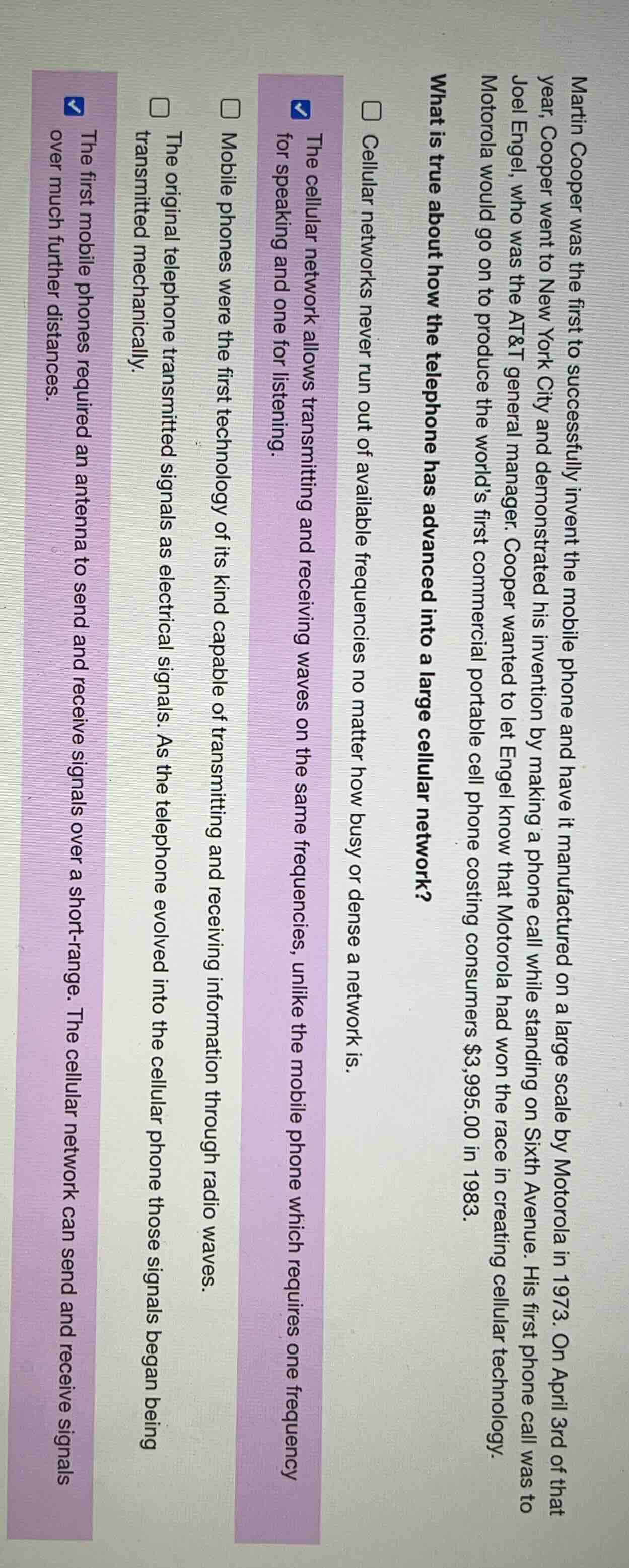
martin cooper was the first to successfully invent the mobile phone and have it manufactured on a large scale by motorola in 1973. on april 3rd of that year, cooper went to new york city and demonstrated his invention by making a phone call while standing on sixth avenue. his first phone call was to joel engel, who was the at&t general manager. cooper wanted to let engel know that motorola had won the race in creating cellular technology. motorola would go on to produce the worlds first commercial portable cell phone costing consumers $3,995.00 in 1983.
what is true about how the telephone has advanced into a large cellular network?
□ cellular networks never run out of available frequencies no matter how busy or dense a network is.
☑ the cellular network allows transmitting and receiving waves on the same frequencies, unlike the mobile phone which requires one frequency for speaking and one for listening.
□ mobile phones were the first technology of its kind capable of transmitting and receiving information through radio waves.
□ the original telephone transmitted signals as electrical signals. as the telephone evolved into the cellular phone those signals began being transmitted mechanically.
☑ the first mobile phones required an antenna to send and receive signals over a short-range. the cellular network can send and receive signals over much further distances.
- The first option is false because cellular networks can face frequency scarcity with high density/usage.
- The second option is true: cellular networks use separate frequencies for transmit and receive, while early mobile phones used a single frequency for both.
- The third option is false: earlier technologies like radio telephones existed before mobile phones, and mobile phones use radio waves which are not the first transmission tech.
- The fourth option is false: original telephones transmitted electrical signals (not mechanical), and cellular networks still rely on antennas, though with improved range via cell towers.

Snap & solve any problem in the app
Get step-by-step solutions on Sovi AI
Photo-based solutions with guided steps
Explore more problems and detailed explanations
- The cellular network allows transmitting and receiving waves on the same frequencies, unlike the mobile phone which requires one frequency for speaking and one for listening.
- The first mobile phones required an antenna to send and receive signals over a short-range. The cellular network can send and receive signals over much further distances.