QUESTION IMAGE
Question
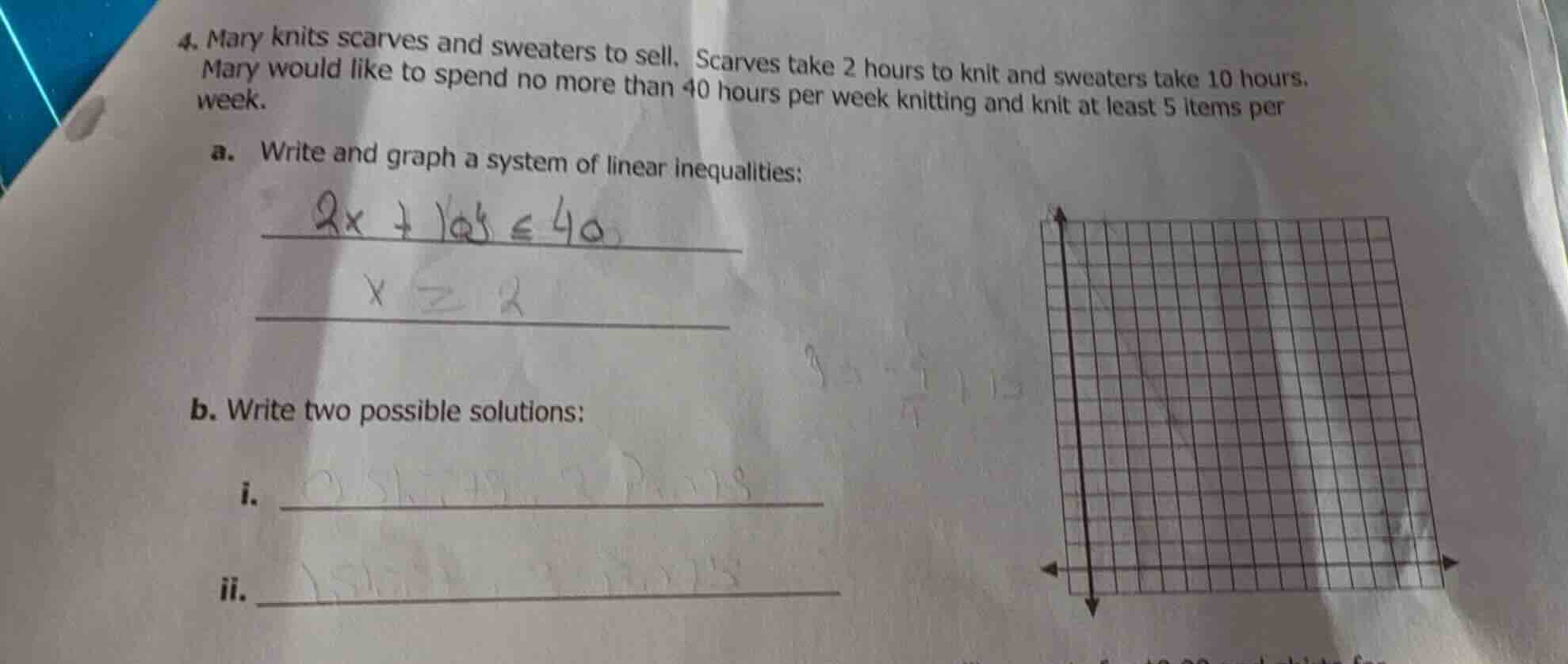
- mary knits scarves and sweaters to sell. scarves take 2 hours to knit and sweaters take 10 hours. mary would like to spend no more than 40 hours per week knitting and knit at least 5 items per week.
a. write and graph a system of linear inequalities:
b. write two possible solutions:
i.
ii.
Part a: Writing the System of Linear Inequalities
Let \( x \) be the number of scarves and \( y \) be the number of sweaters.
Step 1: Time Constraint
Scarves take 2 hours, sweaters take 10 hours, and total time ≤ 40 hours:
\( 2x + 10y \leq 40 \) (simplify: \( x + 5y \leq 20 \))
Step 2: Item Constraint
At least 5 items per week:
\( x + y \geq 5 \)
Step 3: Non - negativity (since number of items can't be negative)
\( x \geq 0 \), \( y \geq 0 \)
Graphing (Brief Description)
- For \( x + 5y \leq 20 \):
- Find intercepts: When \( x = 0 \), \( y = 4 \); when \( y = 0 \), \( x = 20 \). Draw a solid line, shade below (since \( \leq \)).
- For \( x + y \geq 5 \):
- Intercepts: \( x = 5 \) (when \( y = 0 \)), \( y = 5 \) (when \( x = 0 \)). Draw a solid line, shade above (since \( \geq \)).
- For \( x \geq 0 \) and \( y \geq 0 \), shade in the first quadrant. The feasible region is where all shadings overlap.
Part b: Possible Solutions
A solution \((x, y)\) must satisfy \( x + 5y \leq 20 \), \( x + y \geq 5 \), \( x \geq 0 \), \( y \geq 0 \).
i. Solution 1:
Let \( x = 5 \), \( y = 1 \)
- Check time: \( 2(5)+10(1)=10 + 10 = 20\leq40 \)
- Check items: \( 5 + 1 = 6\geq5 \)
So \((5, 1)\) is a solution (5 scarves, 1 sweater).
ii. Solution 2:
Let \( x = 0 \), \( y = 4 \)
- Check time: \( 2(0)+10(4)=40\leq40 \)
- Check items: \( 0 + 4 = 4\)? Wait, no. Wait, \( x + y\geq5 \), so \( x = 5 \), \( y = 0 \):
- Time: \( 2(5)+10(0)=10\leq40 \)
- Items: \( 5+0 = 5\geq5 \)
Or \( x = 3 \), \( y = 2 \):
- Time: \( 2(3)+10(2)=6 + 20 = 26\leq40 \)
- Items: \( 3 + 2 = 5\geq5 \)
Let's use \((3, 2)\): 3 scarves, 2 sweaters.
Final Answers (for part b)
i. \(\boldsymbol{(5, 1)}\) (5 scarves, 1 sweater)
ii. \(\boldsymbol{(3, 2)}\) (3 scarves, 2 sweaters)
(Note: Other valid solutions like \((10, 0)\) (10 scarves, 0 sweaters) or \((0, 4)\) is invalid for items, so correct ones must satisfy \( x + y\geq5 \).)

Snap & solve any problem in the app
Get step-by-step solutions on Sovi AI
Photo-based solutions with guided steps
Explore more problems and detailed explanations
Part a: Writing the System of Linear Inequalities
Let \( x \) be the number of scarves and \( y \) be the number of sweaters.
Step 1: Time Constraint
Scarves take 2 hours, sweaters take 10 hours, and total time ≤ 40 hours:
\( 2x + 10y \leq 40 \) (simplify: \( x + 5y \leq 20 \))
Step 2: Item Constraint
At least 5 items per week:
\( x + y \geq 5 \)
Step 3: Non - negativity (since number of items can't be negative)
\( x \geq 0 \), \( y \geq 0 \)
Graphing (Brief Description)
- For \( x + 5y \leq 20 \):
- Find intercepts: When \( x = 0 \), \( y = 4 \); when \( y = 0 \), \( x = 20 \). Draw a solid line, shade below (since \( \leq \)).
- For \( x + y \geq 5 \):
- Intercepts: \( x = 5 \) (when \( y = 0 \)), \( y = 5 \) (when \( x = 0 \)). Draw a solid line, shade above (since \( \geq \)).
- For \( x \geq 0 \) and \( y \geq 0 \), shade in the first quadrant. The feasible region is where all shadings overlap.
Part b: Possible Solutions
A solution \((x, y)\) must satisfy \( x + 5y \leq 20 \), \( x + y \geq 5 \), \( x \geq 0 \), \( y \geq 0 \).
i. Solution 1:
Let \( x = 5 \), \( y = 1 \)
- Check time: \( 2(5)+10(1)=10 + 10 = 20\leq40 \)
- Check items: \( 5 + 1 = 6\geq5 \)
So \((5, 1)\) is a solution (5 scarves, 1 sweater).
ii. Solution 2:
Let \( x = 0 \), \( y = 4 \)
- Check time: \( 2(0)+10(4)=40\leq40 \)
- Check items: \( 0 + 4 = 4\)? Wait, no. Wait, \( x + y\geq5 \), so \( x = 5 \), \( y = 0 \):
- Time: \( 2(5)+10(0)=10\leq40 \)
- Items: \( 5+0 = 5\geq5 \)
Or \( x = 3 \), \( y = 2 \):
- Time: \( 2(3)+10(2)=6 + 20 = 26\leq40 \)
- Items: \( 3 + 2 = 5\geq5 \)
Let's use \((3, 2)\): 3 scarves, 2 sweaters.
Final Answers (for part b)
i. \(\boldsymbol{(5, 1)}\) (5 scarves, 1 sweater)
ii. \(\boldsymbol{(3, 2)}\) (3 scarves, 2 sweaters)
(Note: Other valid solutions like \((10, 0)\) (10 scarves, 0 sweaters) or \((0, 4)\) is invalid for items, so correct ones must satisfy \( x + y\geq5 \).)