QUESTION IMAGE
Question
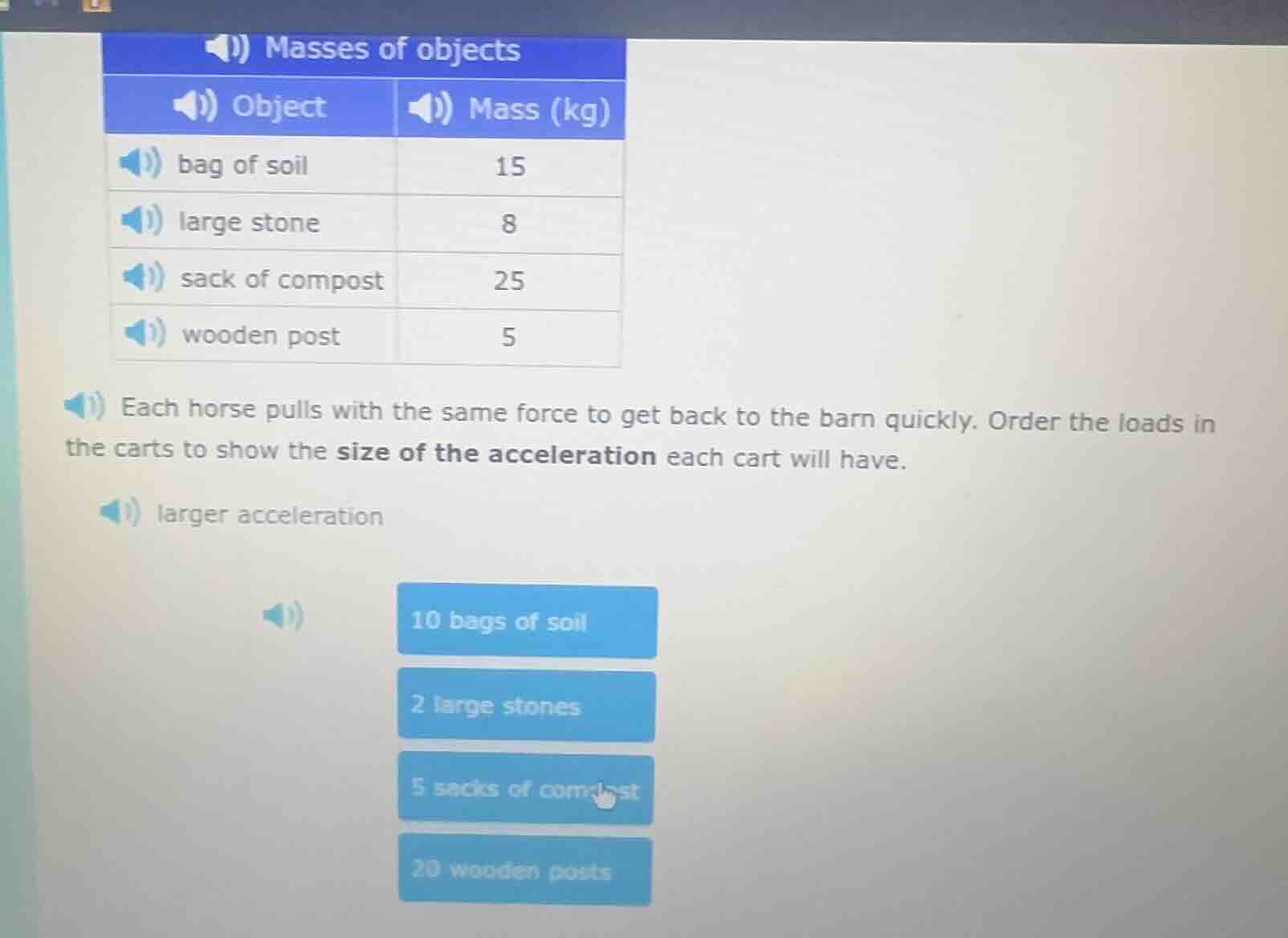
masses of objects
object | mass (kg)
bag of soil | 15
large stone | 8
sack of compost | 25
wooden post | 5
each horse pulls with the same force to get back to the barn quickly. order the loads in the carts to show the size of the acceleration each cart will have.
larger acceleration
10 bags of soil
2 large stones
5 sacks of compost
20 wooden posts
Step1: Calculate mass of each load
- 10 bags of soil: \(10\times15 = 150\) kg
- 2 large stones: \(2\times8 = 16\) kg
- 5 sacks of compost: \(5\times25 = 125\) kg
- 20 wooden posts: \(20\times5 = 100\) kg
Step2: Recall Newton's second law (\(F = ma\), so \(a=\frac{F}{m}\) when \(F\) is constant)
- Acceleration \(a\) is inversely proportional to mass \(m\) (since force \(F\) is same for all horses). So smaller mass means larger acceleration.
Step3: Order by mass (ascending) to get acceleration (descending)
- Masses: 16 kg (2 large stones), 100 kg (20 wooden posts), 125 kg (5 sacks of compost), 150 kg (10 bags of soil)
- So acceleration order (larger to smaller): 2 large stones, 20 wooden posts, 5 sacks of compost, 10 bags of soil

Snap & solve any problem in the app
Get step-by-step solutions on Sovi AI
Photo-based solutions with guided steps
Explore more problems and detailed explanations
From larger acceleration to smaller acceleration: 2 large stones, 20 wooden posts, 5 sacks of compost, 10 bags of soil