QUESTION IMAGE
Question
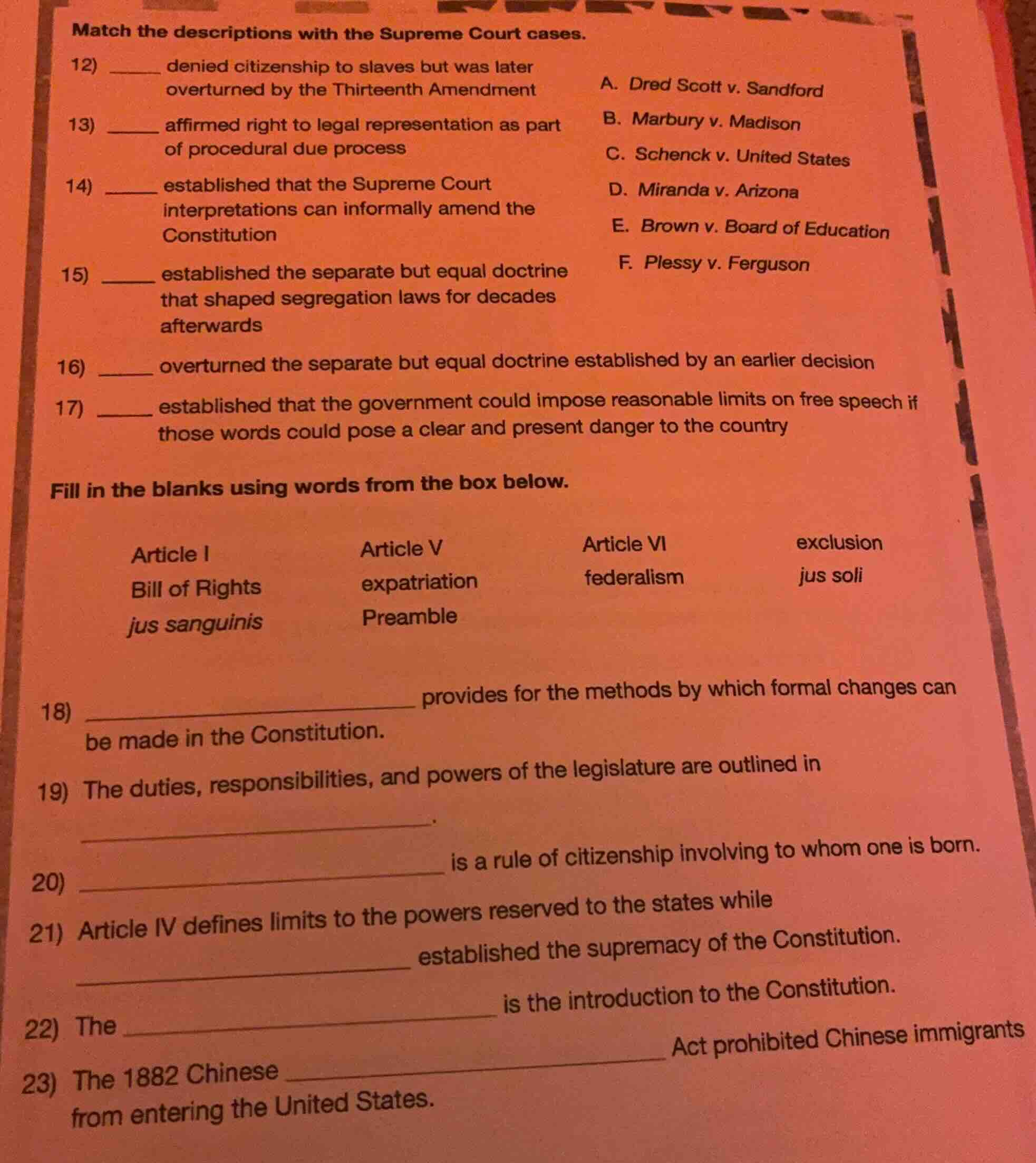
match the descriptions with the supreme court cases.
- ______ denied citizenship to slaves but was later
overturned by the thirteenth amendment a. dred scott v. sandford
- ______ affirmed right to legal representation as part
of procedural due process b. marbury v. madison
- ______ established that the supreme court c. schenck v. united states
interpretations can informally amend the
constitution d. miranda v. arizona
- ______ established the separate but equal doctrine e. brown v. board of education
that shaped segregation laws for decades
afterwards f. plessy v. ferguson
- ______ overturned the separate but equal doctrine established by an earlier decision
- ______ established that the government could impose reasonable limits on free speech if
those words could pose a clear and present danger to the country
fill in the blanks using words from the box below.
article i article v article vi exclusion
bill of rights expatriation federalism jus soli
jus sanguinis preamble
- ______________________ provides for the methods by which formal changes can
be made in the constitution.
- the duties, responsibilities, and powers of the legislature are outlined in
______________________.
- ______________________ is a rule of citizenship involving to whom one is born.
- article iv defines limits to the powers reserved to the states while
______________________ established the supremacy of the constitution.
- the ______________________ is the introduction to the constitution.
- the 1882 chinese ______________________ act prohibited chinese immigrants
from entering the united states.
- For the matching section:
- 12: Dred Scott v. Sandford ruled enslaved people were not citizens, overturned by the 13th Amendment ending slavery.
- 13: Miranda v. Arizona created the Miranda rights, affirming legal representation as part of procedural due process.
- 14: Marbury v. Madison established judicial review, letting the Court interpret the Constitution as an informal amendment method.
- 15: Plessy v. Ferguson created the "separate but equal" doctrine that legalized segregation.
- 16: Brown v. Board of Education overturned the "separate but equal" doctrine from Plessy v. Ferguson.
- 17: Schenck v. United States established the "clear and present danger" test for limiting free speech.
- For the fill-in section:
- 18: Article V of the U.S. Constitution outlines formal amendment procedures.
- 19: Article I details the legislative branch's powers, duties, and structure.
- 20: Jus sanguinis is citizenship based on one's parents' citizenship (birth to specific people).
- 21: Article VI includes the Supremacy Clause, establishing the Constitution as the highest law.
- 22: The Preamble is the introductory statement of the U.S. Constitution.
- 23: The 1882 Chinese Exclusion Act banned Chinese immigration to the U.S.

Snap & solve any problem in the app
Get step-by-step solutions on Sovi AI
Photo-based solutions with guided steps
Explore more problems and detailed explanations
Matching Section:
- A. Dred Scott v. Sandford
- D. Miranda v. Arizona
- B. Marbury v. Madison
- F. Plessy v. Ferguson
- E. Brown v. Board of Education
- C. Schenck v. United States
Fill-in Section:
- Article V
- Article I
- jus sanguinis
- Article VI
- Preamble
- exclusion