QUESTION IMAGE
Question
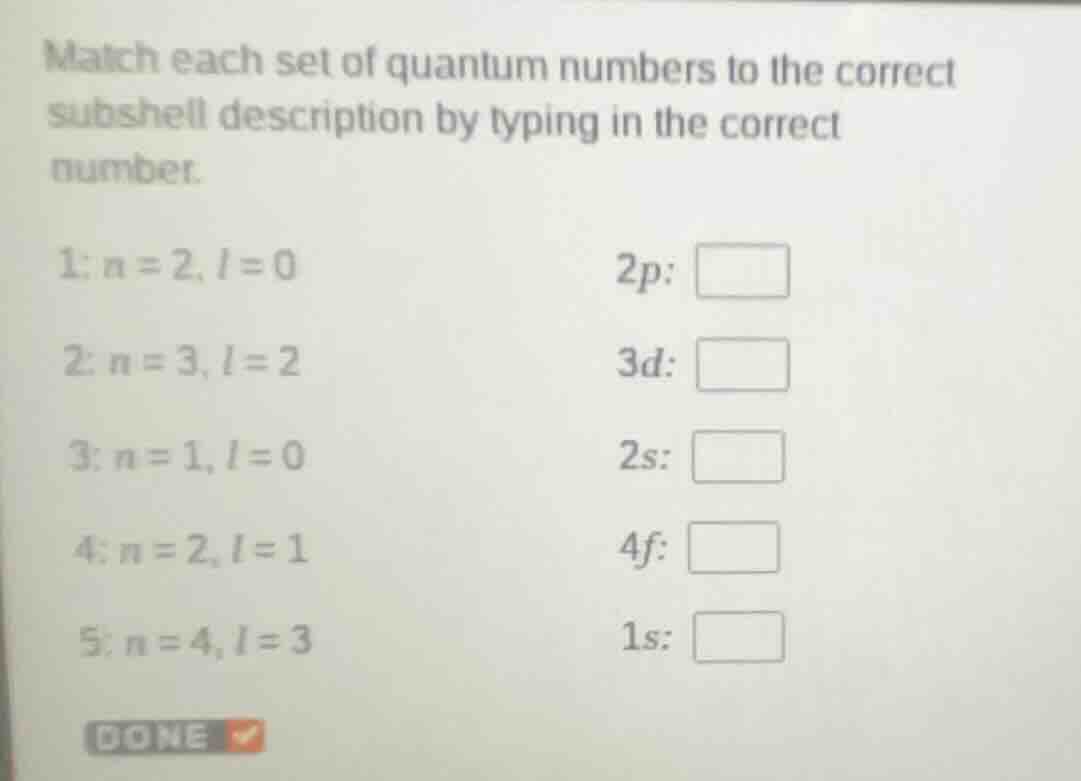
match each set of quantum numbers to the correct subshell description by typing in the correct number. 1: n = 2, l = 0 2p: \square 2: n = 3, l = 2 3d: \square 3: n = 1, l = 0 2s: \square 4: n = 2, l = 1 4f: \square 5: n = 4, l = 3 1s: \square
To solve this, we use the rules of quantum numbers: the principal quantum number \( n \) gives the energy level, and the azimuthal quantum number \( l \) determines the subshell (\( l = 0 \) for \( s \), \( l = 1 \) for \( p \), \( l = 2 \) for \( d \), \( l = 3 \) for \( f \)).
Step 1: Analyze \( 2p \)
For \( 2p \), \( n = 2 \) and \( l = 1 \) (since \( p \) corresponds to \( l = 1 \)). The set with \( n = 2, l = 1 \) is set 4. So \( 2p \) matches 4.
Step 2: Analyze \( 3d \)
For \( 3d \), \( n = 3 \) and \( l = 2 \) (since \( d \) corresponds to \( l = 2 \)). The set with \( n = 3, l = 2 \) is set 2. So \( 3d \) matches 2.
Step 3: Analyze \( 2s \)
For \( 2s \), \( n = 2 \) and \( l = 0 \) (since \( s \) corresponds to \( l = 0 \)). The set with \( n = 2, l = 0 \) is set 1. So \( 2s \) matches 1.
Step 4: Analyze \( 4f \)
For \( 4f \), \( n = 4 \) and \( l = 3 \) (since \( f \) corresponds to \( l = 3 \)). The set with \( n = 4, l = 3 \) is set 5. So \( 4f \) matches 5.
Step 5: Analyze \( 1s \)
For \( 1s \), \( n = 1 \) and \( l = 0 \) (since \( s \) corresponds to \( l = 0 \)). The set with \( n = 1, l = 0 \) is set 3. So \( 1s \) matches 3.
Final Matches:
- \( 2p \): 4
- \( 3d \): 2
- \( 2s \): 1
- \( 4f \): 5
- \( 1s \): 3
So the filled boxes are:
\( 2p \): \(\boldsymbol{4}\)
\( 3d \): \(\boldsymbol{2}\)
\( 2s \): \(\boldsymbol{1}\)
\( 4f \): \(\boldsymbol{5}\)
\( 1s \): \(\boldsymbol{3}\)

Snap & solve any problem in the app
Get step-by-step solutions on Sovi AI
Photo-based solutions with guided steps
Explore more problems and detailed explanations
To solve this, we use the rules of quantum numbers: the principal quantum number \( n \) gives the energy level, and the azimuthal quantum number \( l \) determines the subshell (\( l = 0 \) for \( s \), \( l = 1 \) for \( p \), \( l = 2 \) for \( d \), \( l = 3 \) for \( f \)).
Step 1: Analyze \( 2p \)
For \( 2p \), \( n = 2 \) and \( l = 1 \) (since \( p \) corresponds to \( l = 1 \)). The set with \( n = 2, l = 1 \) is set 4. So \( 2p \) matches 4.
Step 2: Analyze \( 3d \)
For \( 3d \), \( n = 3 \) and \( l = 2 \) (since \( d \) corresponds to \( l = 2 \)). The set with \( n = 3, l = 2 \) is set 2. So \( 3d \) matches 2.
Step 3: Analyze \( 2s \)
For \( 2s \), \( n = 2 \) and \( l = 0 \) (since \( s \) corresponds to \( l = 0 \)). The set with \( n = 2, l = 0 \) is set 1. So \( 2s \) matches 1.
Step 4: Analyze \( 4f \)
For \( 4f \), \( n = 4 \) and \( l = 3 \) (since \( f \) corresponds to \( l = 3 \)). The set with \( n = 4, l = 3 \) is set 5. So \( 4f \) matches 5.
Step 5: Analyze \( 1s \)
For \( 1s \), \( n = 1 \) and \( l = 0 \) (since \( s \) corresponds to \( l = 0 \)). The set with \( n = 1, l = 0 \) is set 3. So \( 1s \) matches 3.
Final Matches:
- \( 2p \): 4
- \( 3d \): 2
- \( 2s \): 1
- \( 4f \): 5
- \( 1s \): 3
So the filled boxes are:
\( 2p \): \(\boldsymbol{4}\)
\( 3d \): \(\boldsymbol{2}\)
\( 2s \): \(\boldsymbol{1}\)
\( 4f \): \(\boldsymbol{5}\)
\( 1s \): \(\boldsymbol{3}\)