QUESTION IMAGE
Question
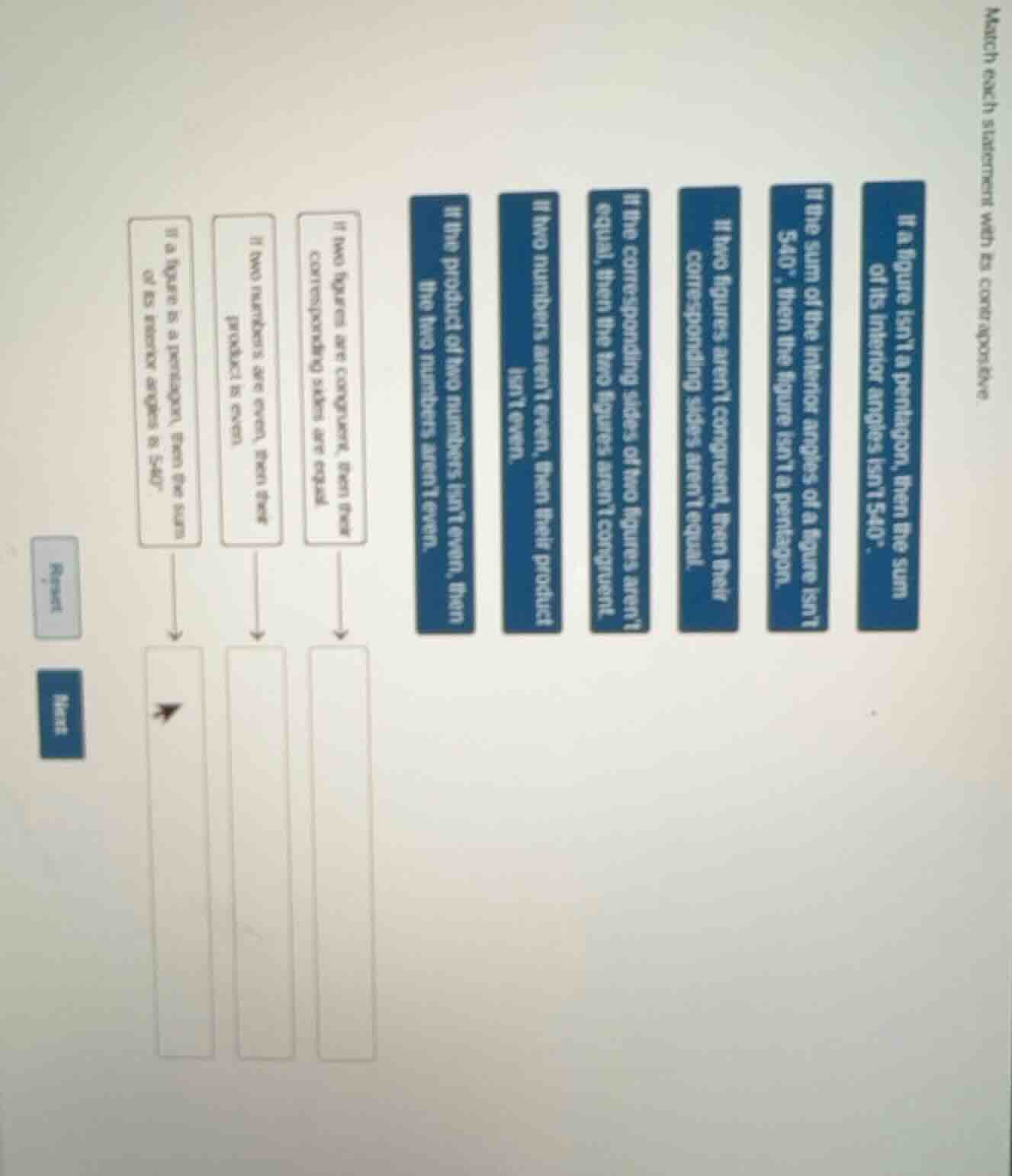
match each statement with its contrapositive.
if a figure isn’t a pentagon, then the sum of its interior angles isn’t 540°.
if the sum of the interior angles of a figure isn’t 540°, then the figure isn’t a pentagon.
if two figures aren’t congruent, then their corresponding sides aren’t equal.
if the corresponding sides of two figures aren’t equal, then the two figures aren’t congruent.
if two numbers aren’t even, then their product isn’t even.
if the product of two numbers isn’t even, then the two numbers aren’t even.
if two figures are congruent, then their corresponding sides are equal.
if two numbers are even, then their product is even.
if a figure is a pentagon, then the sum of its interior angles is 540°.
reset
check
To solve the problem of matching each statement with its contrapositive, we first recall that the contrapositive of a conditional statement \( p
ightarrow q \) is \(
eg q
ightarrow
eg p \). Let's analyze each statement:
1. Statement: "If a figure is a pentagon, then the sum of its interior angles is \( 540^\circ \)."
- Let \( p \): "a figure is a pentagon", \( q \): "the sum of its interior angles is \( 540^\circ \)".
- Contrapositive: \(
eg q
ightarrow
eg p \), which is "If the sum of the interior angles of a figure isn't \( 540^\circ \), then the figure isn't a pentagon."
2. Statement: "If two figures are congruent, then their corresponding sides are equal."
- Let \( p \): "two figures are congruent", \( q \): "their corresponding sides are equal".
- Contrapositive: \(
eg q
ightarrow
eg p \), which is "If two figures' corresponding sides aren't equal, then the two figures aren't congruent."
3. Statement: "If two numbers are even, then their product is even."
- Let \( p \): "two numbers are even", \( q \): "their product is even".
- Contrapositive: \(
eg q
ightarrow
eg p \), which is "If the product of two numbers isn't even, then the two numbers aren't even."
4. Statement: "If the sum of the interior angles of a figure is \( 540^\circ \), then the figure is a pentagon." (Wait, no, the original statement is the other way. Wait, let's re - check. The first white box: "If a figure is a pentagon, then the sum of its interior angles is \( 540^\circ \)". The blue box: "If the sum of the interior angles of a figure isn't \( 540^\circ \), then the figure isn't a pentagon" is its contrapositive.
The second white box: "If two numbers are even, then their product is even." The blue box: "If the product of two numbers isn't even, then the two numbers aren't even" is its contrapositive.
The third white box: "If two figures are congruent, then their corresponding sides are equal." The blue box: "If two figures' corresponding sides aren't equal, then the two figures aren't congruent" is its contrapositive.
Matching:
- "If a figure is a pentagon, then the sum of its interior angles is \( 540^\circ \)" matches with "If the sum of the interior angles of a figure isn't \( 540^\circ \), then the figure isn't a pentagon."
- "If two figures are congruent, then their corresponding sides are equal" matches with "If two figures' corresponding sides aren't equal, then the two figures aren't congruent."
- "If two numbers are even, then their product is even" matches with "If the product of two numbers isn't even, then the two numbers aren't even."
Final Matches:
- "If a figure is a pentagon, then the sum of its interior angles is \( 540^\circ \)" → "If the sum of the interior angles of a figure isn't \( 540^\circ \), then the figure isn't a pentagon."
- "If two figures are congruent, then their corresponding sides are equal" → "If two figures' corresponding sides aren't equal, then the two figures aren't congruent."
- "If two numbers are even, then their product is even" → "If the product of two numbers isn't even, then the two numbers aren't even."

Snap & solve any problem in the app
Get step-by-step solutions on Sovi AI
Photo-based solutions with guided steps
Explore more problems and detailed explanations
To solve the problem of matching each statement with its contrapositive, we first recall that the contrapositive of a conditional statement \( p
ightarrow q \) is \(
eg q
ightarrow
eg p \). Let's analyze each statement:
1. Statement: "If a figure is a pentagon, then the sum of its interior angles is \( 540^\circ \)."
- Let \( p \): "a figure is a pentagon", \( q \): "the sum of its interior angles is \( 540^\circ \)".
- Contrapositive: \(
eg q
ightarrow
eg p \), which is "If the sum of the interior angles of a figure isn't \( 540^\circ \), then the figure isn't a pentagon."
2. Statement: "If two figures are congruent, then their corresponding sides are equal."
- Let \( p \): "two figures are congruent", \( q \): "their corresponding sides are equal".
- Contrapositive: \(
eg q
ightarrow
eg p \), which is "If two figures' corresponding sides aren't equal, then the two figures aren't congruent."
3. Statement: "If two numbers are even, then their product is even."
- Let \( p \): "two numbers are even", \( q \): "their product is even".
- Contrapositive: \(
eg q
ightarrow
eg p \), which is "If the product of two numbers isn't even, then the two numbers aren't even."
4. Statement: "If the sum of the interior angles of a figure is \( 540^\circ \), then the figure is a pentagon." (Wait, no, the original statement is the other way. Wait, let's re - check. The first white box: "If a figure is a pentagon, then the sum of its interior angles is \( 540^\circ \)". The blue box: "If the sum of the interior angles of a figure isn't \( 540^\circ \), then the figure isn't a pentagon" is its contrapositive.
The second white box: "If two numbers are even, then their product is even." The blue box: "If the product of two numbers isn't even, then the two numbers aren't even" is its contrapositive.
The third white box: "If two figures are congruent, then their corresponding sides are equal." The blue box: "If two figures' corresponding sides aren't equal, then the two figures aren't congruent" is its contrapositive.
Matching:
- "If a figure is a pentagon, then the sum of its interior angles is \( 540^\circ \)" matches with "If the sum of the interior angles of a figure isn't \( 540^\circ \), then the figure isn't a pentagon."
- "If two figures are congruent, then their corresponding sides are equal" matches with "If two figures' corresponding sides aren't equal, then the two figures aren't congruent."
- "If two numbers are even, then their product is even" matches with "If the product of two numbers isn't even, then the two numbers aren't even."
Final Matches:
- "If a figure is a pentagon, then the sum of its interior angles is \( 540^\circ \)" → "If the sum of the interior angles of a figure isn't \( 540^\circ \), then the figure isn't a pentagon."
- "If two figures are congruent, then their corresponding sides are equal" → "If two figures' corresponding sides aren't equal, then the two figures aren't congruent."
- "If two numbers are even, then their product is even" → "If the product of two numbers isn't even, then the two numbers aren't even."