QUESTION IMAGE
Question
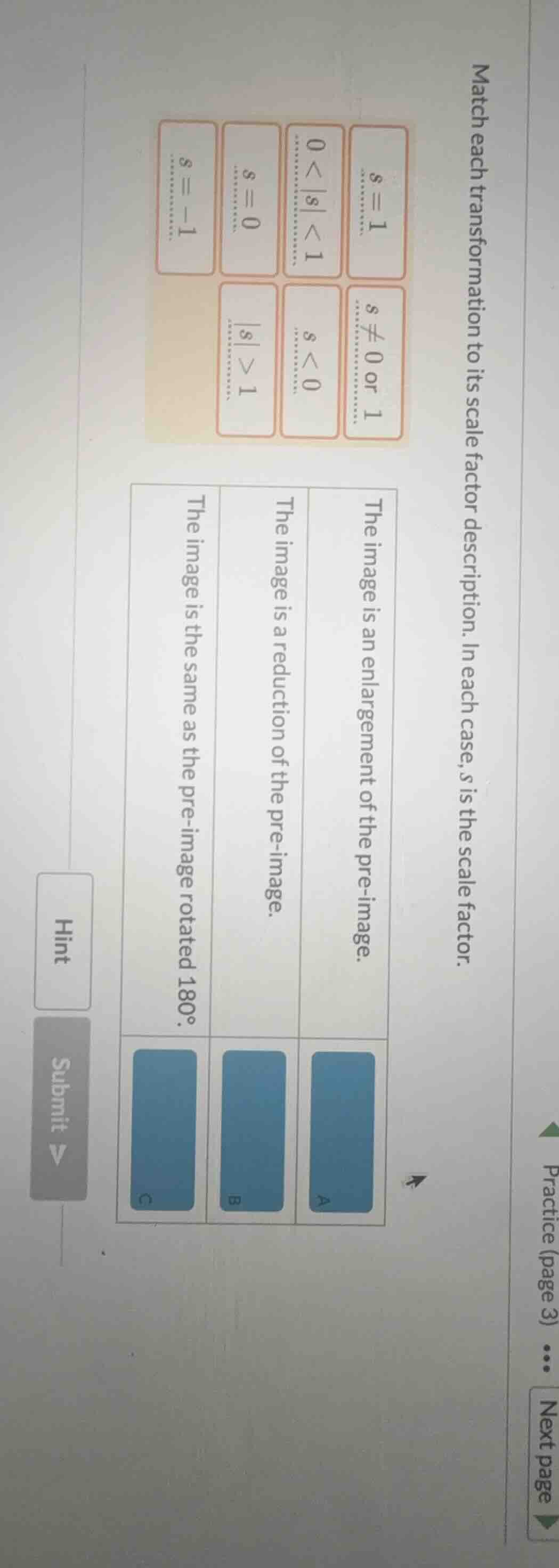
match each transformation to its scale factor description. in each case, s is the scale factor.
the image is an enlargement of the pre - image.
the image is a reduction of the pre - image.
the image is the same as the pre - image rotated 180°.
options for matching:
s = 1, 0 < |s| < 1, s = 0, s ≠ 0 or 1, s < 0, |s| > 1, s = - 1
Step 1: Analyze "The image is an enlargement of the pre - image"
For a dilation (scale transformation), if the absolute value of the scale factor \(|s|\) is greater than 1, the image is an enlargement of the pre - image. So the scale factor description for enlargement is \(|s|>1\).
Step 2: Analyze "The image is a reduction of the pre - image"
If the absolute value of the scale factor \(|s|\) is between 0 and 1 (i.e., \(0 < |s|<1\)), the image is a reduction of the pre - image.
Step 3: Analyze "The image is the same as the pre - image rotated \(180^{\circ}\)"
A rotation of \(180^{\circ}\) with a scale factor of \(s=- 1\) will map the pre - image to an image that is congruent (same size) but rotated \(180^{\circ}\). Also, if \(s = 1\), the image is the same as the pre - image (no change in size or orientation), but a \(180^{\circ}\) rotation with \(s=-1\) also results in an image that has the same size as the pre - image (since \(| - 1|=1\)). However, the key here is that the image is the same as the pre - image (in terms of size) after a \(180^{\circ}\) rotation. The scale factor \(s=-1\) gives a transformation that is a rotation (and also a dilation with scale factor - 1, but the size remains the same as \(|s| = 1\)). Also, \(s = 1\) would mean no rotation (just the same image). But the description says "rotated \(180^{\circ}\)", so \(s=-1\) is the scale factor for a \(180^{\circ}\) rotation (since the transformation \( (x,y)\to(-x,-y)\) has a scale factor of - 1 and is a \(180^{\circ}\) rotation). But also, if we consider the size, when \(s=-1\), the size of the image is the same as the pre - image (because \(|s| = 1\)). Another case is \(s = 1\) (no rotation, just the same image). But the most appropriate for a \(180^{\circ}\) rotation is \(s=-1\), but also, if we think about the size being the same, \(|s| = 1\), so the scale factor descriptions related to the same size (after rotation) are \(s=-1\) and \(s = 1\) (but \(s=-1\) is for \(180^{\circ}\) rotation). However, from the given options, for "The image is the same as the pre - image rotated \(180^{\circ}\)", the scale factor is \(s=-1\) (since a scale factor of - 1 gives a \(180^{\circ}\) rotation and the size remains the same as \(|s|=1\)).
Now, let's match:
- "The image is an enlargement of the pre - image" matches with \(|s|>1\)
- "The image is a reduction of the pre - image" matches with \(0 < |s|<1\)
- "The image is the same as the pre - image rotated \(180^{\circ}\)" matches with \(s=-1\) (and also \(s = 1\) in terms of size, but \(s=-1\) is for \(180^{\circ}\) rotation)

Snap & solve any problem in the app
Get step-by-step solutions on Sovi AI
Photo-based solutions with guided steps
Explore more problems and detailed explanations
- A (The image is an enlargement of the pre - image) : \(|s|>1\)
- B (The image is a reduction of the pre - image) : \(0 < |s|<1\)
- C (The image is the same as the pre - image rotated \(180^{\circ}\)) : \(s=-1\)