QUESTION IMAGE
Question
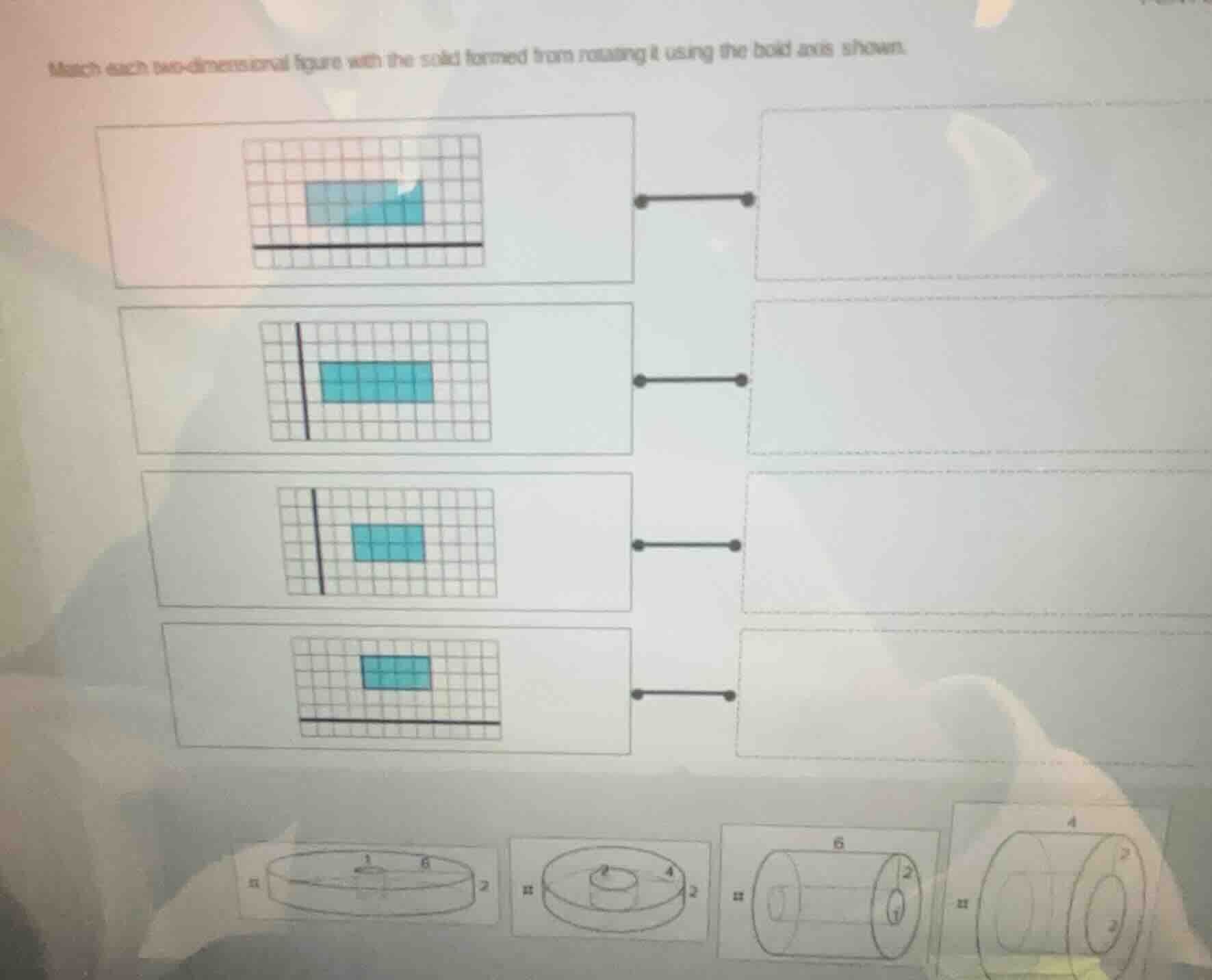
match each two - dimensional figure with the solid formed from rotating it using the bold axis shown.
To solve this problem, we analyze each 2D figure and the solid formed by rotating it about the bold axis:
1. First 2D Figure (Bottom - horizontal axis)
The blue rectangle is above a horizontal bold axis. Rotating a rectangle about a horizontal axis parallel to its length (or side) forms a cylinder (or a disk - like cylinder if the height is small). The key is the distance from the axis to the rectangle (radius) and the dimensions of the rectangle (height of the cylinder).
2. Second 2D Figure (Left - vertical axis, large rectangle)
The blue rectangle is to the right of a vertical bold axis. Rotating a rectangle about a vertical axis parallel to its side forms a cylinder. The distance from the axis to the rectangle (radius) and the rectangle’s dimensions determine the cylinder’s size. The large rectangle here will form a larger - radius cylinder (or a cylindrical shell) when rotated.
3. Third 2D Figure (Left - vertical axis, small rectangle)
The blue rectangle is to the right of a vertical bold axis but is smaller. Rotating it about the vertical axis forms a smaller - radius cylinder (or a smaller cylindrical shell) inside the larger one from the second figure, creating a hollow cylinder (annular cylinder) or a smaller solid cylinder.
4. Fourth 2D Figure (Bottom - horizontal axis, small rectangle)
The blue rectangle is above a horizontal bold axis but is smaller. Rotating it about the horizontal axis forms a smaller - radius cylinder (or a disk - like cylinder) compared to the first figure.
Matching Logic
- The first figure (horizontal axis, large rectangle) matches the solid with a large radius (e.g., the first solid at the bottom left with radius related to the grid distance).
- The second figure (vertical axis, large rectangle) matches the solid with a large outer radius and a smaller inner radius (hollow cylinder or a cylinder with a smaller cylinder inside, like the second solid at the bottom).
- The third figure (vertical axis, small rectangle) matches the solid with a small inner cylinder (like the second solid’s inner cylinder or a small solid cylinder).
- The fourth figure (horizontal axis, small rectangle) matches the solid with a small radius (like the third or fourth solid at the bottom).
Final Matches (Typical Outcome)
- Top - left (horizontal axis, large rectangle) → Bottom - left solid (large disk - like cylinder).
- Middle - left (vertical axis, large rectangle) → Second bottom solid (hollow cylinder with large outer radius).
- Middle - left (vertical axis, small rectangle) → Second bottom solid’s inner cylinder (small solid cylinder).
- Bottom - left (horizontal axis, small rectangle) → Third bottom solid (small disk - like cylinder).
(Note: Exact matching depends on grid dimensions and axis - rectangle distances, but the key is recognizing that rotating a rectangle about an axis parallel to its side forms a cylinder, with radius = distance from axis to rectangle and height = rectangle’s side length.)

Snap & solve any problem in the app
Get step-by-step solutions on Sovi AI
Photo-based solutions with guided steps
Explore more problems and detailed explanations
The matches follow the logic of rotating rectangles to form cylinders (or cylindrical shells) based on axis - rectangle distance and rectangle size. For example:
- First 2D → First bottom solid.
- Second 2D → Second bottom solid.
- Third 2D → Second bottom solid’s inner cylinder.
- Fourth 2D → Third bottom solid.
(Adjust based on the actual grid and solid dimensions in the image.)