QUESTION IMAGE
Question
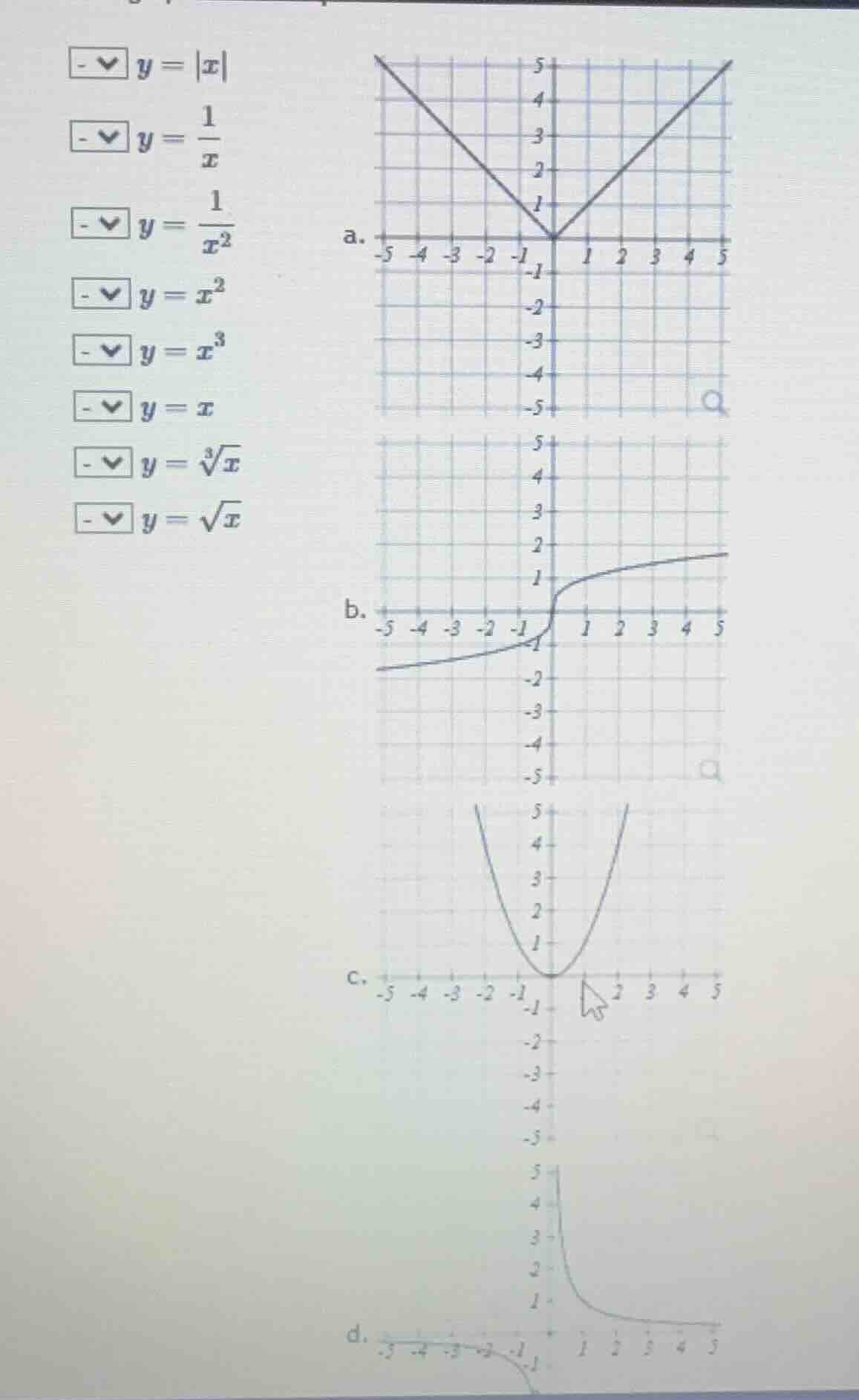
match the functions: $y = |x|$, $y = \frac{1}{x}$, $y = \frac{1}{x^2}$, $y = x^2$, $y = x^3$, $y = x$, $y = \sqrt3{x}$, $y = \sqrt{x}$ to the graphs labeled a, b, c, d (and other possible graphs not fully shown here).
To solve this problem, we analyze each graph and match it with the corresponding function:
Part a:
The graph in part a is a V - shaped graph with the vertex at the origin \((0,0)\). The function \(y = |x|\) (the absolute - value function) has a graph that is a V - shaped graph opening upwards with the vertex at the origin. For \(x\geq0\), \(y=x\) (a line with a slope of 1), and for \(x < 0\), \(y=-x\) (a line with a slope of - 1), which matches the graph in part a.
Part b:
The graph in part b has a point - symmetric shape about the origin. The function \(y=x^{3}\) is an odd function, and its graph is symmetric about the origin. When \(x = 0\), \(y = 0\). For \(x>0\), \(y=x^{3}\) is an increasing function, and for \(x < 0\), \(y=x^{3}\) is also an increasing function (since if \(x_1 The graph in part c is a parabola opening upwards with the vertex at the origin \((0,0)\). The function \(y = x^{2}\) is a quadratic function, and its graph is a parabola opening upwards with the vertex at the origin. For any real number \(x\), \(y=x^{2}\geq0\), and the graph is symmetric about the \(y\) - axis, which matches the graph in part c. The graph in part d is a hyperbola in the first and third quadrants (for \(y=\frac{1}{x}\)) or in the first and second quadrants (for \(y = \frac{1}{x^{2}}\)). The function \(y=\frac{1}{x^{2}}\) has a graph that is symmetric about the \(y\) - axis. When \(x>0\), as \(x\) increases, \(y=\frac{1}{x^{2}}\) decreases towards 0, and when \(x < 0\), as \(|x|\) increases, \(y=\frac{1}{x^{2}}\) also decreases towards 0. The graph in part d (assuming it's the graph of \(y=\frac{1}{x^{2}}\)) or if it's the graph of \(y = \frac{1}{x}\), the graph of \(y=\frac{1}{x}\) has two branches, one in the first quadrant (\(x>0,y>0\)) and one in the third quadrant (\(x < 0,y < 0\)). But looking at the options and the shape, if we consider the graph in part d (the last one), the function \(y=\frac{1}{x^{2}}\) has a graph that is above the \(x\) - axis (since \(x^{2}>0\) for \(x eq0\)) If we assume the questio…Part c:
Part d:
eq0\)) and symmetric about the \(y\) - axis. However, if we consider the graph of \(y=\frac{1}{x}\), it has two branches in the first and third quadrants. But from the given options and the shape of the graph in part d (the one with the curve in the first and second quadrants is not \(y = \frac{1}{x}\), the graph of \(y=\frac{1}{x^{2}}\) is in the first and second quadrants (since \(x^{2}>0\) for all \(x
eq0\), so \(y=\frac{1}{x^{2}}>0\) for all \(x
eq0\)). The graph in part d (the last one) with the curve in the first quadrant (and for \(x<0\), since \(x^{2}\) is positive, \(y=\frac{1}{x^{2}}\) is positive) matches \(y=\frac{1}{x^{2}}\) or \(y=\frac{1}{x}\). But if we re - examine, the graph of \(y=\frac{1}{x}\) has a vertical asymptote at \(x = 0\) and horizontal asymptote at \(y = 0\), with two branches (first and third quadrants). The graph of \(y=\frac{1}{x^{2}}\) has a vertical asymptote at \(x = 0\) and horizontal asymptote at \(y = 0\), with two branches (first and second quadrants).Final Matching:

Snap & solve any problem in the app
Get step-by-step solutions on Sovi AI
Photo-based solutions with guided steps
Explore more problems and detailed explanations
s:
a. \(y = |x|\)
b. \(y=x^{3}\)
c. \(y = x^{2}\)
d. \(y=\frac{1}{x^{2}}\)