QUESTION IMAGE
Question
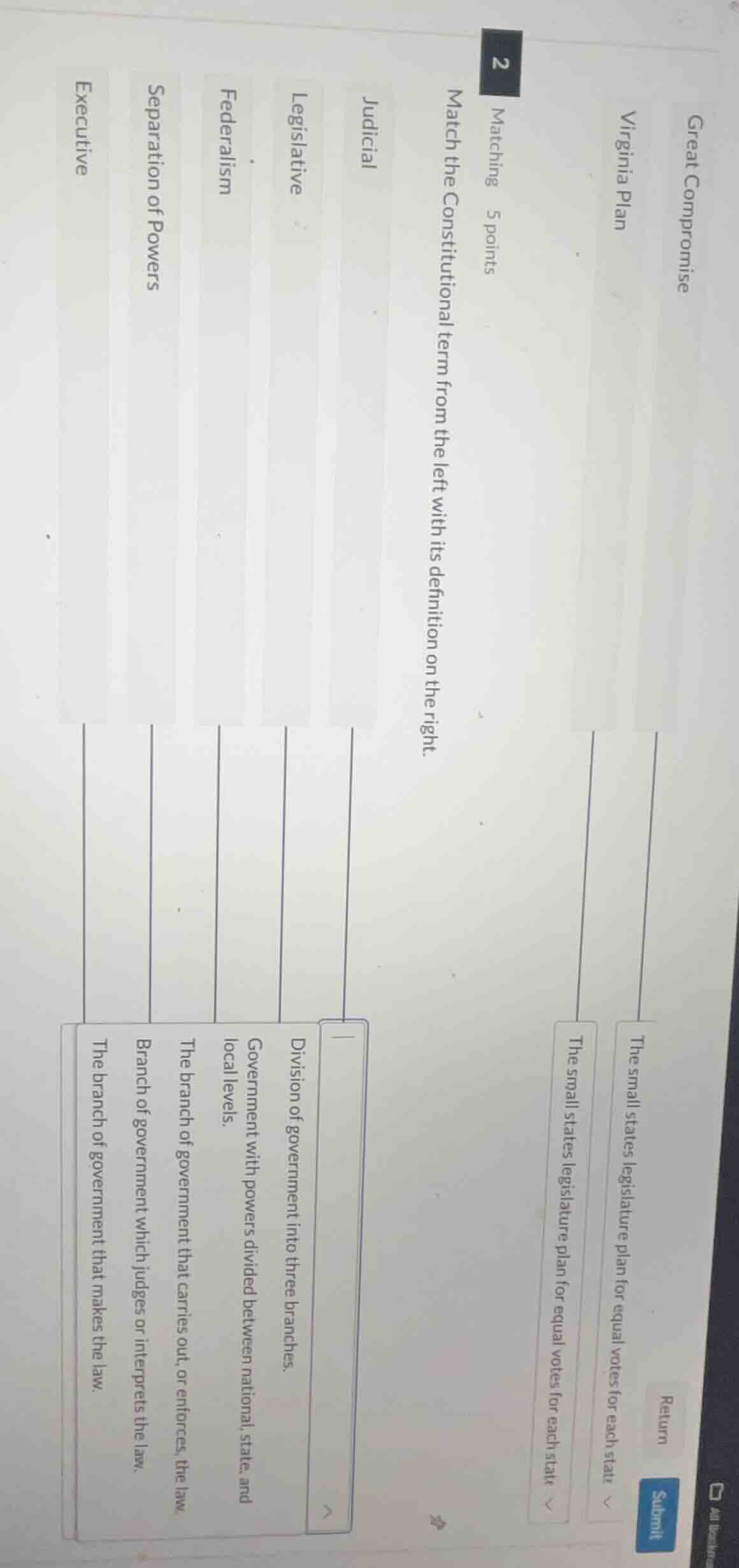
2 matching 5 points match the constitutional term from the left with its definition on the right. judicial legislative federalism separation of powers executive great compromise virginia plan division of government into three branches. government with powers divided between national, state, and local levels. the branch of government that carries out, or enforces, the law branch of government which judges or interprets the law. the branch of government that makes the law. the small states legislature plan for equal votes for each state the small states legislature plan for equal votes for each state
- Judicial: The branch of government which judges or interprets the law. (The judicial branch is responsible for interpreting laws and settling legal disputes.)
- Legislative: The branch of government that makes the law. (The legislative branch, like Congress, is tasked with creating laws.)
- Federalism: Government with powers divided between national, state, and local levels. (Federalism is the system of shared power between different levels of government.)
- Separation of Powers: Division of government into three branches. (This principle splits government into legislative, executive, and judicial to prevent tyranny.)
- Executive: The branch of government that carries out, or enforces, the law. (The executive branch, led by the President, enforces laws.)

Snap & solve any problem in the app
Get step-by-step solutions on Sovi AI
Photo-based solutions with guided steps
Explore more problems and detailed explanations
- Judicial: The branch of government which judges or interprets the law.
- Legislative: The branch of government that makes the law.
- Federalism: Government with powers divided between national, state, and local levels.
- Separation of Powers: Division of government into three branches.
- Executive: The branch of government that carries out, or enforces, the law.