QUESTION IMAGE
Question
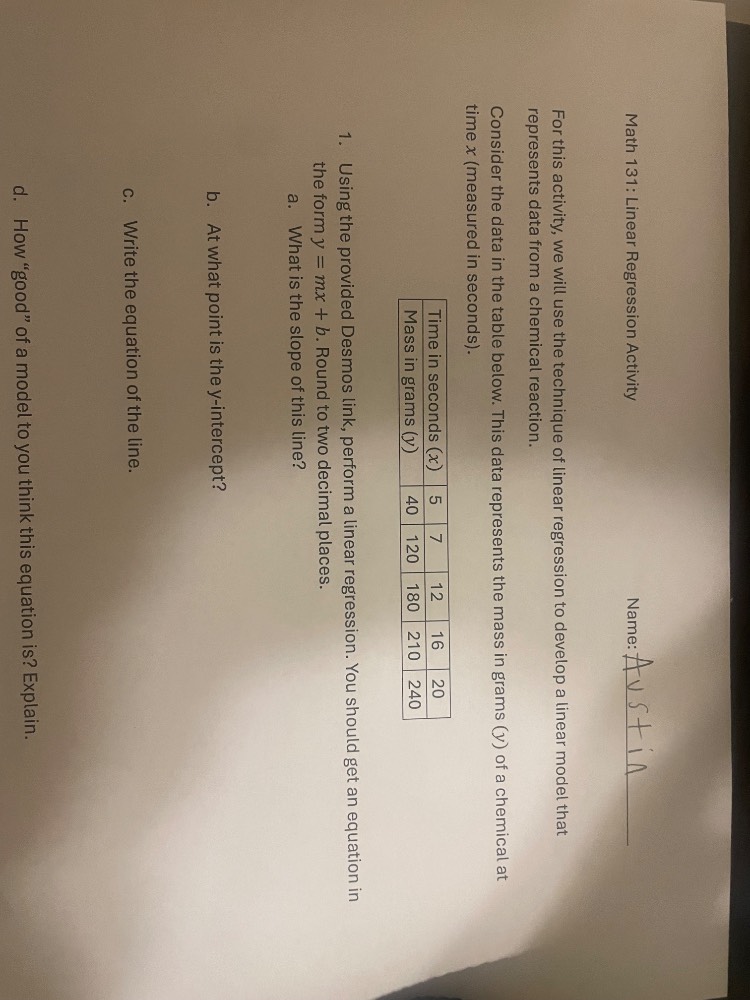
math 131: linear regression activity
name: austin
for this activity, we will use the technique of linear regression to develop a linear model that represents data from a chemical reaction.
consider the data in the table below. this data represents the mass in grams (y) of a chemical at time x (measured in seconds).
| time in seconds (x) | 5 | 7 | 12 | 16 | 20 |
|---|
- using the provided desmos link, perform a linear regression. you should get an equation in the form y = mx + b. round to two decimal places.
a. what is the slope of this line?
b. at what point is the y - intercept?
c. write the equation of the line.
d. how “good” of a model do you think this equation is? explain.
To solve this linear regression problem, we'll use the given data points \((x, y)\): \((5, 40)\), \((7, 120)\), \((12, 180)\), \((16, 210)\), \((20, 240)\). We can use the formula for the slope \(m\) of a line through points \((x_1,y_1)\) and \((x_2,y_2)\) is \(m=\frac{y_2 - y_1}{x_2 - x_1}\), and the \(y\)-intercept \(b=y - mx\). We can also use a calculator or software (like Desmos) for linear regression.
Part (a): Slope of the line
We first find the mean of \(x\) values (\(\bar{x}\)) and mean of \(y\) values (\(\bar{y}\)):
- \(x\) values: \(5,7,12,16,20\)
\(\bar{x}=\frac{5 + 7+12 + 16+20}{5}=\frac{60}{5} = 12\)
- \(y\) values: \(40,120,180,210,240\)
\(\bar{y}=\frac{40+120 + 180+210+240}{5}=\frac{790}{5}=158\)
The formula for the slope \(m\) in linear regression is \(m=\frac{\sum_{i = 1}^{n}(x_i-\bar{x})(y_i-\bar{y})}{\sum_{i=1}^{n}(x_i - \bar{x})^2}\)
- Calculate \((x_i-\bar{x})(y_i-\bar{y})\) for each \(i\):
- For \(i = 1\) (\(x = 5,y = 40\)): \((5 - 12)(40 - 158)=(-7)\times(-118)=826\)
- For \(i = 2\) (\(x = 7,y = 120\)): \((7 - 12)(120 - 158)=(-5)\times(-38)=190\)
- For \(i = 3\) (\(x = 12,y = 180\)): \((12 - 12)(180 - 158)=0\times22 = 0\)
- For \(i = 4\) (\(x = 16,y = 210\)): \((16 - 12)(210 - 158)=4\times52 = 208\)
- For \(i = 5\) (\(x = 20,y = 240\)): \((20 - 12)(240 - 158)=8\times82 = 656\)
\(\sum_{i = 1}^{5}(x_i-\bar{x})(y_i-\bar{y})=826+190 + 0+208+656=1880\)
- Calculate \((x_i-\bar{x})^2\) for each \(i\):
- For \(i = 1\): \((5 - 12)^2=(-7)^2 = 49\)
- For \(i = 2\): \((7 - 12)^2=(-5)^2 = 25\)
- For \(i = 3\): \((12 - 12)^2=0^2 = 0\)
- For \(i = 4\): \((16 - 12)^2=4^2 = 16\)
- For \(i = 5\): \((20 - 12)^2=8^2 = 64\)
\(\sum_{i = 1}^{5}(x_i-\bar{x})^2=49+25 + 0+16+64=154\)
- Then the slope \(m=\frac{1880}{154}\approx12.21\) (rounded to two decimal places)
Part (b): \(y\)-intercept
We use the formula \(b=\bar{y}-m\bar{x}\)
We know that \(\bar{y} = 158\), \(m\approx12.21\) and \(\bar{x}=12\)
\(b=158-12.21\times12\)
\(b=158 - 146.52=11.48\)
Part (c): Equation of the line
The equation of a line in slope - intercept form is \(y=mx + b\)
Substituting \(m\approx12.21\) and \(b = 11.48\) into the equation, we get \(y=12.21x+11.48\)
Part (d): Goodness of the model
To determine how "good" the model is, we can look at the correlation coefficient \(r\). The formula for the correlation coefficient \(r\) is \(r=\frac{\sum_{i = 1}^{n}(x_i-\bar{x})(y_i-\bar{y})}{\sqrt{\sum_{i = 1}^{n}(x_i-\bar{x})^2\sum_{i = 1}^{n}(y_i-\bar{y})^2}}\)
First, calculate \(\sum_{i = 1}^{n}(y_i-\bar{y})^2\):
- \((40 - 158)^2=(-118)^2 = 13924\)
- \((120 - 158)^2=(-38)^2 = 1444\)
- \((180 - 158)^2=(22)^2 = 484\)
- \((210 - 158)^2=(52)^2 = 2704\)
- \((240 - 158)^2=(82)^2 = 6724\)
\(\sum_{i = 1}^{5}(y_i-\bar{y})^2=13924+1444 + 484+2704+6724=25280\)
Then \(r=\frac{1880}{\sqrt{154\times25280}}\)
\(\sqrt{154\times25280}=\sqrt{3893120}\approx1973.1\)
\(r=\frac{1880}{1973.1}\approx0.95\)
Since \(r\approx0.95\) is close to \(1\), the linear model is a good fit because a correlation coefficient close to \(1\) (or \(- 1\)) indicates a strong linear relationship between the variables \(x\) (time) and \(y\) (mass).
Final Answers
a. The slope of the line is \(\boldsymbol{12.21}\)
b. The \(y\)-intercept is \(\boldsymbol{11.48}\)
c. The equation of the line is \(\boldsymbol{y = 12.21x+11.48}\)
d. The model is good because the correlation coefficient \(r\approx0.95\) (close to \(1\)), indicating a strong linear relationship between time and mass.

Snap & solve any problem in the app
Get step-by-step solutions on Sovi AI
Photo-based solutions with guided steps
Explore more problems and detailed explanations
To solve this linear regression problem, we'll use the given data points \((x, y)\): \((5, 40)\), \((7, 120)\), \((12, 180)\), \((16, 210)\), \((20, 240)\). We can use the formula for the slope \(m\) of a line through points \((x_1,y_1)\) and \((x_2,y_2)\) is \(m=\frac{y_2 - y_1}{x_2 - x_1}\), and the \(y\)-intercept \(b=y - mx\). We can also use a calculator or software (like Desmos) for linear regression.
Part (a): Slope of the line
We first find the mean of \(x\) values (\(\bar{x}\)) and mean of \(y\) values (\(\bar{y}\)):
- \(x\) values: \(5,7,12,16,20\)
\(\bar{x}=\frac{5 + 7+12 + 16+20}{5}=\frac{60}{5} = 12\)
- \(y\) values: \(40,120,180,210,240\)
\(\bar{y}=\frac{40+120 + 180+210+240}{5}=\frac{790}{5}=158\)
The formula for the slope \(m\) in linear regression is \(m=\frac{\sum_{i = 1}^{n}(x_i-\bar{x})(y_i-\bar{y})}{\sum_{i=1}^{n}(x_i - \bar{x})^2}\)
- Calculate \((x_i-\bar{x})(y_i-\bar{y})\) for each \(i\):
- For \(i = 1\) (\(x = 5,y = 40\)): \((5 - 12)(40 - 158)=(-7)\times(-118)=826\)
- For \(i = 2\) (\(x = 7,y = 120\)): \((7 - 12)(120 - 158)=(-5)\times(-38)=190\)
- For \(i = 3\) (\(x = 12,y = 180\)): \((12 - 12)(180 - 158)=0\times22 = 0\)
- For \(i = 4\) (\(x = 16,y = 210\)): \((16 - 12)(210 - 158)=4\times52 = 208\)
- For \(i = 5\) (\(x = 20,y = 240\)): \((20 - 12)(240 - 158)=8\times82 = 656\)
\(\sum_{i = 1}^{5}(x_i-\bar{x})(y_i-\bar{y})=826+190 + 0+208+656=1880\)
- Calculate \((x_i-\bar{x})^2\) for each \(i\):
- For \(i = 1\): \((5 - 12)^2=(-7)^2 = 49\)
- For \(i = 2\): \((7 - 12)^2=(-5)^2 = 25\)
- For \(i = 3\): \((12 - 12)^2=0^2 = 0\)
- For \(i = 4\): \((16 - 12)^2=4^2 = 16\)
- For \(i = 5\): \((20 - 12)^2=8^2 = 64\)
\(\sum_{i = 1}^{5}(x_i-\bar{x})^2=49+25 + 0+16+64=154\)
- Then the slope \(m=\frac{1880}{154}\approx12.21\) (rounded to two decimal places)
Part (b): \(y\)-intercept
We use the formula \(b=\bar{y}-m\bar{x}\)
We know that \(\bar{y} = 158\), \(m\approx12.21\) and \(\bar{x}=12\)
\(b=158-12.21\times12\)
\(b=158 - 146.52=11.48\)
Part (c): Equation of the line
The equation of a line in slope - intercept form is \(y=mx + b\)
Substituting \(m\approx12.21\) and \(b = 11.48\) into the equation, we get \(y=12.21x+11.48\)
Part (d): Goodness of the model
To determine how "good" the model is, we can look at the correlation coefficient \(r\). The formula for the correlation coefficient \(r\) is \(r=\frac{\sum_{i = 1}^{n}(x_i-\bar{x})(y_i-\bar{y})}{\sqrt{\sum_{i = 1}^{n}(x_i-\bar{x})^2\sum_{i = 1}^{n}(y_i-\bar{y})^2}}\)
First, calculate \(\sum_{i = 1}^{n}(y_i-\bar{y})^2\):
- \((40 - 158)^2=(-118)^2 = 13924\)
- \((120 - 158)^2=(-38)^2 = 1444\)
- \((180 - 158)^2=(22)^2 = 484\)
- \((210 - 158)^2=(52)^2 = 2704\)
- \((240 - 158)^2=(82)^2 = 6724\)
\(\sum_{i = 1}^{5}(y_i-\bar{y})^2=13924+1444 + 484+2704+6724=25280\)
Then \(r=\frac{1880}{\sqrt{154\times25280}}\)
\(\sqrt{154\times25280}=\sqrt{3893120}\approx1973.1\)
\(r=\frac{1880}{1973.1}\approx0.95\)
Since \(r\approx0.95\) is close to \(1\), the linear model is a good fit because a correlation coefficient close to \(1\) (or \(- 1\)) indicates a strong linear relationship between the variables \(x\) (time) and \(y\) (mass).
Final Answers
a. The slope of the line is \(\boldsymbol{12.21}\)
b. The \(y\)-intercept is \(\boldsymbol{11.48}\)
c. The equation of the line is \(\boldsymbol{y = 12.21x+11.48}\)
d. The model is good because the correlation coefficient \(r\approx0.95\) (close to \(1\)), indicating a strong linear relationship between time and mass.