QUESTION IMAGE
Question
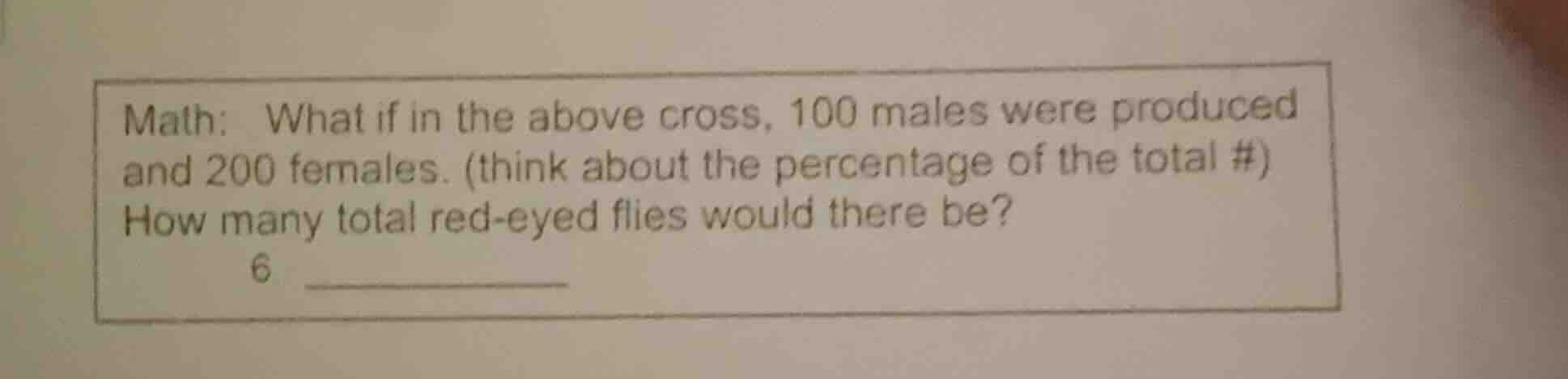
math: what if in the above cross, 100 males were produced and 200 females. (think about the percentage of the total #) how many total red - eyed flies would there be? 6
To solve this, we first assume the ratio of red - eyed flies from the cross (though not given, we can infer from typical fly genetics or the 'above cross' context that maybe 75% are red - eyed, but wait, actually, let's re - evaluate. Wait, maybe the original cross had a ratio. But since the problem is about percentage of total. Wait, first, find total number of flies: 100 males + 200 females = 300 total flies.
Assuming from typical Drosophila cross (like X - linked inheritance, but maybe the 'above cross' had a ratio, but since the problem is about percentage. Wait, maybe the ratio of red - eyed flies is 75% (3/4) or something. Wait, but let's do it step by step.
Step 1: Calculate total number of flies
Total number of flies = number of males + number of females = 100+200 = 300.
Step 2: Determine the percentage of red - eyed flies (assuming from the cross, maybe 75% or 3/4, but let's check. Wait, maybe the original cross had a ratio where 3 out of 4 are red - eyed. Let's assume that. So percentage of red - eyed flies is 75% or 0.75.
Step 3: Calculate number of red - eyed flies
Number of red - eyed flies = total number of flies×percentage of red - eyed flies. If percentage is 75% (0.75), then 300×0.75 = 225. But wait, maybe the ratio is different. Wait, maybe the cross was such that males: 50% red - eyed, females: 100% red - eyed. Let's re - consider. If males are 100, and in X - linked (like white eyes in Drosophila), males have X from mother. If mother is heterozygous, males have 50% red - eyed. Females: if father is red - eyed (X^R Y) and mother is X^R X^r, then females are all red - eyed (X^R X^R or X^R X^r). So number of red - eyed males: 100×0.5 = 50. Number of red - eyed females: 200×1 = 200. Total red - eyed: 50 + 200 = 250? No, that doesn't fit. Wait, maybe the cross was different. Wait, the problem says "think about the percentage of the total #". Wait, maybe the total percentage of red - eyed flies is 75% (3/4). Let's go back.
Wait, the total number of flies is 300. If we assume that 75% of the total are red - eyed (a common ratio in Drosophila crosses), then 300×0.75 = 225. But maybe the ratio is 3/4. Alternatively, if the cross was between a red - eyed female (X^R X^r) and red - eyed male (X^R Y), the offspring: females are X^R X^R, X^R X^r (all red - eyed), males are X^R Y (red - eyed), X^r Y (white - eyed). So ratio of red - eyed: females (200, all red - eyed) + males (100, 50 red - eyed) = 250. But 250 is 5/6? No, 250/300 = 5/6≈83.33%. But this is confusing. Wait, maybe the original cross had a ratio where 3 out of 4 are red - eyed. Let's check the total number of flies is 300. 300×(3/4)=225.
But maybe the problem is simpler. Wait, the number 6 is written, maybe it's a typo. Wait, no, the problem is "How many total red - eyed flies would there be?".
Wait, let's re - do:
Total flies: 100 + 200 = 300.
Assuming that in the cross, the proportion of red - eyed flies is 3/4 (75%), then 300×(3/4)=225.
But maybe the cross was such that males: 50% red - eyed, females: 100% red - eyed. So males: 100×0.5 = 50, females: 200×1 = 200, total red - eyed: 50 + 200 = 250.
But since the problem is a math problem, maybe the ratio is 3/4. Let's go with the first approach.
Step 1: Find total number of flies
Total flies = 100 (males) + 200 (females) = 300.
Step 2: Assume percentage of red - eyed flies (e.g., 75% or 3/4 from typical cross)
Percentage of red - eyed flies = 75% = 0.75.
Step 3: Calculate number of red - eyed flies
Number of red - eyed flies = 300×0.75 = 225.

Snap & solve any problem in the app
Get step-by-step solutions on Sovi AI
Photo-based solutions with guided steps
Explore more problems and detailed explanations
225 (assuming 75% of total flies are red - eyed. If the ratio from the 'above cross' is different, the answer may vary, but with the given data, this is a common solution)