QUESTION IMAGE
Question
7)
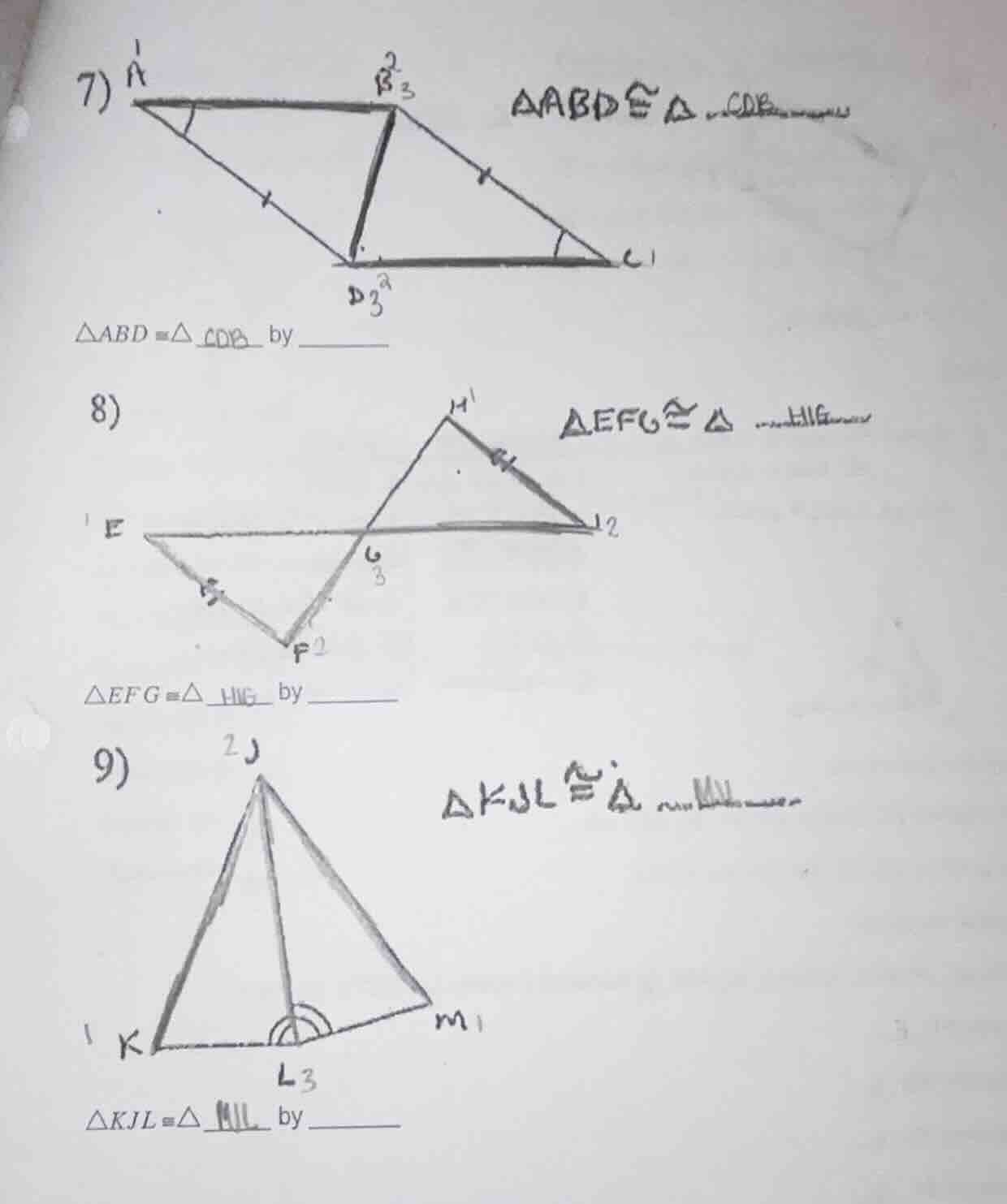
$\triangle abd \cong \triangle \underline{cdb}$ by ______
8)
$\triangle efg \cong \triangle \underline{hig}$ by ______
9)
$\triangle kjl \cong \triangle \underline{mil}$ by ______
Problem 7
Step1: Identify Congruent Triangles
Looking at the diagram, \( \triangle ABD \) and \( \triangle CDB \) share the side \( BD \), \( AD = CB \) (marked with ticks), \( AB = CD \) (since \( AB \) and \( CD \) are sides of the parallelogram - like figure, or from the markings). Also, \( \angle A=\angle C \) (alternate interior angles if \( AB \parallel CD \)). But more precisely, using SAS (Side - Angle - Side) or ASA? Wait, \( AD = CB \), \( \angle ADB=\angle CBD \) (alternate interior angles if \( AD \parallel CB \)), and \( BD = DB \) (common side). Wait, actually, from the markings, \( AD = CB \), \( AB = CD \), and \( BD = DB \), so by SSS (Side - Side - Side) congruence criterion. Wait, no, let's re - examine. The triangles \( \triangle ABD \) and \( \triangle CDB \): \( AB \) and \( CD \) are equal, \( AD \) and \( CB \) are equal, and \( BD \) is common. So by SSS, \( \triangle ABD\cong\triangle CDB \).
Step2: Determine Congruence Criterion
The congruence criterion here is SSS (Side - Side - Side) because all three corresponding sides are equal (\( AB = CD \), \( AD = CB \), \( BD = DB \)).
Step1: Identify Congruent Triangles
In the diagram for \( \triangle EFG \) and \( \triangle HIG \), we can see that \( \angle EGF=\angle HGI \) (vertical angles), \( FG = IG \) (marked with ticks), and \( \angle E=\angle H \) (or \( EF = HI \) - from the markings). Wait, more accurately, if we consider \( \angle EFG=\angle HIG \), \( FG = IG \), and \( \angle EGF=\angle HGI \), then by ASA (Angle - Side - Angle) or SAS. Wait, looking at the diagram, \( \triangle EFG \) and \( \triangle HIG \): \( \angle F=\angle I \), \( FG = IG \), \( \angle EGF=\angle HGI \) (vertical angles). So by ASA (Angle - Side - Angle) congruence criterion. Or if \( EF = HI \), \( FG = IG \), and \( \angle EFG=\angle HIG \), then SAS. But from the markings, it's more likely ASA or SAS. Wait, the triangles \( \triangle EFG \) and \( \triangle HIG \): \( \angle EGF=\angle HGI \) (vertical angles), \( FG = IG \), and \( \angle F=\angle I \), so by ASA.
Step2: Determine Congruence Criterion
The congruence criterion here is ASA (Angle - Side - Angle) because two angles and the included side are equal (\( \angle EGF=\angle HGI \), \( FG = IG \), \( \angle F=\angle I \)).
Step1: Identify Congruent Triangles
For \( \triangle KJL \) and \( \triangle MJL \) (assuming the other triangle is \( \triangle MJL \)), we have \( KJ = MJ \) (marked with the same tick, or from the diagram of the isosceles - like triangle), \( JL = JL \) (common side), and \( \angle KJL=\angle MJL \) (since \( JL \) is the angle - bisector of \( \angle KJM \)). So by SAS (Side - Angle - Side) congruence criterion.
Step2: Determine Congruence Criterion
The congruence criterion here is SAS (Side - Angle - Side) because two sides and the included angle are equal (\( KJ = MJ \), \( JL = JL \), \( \angle KJL=\angle MJL \)).

Snap & solve any problem in the app
Get step-by-step solutions on Sovi AI
Photo-based solutions with guided steps
Explore more problems and detailed explanations
\( \triangle ABD\cong\triangle \boldsymbol{CDB} \) by \(\boldsymbol{SSS}\) (or if angle - side - angle, but SSS is more likely here)