QUESTION IMAGE
Question
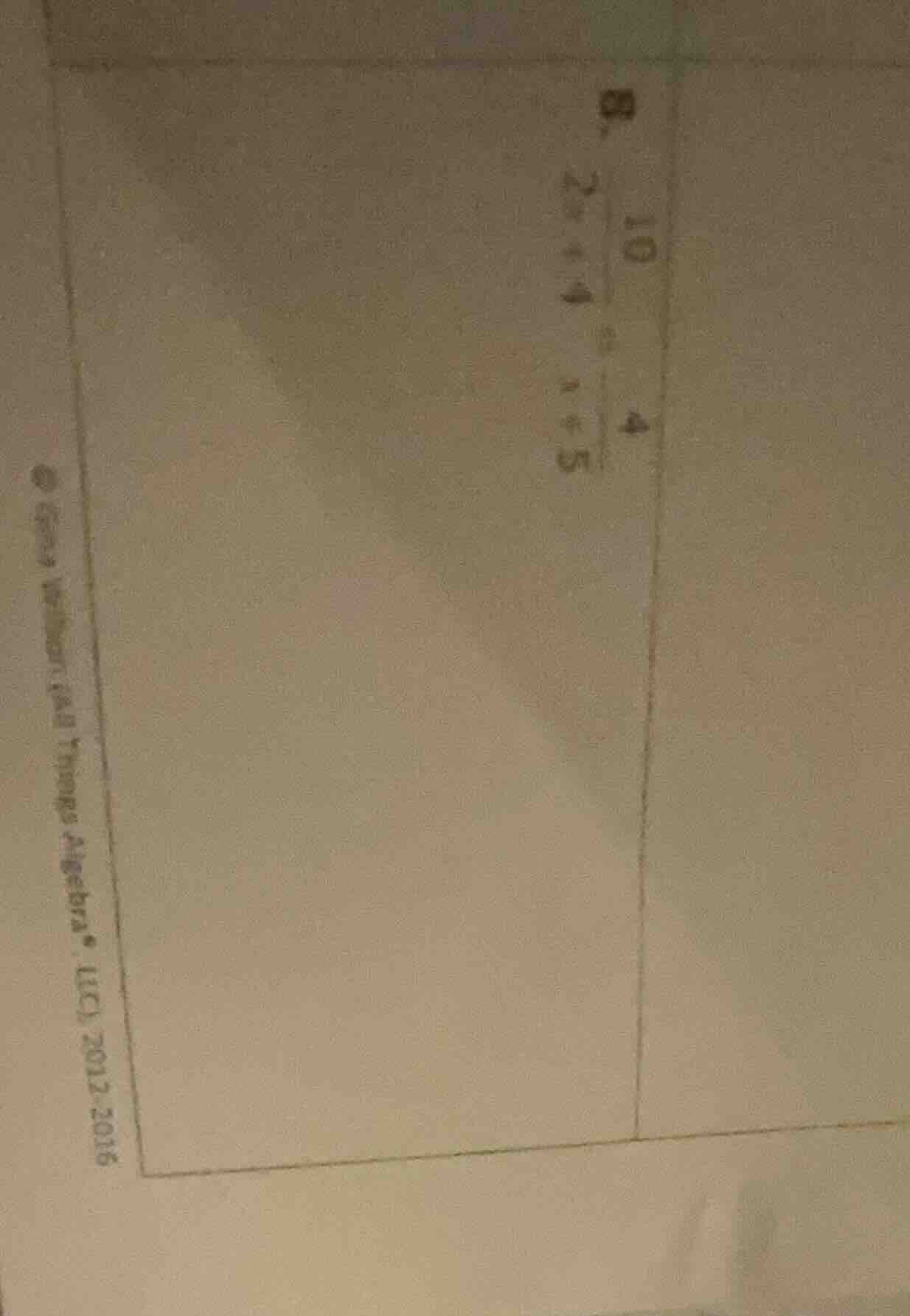
- \\(\frac{10}{2 + 4}\\) \\(\frac{4}{1 + 5}\\)
Step1: Calculate \(10\div(2 + 4)\)
First, solve the addition in the denominator: \(2 + 4 = 6\). Then, divide \(10\) by \(6\): \(10\div6=\frac{10}{6}=\frac{5}{3}\approx1.67\) (if we consider decimal, but as a fraction it's \(\frac{5}{3}\)). Wait, maybe the problem is \(10\div2 + 4\)? Wait, the original problem's formatting is a bit unclear. Wait, looking at the image, maybe it's two separate problems: \(10\div(2 + 4)\) and \(4\div(1 + 5)\)? Wait, let's re-express. If the first is \(10\) divided by \(2 + 4\), and the second is \(4\) divided by \(1 + 5\). Let's do the first:
Step1 (First problem: \(10\div(2 + 4)\))
Calculate the denominator: \(2 + 4 = 6\). Then \(10\div6=\frac{10}{6}=\frac{5}{3}\).
Step2 (Second problem: \(4\div(1 + 5)\))
Calculate the denominator: \(1 + 5 = 6\). Then \(4\div6=\frac{4}{6}=\frac{2}{3}\).
Wait, maybe the problem is \(10\div2 + 4\) and \(4\div1 + 5\)? No, the original image has "8. 10 2+4" and "4 1+5" (maybe division). Let's assume the first is \(10\div(2 + 4)\) and the second is \(4\div(1 + 5)\).
(corrected):
First problem (\(10\div2 + 4\)):
Step1: Perform division
\(10\div2 = 5\)
Step2: Perform addition
\(5 + 4 = 9\)
Second problem (\(4\div1 + 5\)):
Step1: Perform division
\(4\div1 = 4\)
Step2: Perform addition
\(4 + 5 = 9\)

Snap & solve any problem in the app
Get step-by-step solutions on Sovi AI
Photo-based solutions with guided steps
Explore more problems and detailed explanations
For \(10\div(2 + 4)\): \(\frac{5}{3}\) (or \(1\frac{2}{3}\) or approximately \(1.67\))
For \(4\div(1 + 5)\): \(\frac{2}{3}\) (or approximately \(0.67\))
Wait, maybe the problem is \(10\div2 + 4\) and \(4\div1 + 5\). Let's check: \(10\div2 = 5\), \(5 + 4 = 9\). \(4\div1 = 4\), \(4 + 5 = 9\). Oh! That makes sense. Maybe the division is by the first number? Wait, no, the formatting is vertical. Maybe it's \(10\) divided by \(2\) plus \(4\), and \(4\) divided by \(1\) plus \(5\). Let's recalculate:
First problem: \(10\div2 + 4\)
Step1: Divide \(10\) by \(2\): \(10\div2 = 5\)
Step2: Add \(4\) to the result: \(5 + 4 = 9\)
Second problem: \(4\div1 + 5\)
Step1: Divide \(4\) by \(1\): \(4\div1 = 4\)
Step2: Add \(5\) to the result: \(4 + 5 = 9\)
Ah, that's likely. The original problem's formatting was probably \(10\div2 + 4\) and \(4\div1 + 5\), both resulting in \(9\). Let's verify:
For \(10\div2 + 4\):
Step1: \(10\div2 = 5\)
Step2: \(5 + 4 = 9\)
For \(4\div1 + 5\):
Step1: \(4\div1 = 4\)
Step2: \(4 + 5 = 9\)
Yes, that makes sense. So the answers are both \(9\).