QUESTION IMAGE
Question
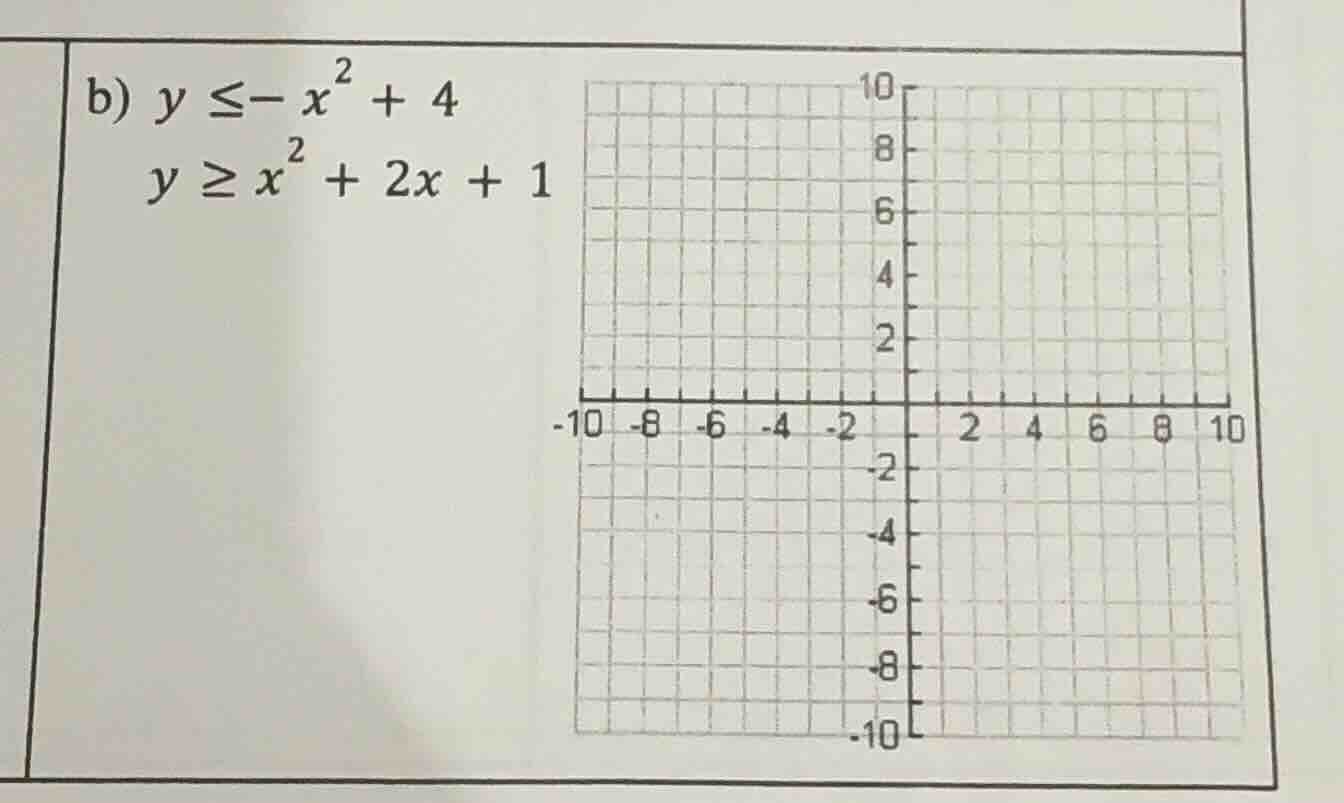
b) $y \leq -x^2 + 4$ $y \geq x^2 + 2x + 1$
Step1: Analyze \( y \leq -x^2 + 4 \)
This is a downward - opening parabola with vertex at \((0,4)\) and \(x\) - intercepts found by setting \(y = 0\):
\(0=-x^{2}+4\), so \(x^{2}=4\), \(x=\pm2\). The inequality \(y\leq - x^{2}+4\) represents the region below or on the parabola \(y=-x^{2}+4\).
Step2: Analyze \( y\geq x^{2}+2x + 1\)
First, rewrite \(y = x^{2}+2x + 1\) as \(y=(x + 1)^{2}\), which is an upward - opening parabola with vertex at \((-1,0)\). The inequality \(y\geq(x + 1)^{2}\) represents the region above or on the parabola \(y=(x + 1)^{2}\).
Step3: Find the intersection points of the two parabolas
Set \(-x^{2}+4=(x + 1)^{2}\)
Expand the right - hand side: \(-x^{2}+4=x^{2}+2x + 1\)
Bring all terms to one side: \(-x^{2}-x^{2}-2x+4 - 1 = 0\)
Simplify: \(-2x^{2}-2x + 3 = 0\), or \(2x^{2}+2x - 3 = 0\)
Use the quadratic formula \(x=\frac{-b\pm\sqrt{b^{2}-4ac}}{2a}\) for \(ax^{2}+bx + c = 0\). Here, \(a = 2\), \(b = 2\), \(c=-3\)
\(x=\frac{-2\pm\sqrt{2^{2}-4\times2\times(-3)}}{2\times2}=\frac{-2\pm\sqrt{4 + 24}}{4}=\frac{-2\pm\sqrt{28}}{4}=\frac{-2\pm2\sqrt{7}}{4}=\frac{-1\pm\sqrt{7}}{2}\)
\(\sqrt{7}\approx2.65\), so \(x_1=\frac{-1 + 2.65}{2}\approx0.82\), \(x_2=\frac{-1-2.65}{2}\approx - 1.82\)
For \(x=\frac{-1+\sqrt{7}}{2}\), \(y=-(\frac{-1 + \sqrt{7}}{2})^{2}+4\) (or \(y = (\frac{-1+\sqrt{7}}{2}+1)^{2}\))
For \(x=\frac{-1-\sqrt{7}}{2}\), \(y=-(\frac{-1-\sqrt{7}}{2})^{2}+4\) (or \(y = (\frac{-1-\sqrt{7}}{2}+1)^{2}\))
Step4: Graph the inequalities
- For \(y=-x^{2}+4\), plot the vertex \((0,4)\) and the \(x\) - intercepts \((2,0)\) and \((-2,0)\). Draw a solid line (since the inequality is \(\leq\)) and shade the region below the parabola.
- For \(y=(x + 1)^{2}\), plot the vertex \((-1,0)\). Since the coefficient of \(x^{2}\) is positive, the parabola opens upwards. Draw a solid line (since the inequality is \(\geq\)) and shade the region above the parabola.
The solution to the system of inequalities is the region that is shaded by both inequalities, i.e., the region that is below \(y=-x^{2}+4\) and above \(y=(x + 1)^{2}\) and between the intersection points of the two parabolas.

Snap & solve any problem in the app
Get step-by-step solutions on Sovi AI
Photo-based solutions with guided steps
Explore more problems and detailed explanations
The solution is the region bounded by the parabolas \(y = -x^{2}+4\) (below or on the curve) and \(y=(x + 1)^{2}\) (above or on the curve), between their intersection points \(x=\frac{-1-\sqrt{7}}{2}\approx - 1.82\) and \(x=\frac{-1+\sqrt{7}}{2}\approx0.82\). To graph it, draw the two parabolas as solid lines, shade the region below \(y=-x^{2}+4\) and above \(y=(x + 1)^{2}\) between the intersection points.