QUESTION IMAGE
Question
graph $g(x) = -2|x - 5| - 4$.
Step1: Recall the vertex form of absolute value function
The general form of an absolute value function is \( y = a|x - h| + k \), where \((h, k)\) is the vertex. For \( g(x)=-2|x - 5|-4 \), we identify \( h = 5 \) and \( k=-4 \), so the vertex is \((5, -4)\).
Step2: Determine the direction and vertical stretch
The coefficient \( a=-2 \). Since \( a<0 \), the graph opens downward. The absolute value of \( a \), \( |a| = 2 \), means the graph is vertically stretched by a factor of 2.
Step3: Find two points to plot
- For \( x = 5 \), \( g(5)=-2|5 - 5|-4=-4 \) (vertex).
- For \( x = 6 \), \( g(6)=-2|6 - 5|-4=-2(1)-4=-6 \)
- For \( x = 4 \), \( g(4)=-2|4 - 5|-4=-2(1)-4=-6 \)
Now, plot the vertex \((5, -4)\) and the points \((6, -6)\) and \((4, -6)\), then draw the two rays (since it's an absolute value graph) with slope \( 2 \) (but downward, so slope \( -2 \) for \( x>5 \) and slope \( 2 \) for \( x<5 \)? Wait, no: the slope for \( x > h \) (here \( h = 5 \)) in \( y=a|x - h|+k \) is \( a \), and for \( x < h \) is \( -a \). Since \( a=-2 \), for \( x>5 \), slope is \( -2 \); for \( x<5 \), slope is \( 2 \). Wait, let's check with \( x = 6 \): from \( x = 5 \) (y=-4) to \( x = 6 \) (y=-6), the change in y is -2, change in x is 1, so slope is \( \frac{-6 - (-4)}{6 - 5}=\frac{-2}{1}=-2 \). For \( x = 4 \): from \( x = 5 \) (y=-4) to \( x = 4 \) (y=-6), change in y is -2, change in x is -1, slope is \( \frac{-6 - (-4)}{4 - 5}=\frac{-2}{-1}=2 \). So the left ray (x < 5) has slope 2, right ray (x > 5) has slope -2.
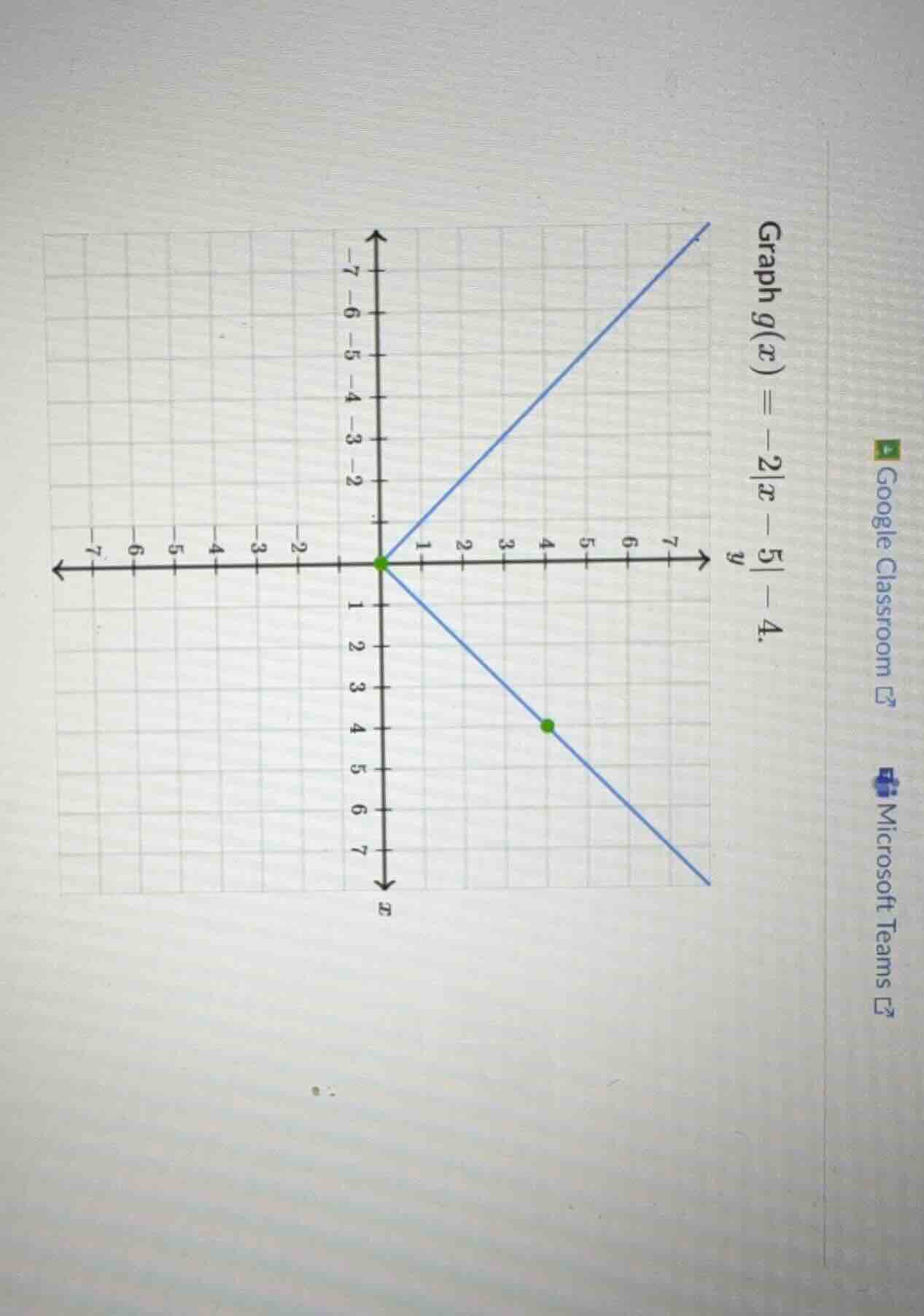
Wait, but the given graph in the image has vertex at (0,0), which is incorrect. The correct graph should have vertex at (5, -4). So to graph \( g(x)=-2|x - 5|-4 \):
- Plot the vertex (5, -4).
- For the right side (x ≥ 5), use slope -2: from (5, -4), go 1 unit right (x=6), 2 units down (y=-6) to (6, -6).
- For the left side (x ≤ 5), use slope 2: from (5, -4), go 1 unit left (x=4), 2 units down? Wait no, slope 2: change in y over change in x is 2. So from (5, -4), go 1 unit left (x=4), change in y is 2( -1 )? Wait no, slope = (y2 - y1)/(x2 - x1) = 2. So if x2 - x1 = -1 (x decreases by 1), then y2 - y1 = 2(-1) = -2? Wait no, slope 2 means (y2 - y1) = 2(x2 - x1). So if x2 = 4 (x1=5, x2 - x1 = -1), then y2 - y1 = 2(-1) = -2. So y2 = y1 - 2 = -4 - 2 = -6. So (4, -6) is correct. So the left ray (x ≤ 5) goes from (5, -4) through (4, -6), (3, -8), etc. The right ray (x ≥ 5) goes from (5, -4) through (6, -6), (7, -8), etc.
So the correct graph should have vertex at (5, -4), opening downward, with vertical stretch of 2. The given graph in the image is incorrect (vertex at (0,0)), so to graph \( g(x) \), follow the steps above.

Snap & solve any problem in the app
Get step-by-step solutions on Sovi AI
Photo-based solutions with guided steps
Explore more problems and detailed explanations
To graph \( g(x) = -2|x - 5| - 4 \):
- Identify the vertex: From \( y = a|x - h| + k \), \( h = 5 \), \( k = -4 \), so vertex is \( (5, -4) \).
- Determine direction/stretch: \( a = -2 \) (opens downward, vertical stretch by 2).
- Find points:
- For \( x = 5 \): \( g(5) = -4 \) (vertex).
- For \( x = 6 \): \( g(6) = -2|1| - 4 = -6 \) (point \( (6, -6) \)).
- For \( x = 4 \): \( g(4) = -2| -1 | - 4 = -6 \) (point \( (4, -6) \)).
- Draw the graph: Plot \( (5, -4) \), \( (4, -6) \), \( (6, -6) \), then draw two rays: left ray ( \( x \leq 5 \) ) with slope \( 2 \) (from \( (5, -4) \) to \( (4, -6) \)), right ray ( \( x \geq 5 \) ) with slope \( -2 \) (from \( (5, -4) \) to \( (6, -6) \)).