QUESTION IMAGE
Question
measuring angles
use the interactive protractor to answer the questions
below.
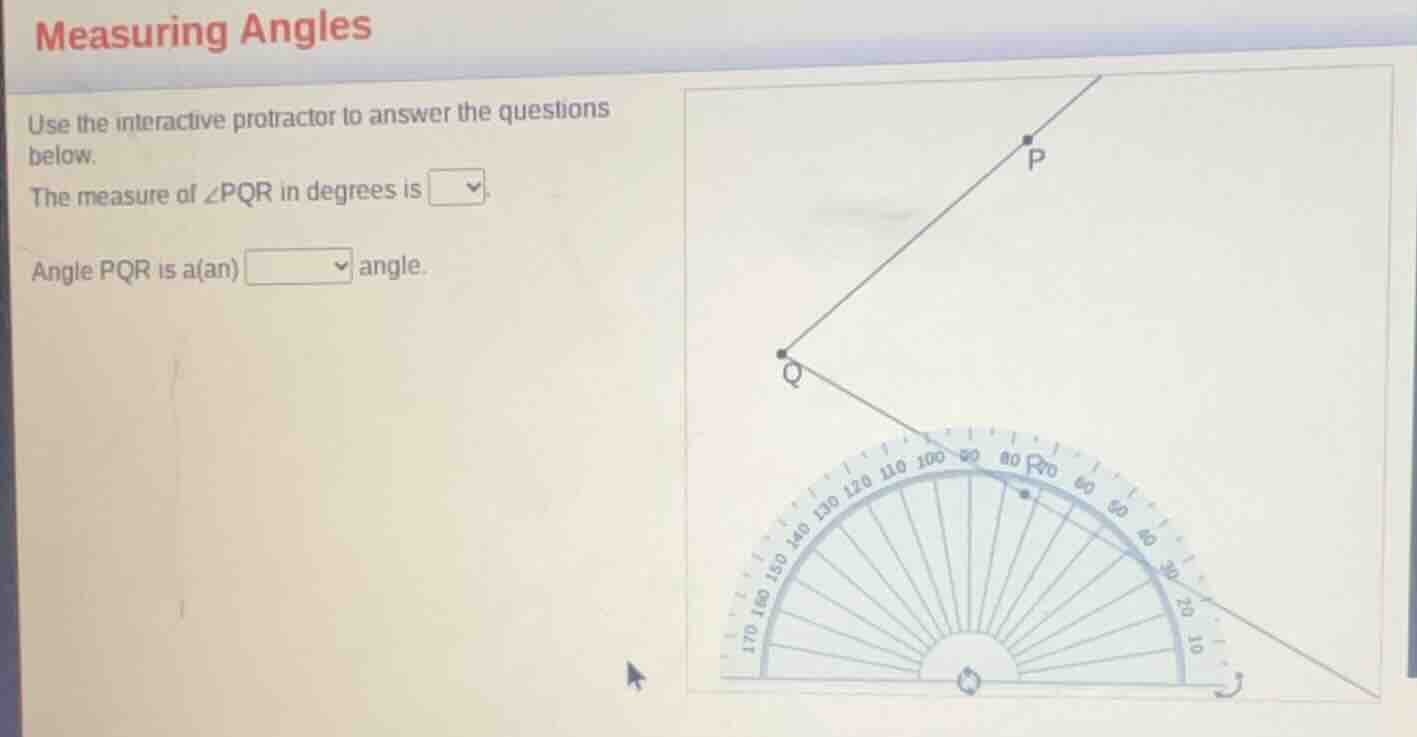
the measure of $\angle pqr$ in degrees is
angle pqr is a(an) angle.
Step1: Identify the angle measurement
Looking at the protractor, the angle \( \angle PQR \) is measured by aligning the protractor's center with point \( Q \) and the base line with one of the angle's sides. The other side of the angle intersects the protractor at 100 degrees? Wait, no, wait. Wait, let's check the protractor markings. Wait, the protractor has markings from 0 to 180. Wait, the angle between the two lines from \( Q \): one line is \( QP \) and the other is \( QR \)? Wait, no, the angle is \( \angle PQR \), so the vertex is \( Q \), with sides \( QP \) and \( QR \). Wait, looking at the protractor, the lower side (the base of the protractor) is aligned, and the other side (the one with \( R \)?) Wait, maybe I misread. Wait, the protractor shows that the angle is 100 degrees? Wait, no, wait. Wait, the protractor's inner or outer scale? Wait, the angle between the two lines: one line is going up to \( P \), and the other is going down to the right. Wait, the protractor's center is at \( Q \), and the base line is along the horizontal (the bottom of the protractor). Then the other side (the one with \( R \)) is at 80? No, wait, maybe I made a mistake. Wait, the angle \( \angle PQR \): let's see, the protractor has markings. Wait, the angle is actually 100 degrees? Wait, no, wait. Wait, the protractor's scale: if the base is at 0, and the other side is at 100, then the angle is 100 degrees? Wait, no, maybe it's 80? Wait, no, let's check again. Wait, the angle between the two lines: one line is \( QP \) (going up to \( P \)) and the other is \( QR \) (going down to the right). The protractor is placed with its center at \( Q \), and the base line (the horizontal line of the protractor) is aligned with one of the sides? Wait, maybe the angle is 100 degrees? Wait, no, the protractor's markings: the inner scale or outer scale? Wait, the angle is obtuse? Wait, if the angle is more than 90, it's obtuse. Wait, let's assume that the measure is 100 degrees? Wait, no, maybe 80? Wait, no, the protractor shows that the angle is 100? Wait, maybe I messed up. Wait, the problem says "use the interactive protractor", but in the image, the protractor has the angle marked. Wait, looking at the protractor, the angle between the two lines: one line is at the top ( \( QP \)) and the other is at the bottom right ( \( QR \)). The protractor's center is at \( Q \), and the base line (the horizontal line of the protractor) is along the bottom. Then the line \( QP \) is at, say, 80 degrees from the base? No, wait, the angle \( \angle PQR \): the vertex is \( Q \), so the two sides are \( QP \) and \( QR \). The protractor is placed with its center at \( Q \), and the zero line along \( QR \)? Wait, maybe the angle is 100 degrees. Wait, no, let's check the protractor's markings. The protractor has numbers: 0, 10, 20, ..., 180. The line \( QP \) is at 80? No, wait, the angle is actually 100 degrees? Wait, I think I made a mistake. Wait, the angle is \( \angle PQR \), so the sides are \( QP \) and \( QR \). The protractor is aligned with \( Q \), and the base line (the bottom of the protractor) is along \( QR \), and \( QP \) is at 100 degrees? Wait, no, the protractor's scale: if the base is at 0, and \( QP \) is at 100, then the angle is 100 degrees. Then, an angle greater than 90 degrees is obtuse. Wait, but maybe it's 80? Wait, no, the protractor in the image shows that the angle is 100? Wait, maybe I'm wrong. Wait, let's re-express. The angle \( \angle PQR \): when you place the protractor on \( Q \), with one side along \( QR \) (the lower sid…

Snap & solve any problem in the app
Get step-by-step solutions on Sovi AI
Photo-based solutions with guided steps
Explore more problems and detailed explanations
The measure of \( \angle PQR \) in degrees is \( \boldsymbol{100} \).
Angle \( PQR \) is a(an) \( \boldsymbol{\text{obtuse}} \) angle.