QUESTION IMAGE
Question
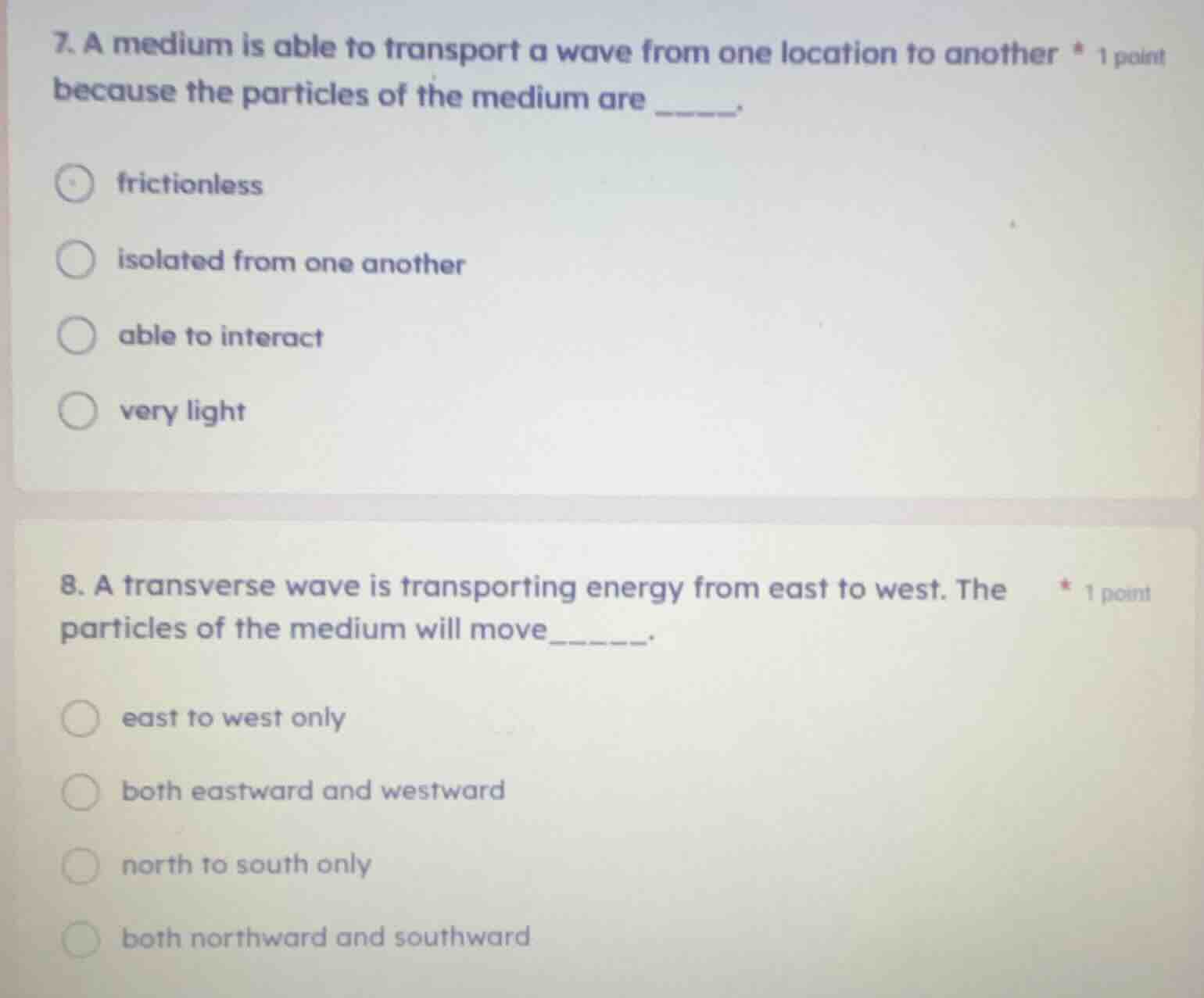
- a medium is able to transport a wave from one location to another because the particles of the medium are ______.
options: frictionless, isolated from one another, able to interact, very light
- a transverse wave is transporting energy from east to west. the particles of the medium will move______.
options: east to west only, both eastward and westward, north to south only, both northward and southward
Question 7
To determine why a medium can transport a wave, we analyze each option:
- "Frictionless" is not the key reason for wave transport; waves can exist in non - frictionless media.
- "Isolated from one another" would prevent wave transfer as interaction between particles is needed.
- "Able to interact" is correct. In a wave, energy is transferred through the interaction (like collisions or forces) between adjacent particles of the medium.
- "Very light" is irrelevant to the ability of the medium to transport a wave.
For a transverse wave, the particles of the medium vibrate perpendicular to the direction of wave energy transport. The wave is transporting energy from east to west (direction of wave propagation). So the particles must vibrate perpendicular to this direction, i.e., in a north - south (or south - north) direction. And in transverse wave motion, particles oscillate back and forth (both northward and southward) around their equilibrium positions.
- "East to west only" is the direction of wave energy transport, not particle motion.
- "Both eastward and westward" is parallel to wave propagation, not transverse.
- "North to south only" implies a one - way motion, but particles oscillate (back and forth).
- "Both northward and southward" is correct as particles vibrate perpendicular to wave direction (east - west) in a back - and - forth (north - south) manner.

Snap & solve any problem in the app
Get step-by-step solutions on Sovi AI
Photo-based solutions with guided steps
Explore more problems and detailed explanations
C. able to interact