QUESTION IMAGE
Question
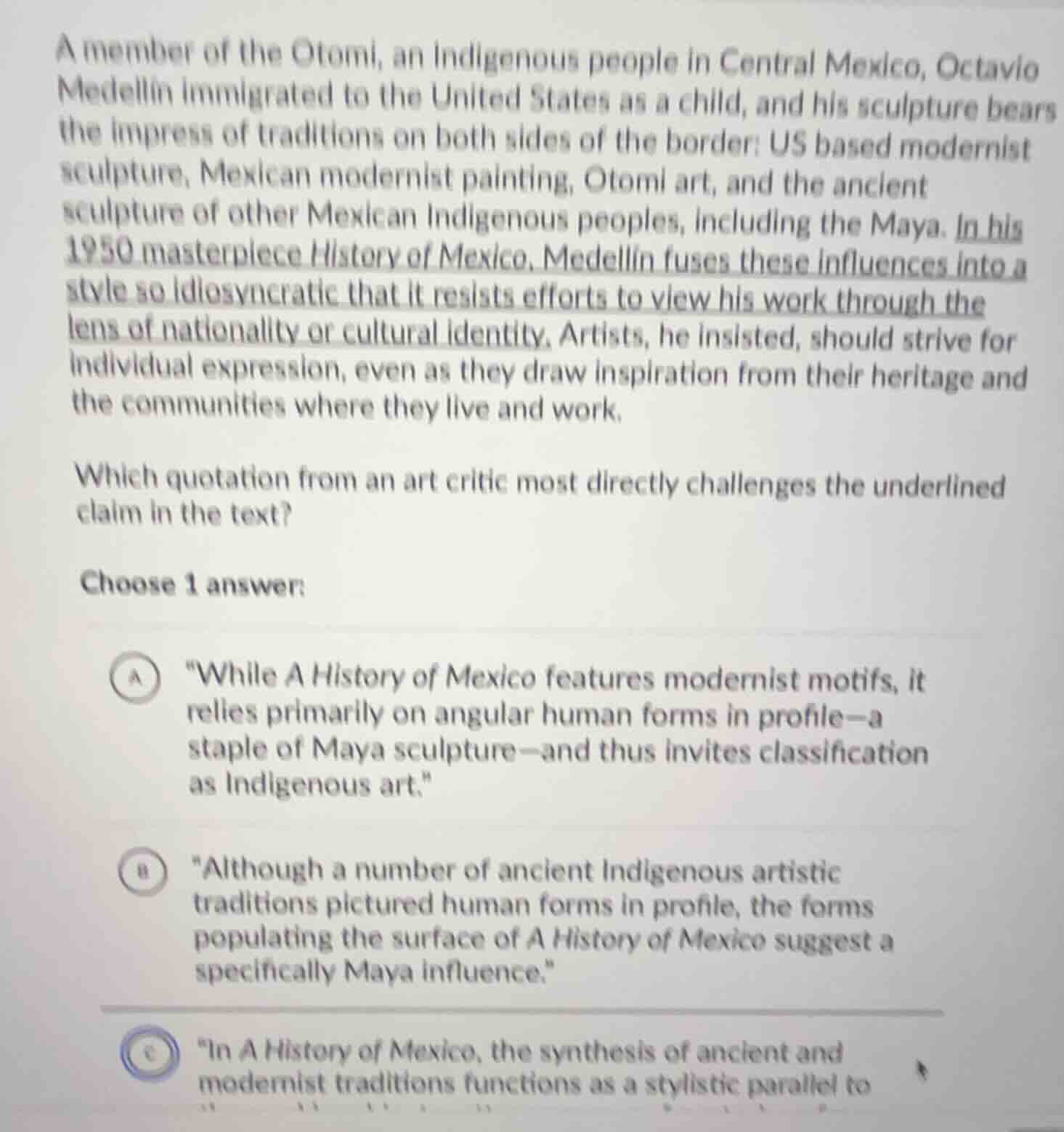
a member of the otomi, an indigenous people in central mexico, octavio medellín immigrated to the united states as a child, and his sculpture bears the impress of traditions on both sides of the border: us based modernist sculpture, mexican modernist painting, otomi art, and the ancient sculpture of other mexican indigenous peoples, including the maya. in his 1950 masterpiece history of mexico, medellín fuses these influences into a style so idiosyncratic that it resists efforts to view his work through the lens of nationality or cultural identity. artists, he insisted, should strive for individual expression, even as they draw inspiration from their heritage and the communities where they live and work. which quotation from an art critic most directly challenges the underlined claim in the text? choose 1 answer: a \while a history of mexico features modernist motifs, it relies primarily on angular human forms in profile—a staple of maya sculpture—and thus invites classification as indigenous art.\ b \although a number of ancient indigenous artistic traditions pictured human forms in profile, the forms populating the surface of a history of mexico suggest a specifically maya influence.\ c \in a history of mexico, the synthesis of ancient and modernist traditions functions as a stylistic parallel to
The underlined claim is that Medellín's work in History of Mexico resists being viewed through nationality/cultural identity. Option A claims the work can be classified as Indigenous art (a cultural identity - based classification), directly challenging the claim. Option B just identifies a Maya influence (not challenging the resistance to classification), and Option C's content (incomplete here) doesn't seem to challenge the claim. So A is the correct choice.

Snap & solve any problem in the app
Get step-by-step solutions on Sovi AI
Photo-based solutions with guided steps
Explore more problems and detailed explanations
A. "While A History of Mexico features modernist motifs, it relies primarily on angular human forms in profile—a staple of Maya sculpture—and thus invites classification as Indigenous art."