QUESTION IMAGE
Question
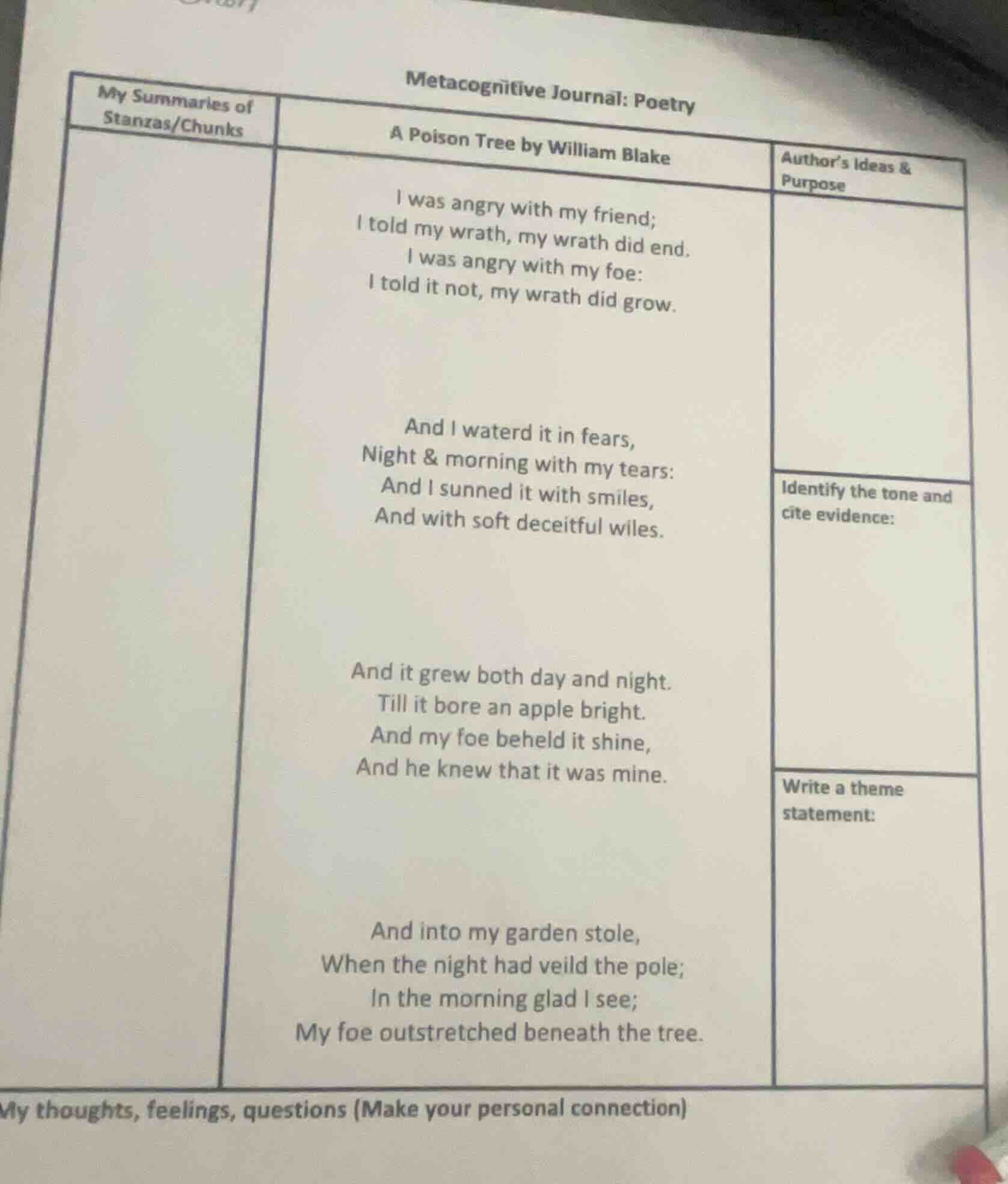
metacognitive journal: poetry
my summaries of stanzas/chunks\ta poison tree by william blake\tauthor’s ideas & purpose
\ti was angry with my friend;
i told my wrath, my wrath did end.
i was angry with my foe:
i told it not, my wrath did grow.
\t\t
\tand i waterd it in fears,
night & morning with my tears:
and i sunned it with smiles,
and with soft deceitful wiles.\tidentify the tone and cite evidence:
\tand it grew both day and night.
till it bore an apple bright.
and my foe beheld it shine,
and he knew that it was mine.\twrite a theme statement:
\tand into my garden stole,
when the night had veild the pole;
in the morning glad i see;
my foe outstretched beneath the tree.
my thoughts, feelings, questions (make your personal connection)
My Summaries of Stanzas/Chunks
- First Stanza: The speaker was angry with a friend and shared the anger, which then ended. But when angry with a foe, the speaker kept it hidden, so the anger grew.
- Second Stanza: The speaker nurtured the anger (represented as a "tree") with fear (watering with tears) and deceit (sunning with smiles and wiles).
- Third Stanza: The anger - tree grew day and night until it bore a bright apple. The foe saw the apple and knew it belonged to the speaker.
- Fourth Stanza: The foe stole into the garden at night to get the apple. In the morning, the speaker is glad to see the foe dead beneath the tree.
Author’s Ideas & Purpose
The author, William Blake, explores the nature of anger. The idea is that repressing anger (not telling the foe) leads to its growth, and the purpose is to show the destructive consequences of nurturing such repressed negative emotions.
Identify the tone and cite evidence:
- Tone: The tone is dark, vengeful, and somewhat secretive.
- Evidence:
- "I told it not, my wrath did grow" shows the secretive nurturing of anger.
- "And I waterd it in fears... And I sunned it with smiles, And with soft deceitful wiles" shows the devious way the speaker nurtures the anger.
- "In the morning glad I see; My foe outstretched beneath the tree" shows the vengeful satisfaction at the foe's death.
Write a theme statement:
When anger is repressed and nurtured through deceit and fear, it can grow into a destructive force that harms others and ultimately reveals the dark, vengeful nature of the one who harbors it.
My thoughts, feelings, questions (Make your personal connection)
- Thoughts: It's interesting how Blake uses the metaphor of a tree to represent anger. It makes the abstract emotion seem like a living, growing thing.
- Feelings: The poem makes me feel a bit uneasy because of the cold - blooded way the speaker deals with the foe. It's a stark reminder of how negative emotions can spiral out of control.
- Questions: I wonder if Blake is commenting on the social or moral implications of holding onto anger, and if there are other ways he could have portrayed the resolution of anger instead of the foe's death.

Snap & solve any problem in the app
Get step-by-step solutions on Sovi AI
Photo-based solutions with guided steps
Explore more problems and detailed explanations
My Summaries of Stanzas/Chunks
- First Stanza: The speaker was angry with a friend and shared the anger, which then ended. But when angry with a foe, the speaker kept it hidden, so the anger grew.
- Second Stanza: The speaker nurtured the anger (represented as a "tree") with fear (watering with tears) and deceit (sunning with smiles and wiles).
- Third Stanza: The anger - tree grew day and night until it bore a bright apple. The foe saw the apple and knew it belonged to the speaker.
- Fourth Stanza: The foe stole into the garden at night to get the apple. In the morning, the speaker is glad to see the foe dead beneath the tree.
Author’s Ideas & Purpose
The author, William Blake, explores the nature of anger. The idea is that repressing anger (not telling the foe) leads to its growth, and the purpose is to show the destructive consequences of nurturing such repressed negative emotions.
Identify the tone and cite evidence:
- Tone: The tone is dark, vengeful, and somewhat secretive.
- Evidence:
- "I told it not, my wrath did grow" shows the secretive nurturing of anger.
- "And I waterd it in fears... And I sunned it with smiles, And with soft deceitful wiles" shows the devious way the speaker nurtures the anger.
- "In the morning glad I see; My foe outstretched beneath the tree" shows the vengeful satisfaction at the foe's death.
Write a theme statement:
When anger is repressed and nurtured through deceit and fear, it can grow into a destructive force that harms others and ultimately reveals the dark, vengeful nature of the one who harbors it.
My thoughts, feelings, questions (Make your personal connection)
- Thoughts: It's interesting how Blake uses the metaphor of a tree to represent anger. It makes the abstract emotion seem like a living, growing thing.
- Feelings: The poem makes me feel a bit uneasy because of the cold - blooded way the speaker deals with the foe. It's a stark reminder of how negative emotions can spiral out of control.
- Questions: I wonder if Blake is commenting on the social or moral implications of holding onto anger, and if there are other ways he could have portrayed the resolution of anger instead of the foe's death.