QUESTION IMAGE
Question
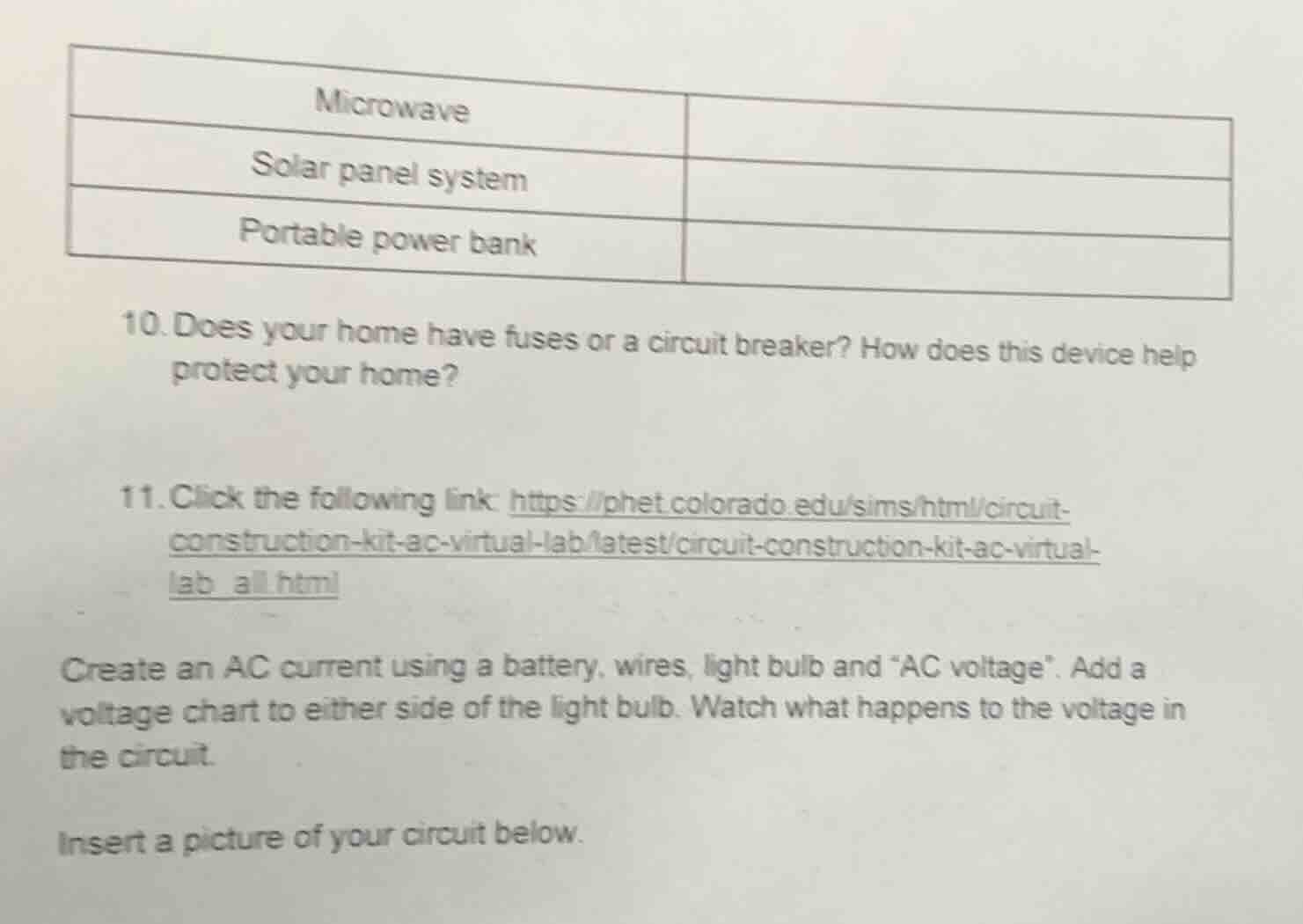
microwave
solar panel system
portable power bank
- does your home have fuses or a circuit breaker? how does this device help protect your home?
- click the following link: https://phet.colorado.edu/sims/html/circuit-construction-kit-ac-virtual-lab/latest/circuit-construction-kit-ac-virtual-lab_all.html
create an ac current using a battery, wires, light bulb and \ac voltage\. add a voltage chart to either side of the light bulb. watch what happens to the voltage in the circuit.
insert a picture of your circuit below.
For the table (energy type categorization):
- A microwave uses alternating current (AC) from the wall outlet to operate.
- A solar panel system generates direct current (DC) from sunlight, which can be converted to AC for home use, but the core output is DC.
- A portable power bank stores and supplies direct current (DC) to charge devices.
For question 10:
Fuses and circuit breakers are overcurrent protection devices. When an excessive current (from a short circuit or overloaded circuit) flows, a fuse's metal wire melts to break the circuit; a circuit breaker trips (switches off) to interrupt the current. Both prevent overheating of wires, which could cause fires or damage electrical devices.
For question 11:
- Access the provided PHET simulation link.
- Drag an AC voltage source (not a battery, as batteries produce DC) from the components menu, along with wires, a light bulb, and two voltage charts (voltmeters).
- Connect the AC voltage source, light bulb, and wires in a closed loop.
- Attach one voltage chart across the AC source and another across the light bulb.
- Activate the simulation: the voltage charts will show that the voltage oscillates sinusoidally (positive and negative values alternating) across both the source and the bulb, matching the nature of AC current. A visual of this circuit would show the closed loop with the AC source, bulb, and two voltmeters attached to either side of the bulb and the source.

Snap & solve any problem in the app
Get step-by-step solutions on Sovi AI
Photo-based solutions with guided steps
Explore more problems and detailed explanations
Completed Table:
| Device | Power Type (AC/DC) |
|---|---|
| Solar panel system | DC |
| Portable power bank | DC |
Question 10 Answer:
Most homes have either fuses or circuit breakers. These devices protect the home by detecting and interrupting excessive electrical current (caused by short circuits or overloaded circuits). Fuses melt a metal element to break the circuit, while circuit breakers trip a switch. Both prevent wire overheating, fire risks, and damage to electrical equipment.
Question 11 Answer:
- Open the PHET circuit simulation via the provided link.
- Use an AC voltage source (not a battery, as batteries produce DC), wires, a light bulb, and two voltage charts to build a closed circuit.
- Attach one voltage chart across the light bulb and one across the AC source.
- Run the simulation: the voltage charts will display a sinusoidal, oscillating voltage (swapping positive and negative values) across both the bulb and the source, demonstrating the alternating nature of the current.
(Note: A picture of the circuit would show a closed loop with the AC generator, light bulb, and two voltmeters connected in parallel to the bulb and generator respectively.)