QUESTION IMAGE
Question
mit 230: medical information management (4256_1021)
ch2 ehrs
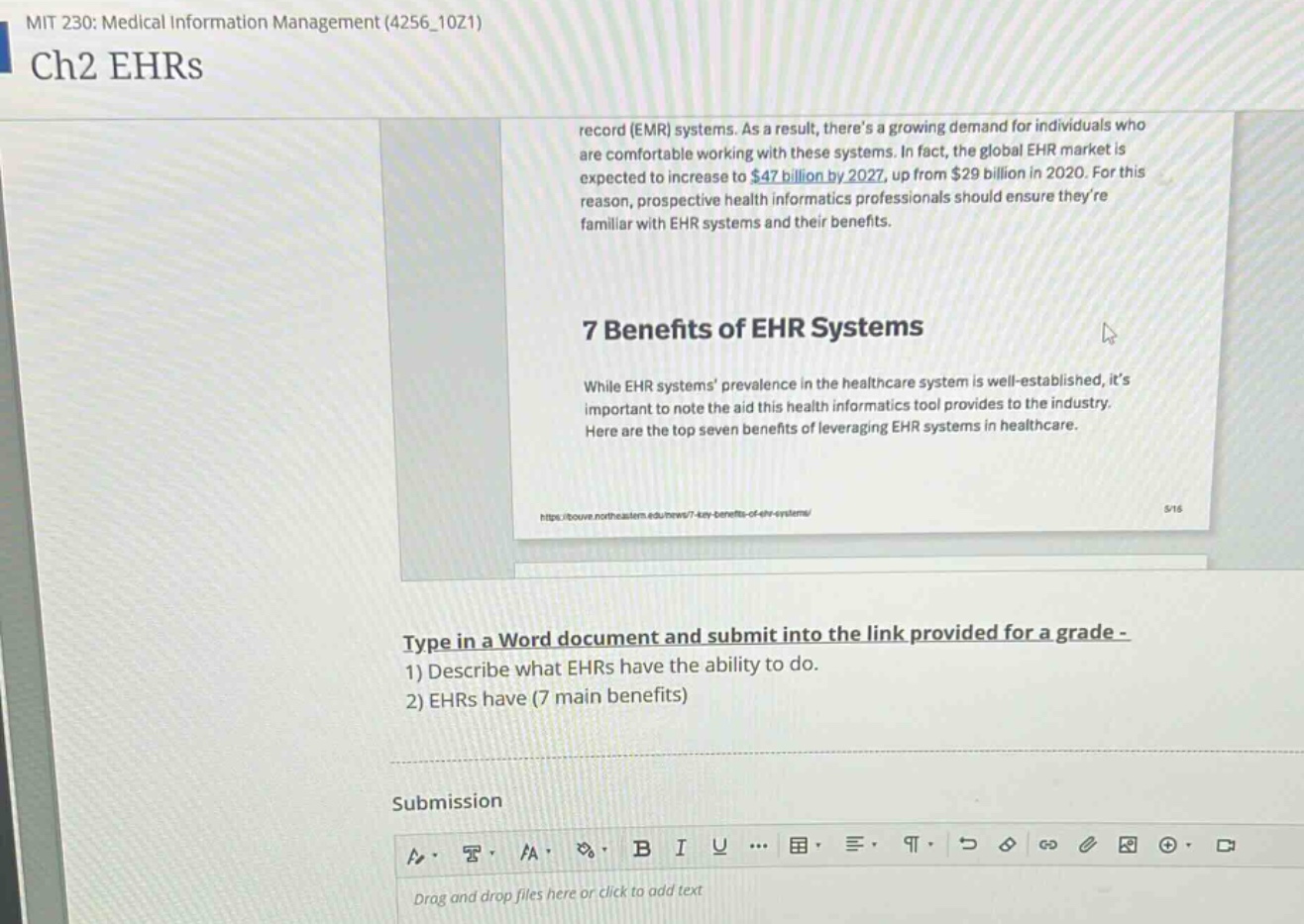
record (emr) systems. as a result, theres a growing demand for individuals who
are comfortable working with these systems. in fact, the global ehr market is
expected to increase to $47 billion by 2027, up from $29 billion in 2020. for this
reason, prospective health informatics professionals should ensure theyre
familiar with ehr systems and their benefits.
7 benefits of ehr systems
while ehr systems prevalence in the healthcare system is well - established, its
important to note the aid this health informatics tool provides to the industry.
here are the top seven benefits of leveraging ehr systems in healthcare.
https://www.northeastern.edu/graduate/blog/7 - key - benefits - of - ehr - systems/
5/16
type in a word document and submit into the link provided for a grade -
- describe what ehrs have the ability to do.
- ehrs have (7 main benefits)
submission
drag and drop files here or click to add text.
To answer these questions, we can refer to the context of Electronic Health Records (EHRs) and the provided link (https://www.northeastern.edu/graduate/blog/7-key-benefits-of-ehr-systems/) for detailed information. Here's a breakdown:
1) Describe what EHRs have the ability to do.
EHRs (Electronic Health Records) are digital versions of patients’ medical histories, diagnoses, medications, treatment plans, immunization dates, allergies, radiology images, and laboratory test results. They have the ability to:
- Centralize patient data: Aggregate health information from multiple sources (e.g., clinics, hospitals, labs) into a single, accessible record.
- Support clinical decision - making: Provide healthcare providers with real - time, comprehensive patient information to inform diagnoses, treatment plans, and medication management.
- Facilitate communication: Enable seamless sharing of patient information among authorized healthcare professionals (e.g., doctors, nurses, specialists) across different care settings.
- Improve care coordination: Help coordinate care for patients with complex health needs by ensuring all care team members have up - to - date information.
- Enhance patient engagement: Allow patients to access their own health records, view test results, and communicate with their care team (in some EHR systems).
- Streamline administrative tasks: Automate processes like billing, insurance claims, and appointment scheduling.
2) EHRs have (7 main benefits)
From the context and typical EHR benefit frameworks, the 7 key benefits of EHR systems (as likely outlined in the linked article) include:
- Improved Patient Care Coordination: EHRs enable different healthcare providers (e.g., primary care physicians, specialists, pharmacists) to access and update a patient’s health information in real - time. This ensures that everyone involved in a patient’s care has a complete and accurate picture of the patient’s medical history, reducing the risk of medical errors due to incomplete information.
- Enhanced Patient Safety: By providing instant access to a patient’s allergies, medication history, and pre - existing conditions, EHRs help prevent adverse drug interactions, duplicate tests, and other safety risks. They also include clinical decision support tools (e.g., alerts for drug allergies or contraindications) that further protect patients.
- Increased Efficiency in Healthcare Delivery: EHRs automate many administrative tasks, such as filling out forms, ordering tests, and sending prescriptions. This reduces the time healthcare providers spend on paperwork, allowing them to focus more on patient care. It also speeds up processes like test result retrieval and appointment scheduling.
- Better Population Health Management: Healthcare organizations can use EHR data to identify trends in patient populations (e.g., the prevalence of a certain disease in a community, or patterns of non - compliance with treatment). This data can be used to design targeted public health interventions, preventive care programs, and resource allocation strategies.
- Facilitated Regulatory Compliance and Reporting: EHRs make it easier for healthcare providers to meet regulatory requirements (e.g., for quality reporting, privacy standards like HIPAA) by providing structured data and audit trails. They can generate reports for regulatory bodies, insurance companies, and accreditation agencies more efficiently.
- Improved Financial Performance for Healthcare Organizations: By streamlining billing and c…

Snap & solve any problem in the app
Get step-by-step solutions on Sovi AI
Photo-based solutions with guided steps
Explore more problems and detailed explanations
To answer these questions, we can refer to the context of Electronic Health Records (EHRs) and the provided link (https://www.northeastern.edu/graduate/blog/7-key-benefits-of-ehr-systems/) for detailed information. Here's a breakdown:
1) Describe what EHRs have the ability to do.
EHRs (Electronic Health Records) are digital versions of patients’ medical histories, diagnoses, medications, treatment plans, immunization dates, allergies, radiology images, and laboratory test results. They have the ability to:
- Centralize patient data: Aggregate health information from multiple sources (e.g., clinics, hospitals, labs) into a single, accessible record.
- Support clinical decision - making: Provide healthcare providers with real - time, comprehensive patient information to inform diagnoses, treatment plans, and medication management.
- Facilitate communication: Enable seamless sharing of patient information among authorized healthcare professionals (e.g., doctors, nurses, specialists) across different care settings.
- Improve care coordination: Help coordinate care for patients with complex health needs by ensuring all care team members have up - to - date information.
- Enhance patient engagement: Allow patients to access their own health records, view test results, and communicate with their care team (in some EHR systems).
- Streamline administrative tasks: Automate processes like billing, insurance claims, and appointment scheduling.
2) EHRs have (7 main benefits)
From the context and typical EHR benefit frameworks, the 7 key benefits of EHR systems (as likely outlined in the linked article) include:
- Improved Patient Care Coordination: EHRs enable different healthcare providers (e.g., primary care physicians, specialists, pharmacists) to access and update a patient’s health information in real - time. This ensures that everyone involved in a patient’s care has a complete and accurate picture of the patient’s medical history, reducing the risk of medical errors due to incomplete information.
- Enhanced Patient Safety: By providing instant access to a patient’s allergies, medication history, and pre - existing conditions, EHRs help prevent adverse drug interactions, duplicate tests, and other safety risks. They also include clinical decision support tools (e.g., alerts for drug allergies or contraindications) that further protect patients.
- Increased Efficiency in Healthcare Delivery: EHRs automate many administrative tasks, such as filling out forms, ordering tests, and sending prescriptions. This reduces the time healthcare providers spend on paperwork, allowing them to focus more on patient care. It also speeds up processes like test result retrieval and appointment scheduling.
- Better Population Health Management: Healthcare organizations can use EHR data to identify trends in patient populations (e.g., the prevalence of a certain disease in a community, or patterns of non - compliance with treatment). This data can be used to design targeted public health interventions, preventive care programs, and resource allocation strategies.
- Facilitated Regulatory Compliance and Reporting: EHRs make it easier for healthcare providers to meet regulatory requirements (e.g., for quality reporting, privacy standards like HIPAA) by providing structured data and audit trails. They can generate reports for regulatory bodies, insurance companies, and accreditation agencies more efficiently.
- Improved Financial Performance for Healthcare Organizations: By streamlining billing and claims processes, reducing errors in coding, and improving revenue cycle management, EHRs can enhance the financial health of healthcare providers. Faster and more accurate claims submission also leads to quicker reimbursement from insurance companies.
- Empowered Patients: Many EHR systems offer patient portals that allow individuals to access their health records, view test results, schedule appointments, and communicate with their care team. This increased access to their own health information empowers patients to take a more active role in managing their health.
To get the exact wording and details of the 7 benefits, you should refer to the linked article (https://www.northeastern.edu/graduate/blog/7 - key - benefits - of - ehr - systems/).