QUESTION IMAGE
Question
module 1 quiz
100 points possible answered: 12/20
question 19
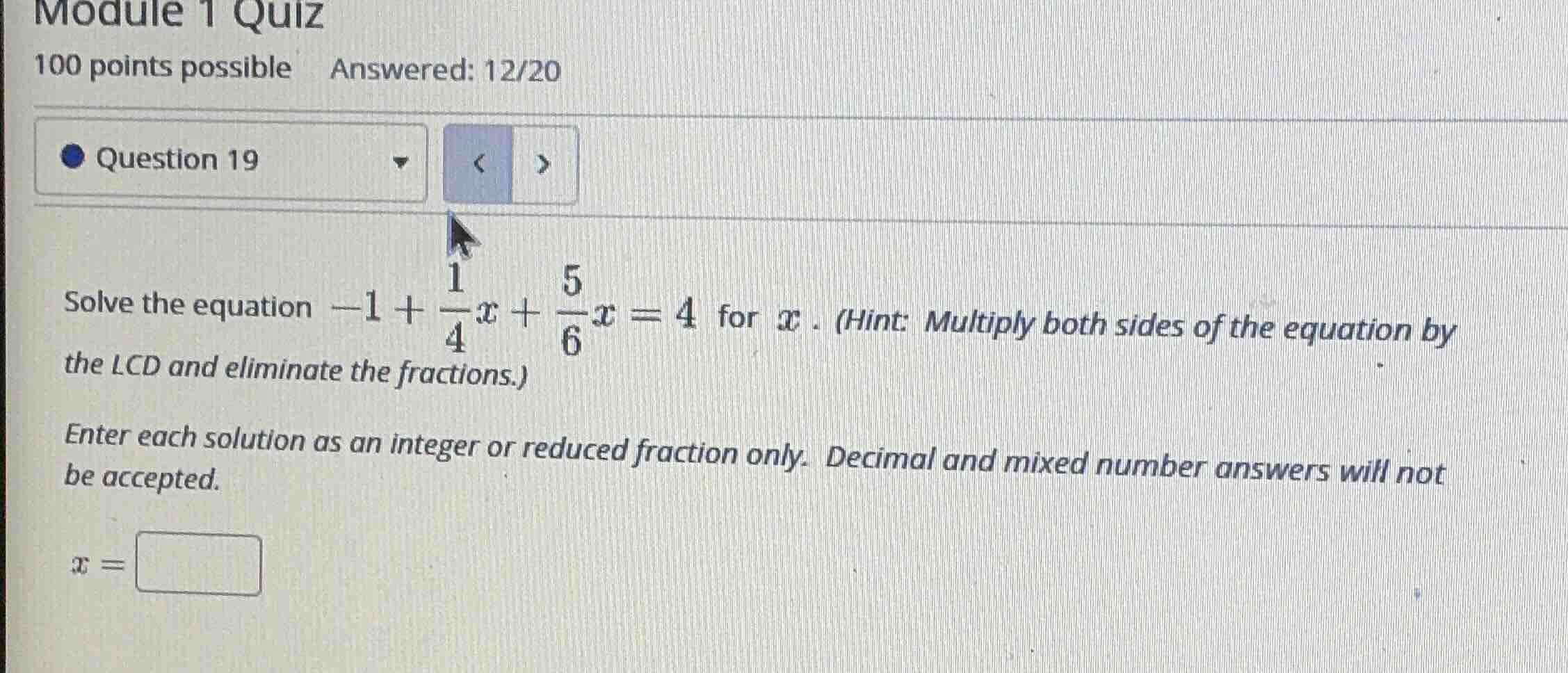
solve the equation $-1 + \frac{1}{4}x + \frac{5}{6}x = 4$ for $x$. (hint: multiply both sides of the equation by the lcd and eliminate the fractions.)
enter each solution as an integer or reduced fraction only. decimal and mixed number answers will not be accepted.
$x = \square$
Step1: Find the LCD of 4 and 6
The denominators are 4 and 6. Prime factors of 4: \(2^2\), prime factors of 6: \(2\times3\). So LCD is \(2^2\times3 = 12\).
Step2: Multiply each term by 12
Multiply each term in \(-1+\frac{1}{4}x+\frac{5}{6}x = 4\) by 12:
\(12\times(-1)+12\times\frac{1}{4}x + 12\times\frac{5}{6}x=12\times4\)
Simplify each term: \(-12 + 3x+10x = 48\)
Step3: Combine like terms
Combine \(3x\) and \(10x\): \(-12 + 13x = 48\)
Step4: Solve for x
Add 12 to both sides: \(13x = 48 + 12 = 60\)
Divide both sides by 13: \(x=\frac{60}{13}\)? Wait, no, wait: Wait, 48 + 12 is 60? Wait, no, -12 +13x=48, so 13x=48 +12=60? Wait, no, 48 +12 is 60? Wait, 48 +12 is 60? Wait, 124 is 48, 12(-1) is -12, 12(1/4)x is 3x, 12(5/6)x is 10x. So -12 +3x +10x =48. Then 3x +10x is 13x, so -12 +13x=48. Then 13x=48 +12=60? Wait, 48 +12 is 60? Yes. Then x=60/13? Wait, no, that can't be. Wait, did I make a mistake? Wait, no, let's check again. Wait, the original equation: -1 + (1/4)x + (5/6)x =4. Multiply by 12: 12(-1) = -12, 12(1/4)x=3x, 12(5/6)x=10x, 124=48. So -12 +3x +10x=48. Combine like terms: 13x -12=48. Add 12 to both sides: 13x=60. Then x=60/13? Wait, but 60 and 13 have no common factors, so x=60/13? Wait, but maybe I made a mistake in LCD? Wait, 4 and 6: LCD is 12, that's correct. 1/4 12=3, 5/6 12=10, correct. -112=-12, 412=48, correct. Then 3x +10x=13x, correct. Then -12 +13x=48, so 13x=60, so x=60/13? Wait, but 60 divided by 13 is about 4.615, but the problem says to enter as integer or reduced fraction. Wait, maybe I messed up the addition. Wait, 48 +12 is 60? Yes. So 13x=60, so x=60/13? Wait, but that seems odd. Wait, no, wait, the original equation: -1 + (1/4)x + (5/6)x =4. Let's combine the x terms first. (1/4 +5/6)x. Find common denominator for 4 and 6, which is 12. So (3/12 +10/12)x=13/12 x. So equation is -1 +13/12 x=4. Then 13/12 x=4 +1=5. Then x=5(12/13)=60/13. Oh! Wait, I see my mistake earlier. -1 +13/12 x=4, so 13/12 x=4 +1=5. Then x=5(12/13)=60/13? Wait, no, 4 +1 is 5? Wait, -1 + something =4, so something is 5. So 13/12 x=5. Then x=5(12/13)=60/13. Wait, but that's the same as before. Wait, but maybe the problem was written incorrectly? Wait, no, the user's problem is -1 + (1/4)x + (5/6)x =4. So let's do it again. Combine x terms: (1/4 +5/6)x = (3/12 +10/12)x=13/12 x. So equation: -1 +13/12 x=4. Add 1 to both sides: 13/12 x=5. Multiply both sides by 12/13: x=5(12/13)=60/13. Wait, but 60 and 13 are coprime, so x=60/13. But the problem says "Enter each solution as an integer or reduced fraction only". So 60/13 is a reduced fraction. Wait, but maybe I made a mistake in the sign? Wait, original equation: -1 + (1/4)x + (5/6)x =4. So moving -1 to the right: (1/4 +5/6)x=4 +1=5. Then (13/12)x=5. So x=5*(12/13)=60/13. Yes, that's correct.
Wait, but let's check with x=60/13. Plug into original equation: -1 + (1/4)(60/13) + (5/6)(60/13). Calculate each term: (1/4)(60/13)=15/13, (5/6)(60/13)=50/13. So -1 +15/13 +50/13= -1 + (65/13)= -1 +5=4. Yes, that works. So x=60/13.

Snap & solve any problem in the app
Get step-by-step solutions on Sovi AI
Photo-based solutions with guided steps
Explore more problems and detailed explanations
\(\frac{60}{13}\)