QUESTION IMAGE
Question
molecular masses
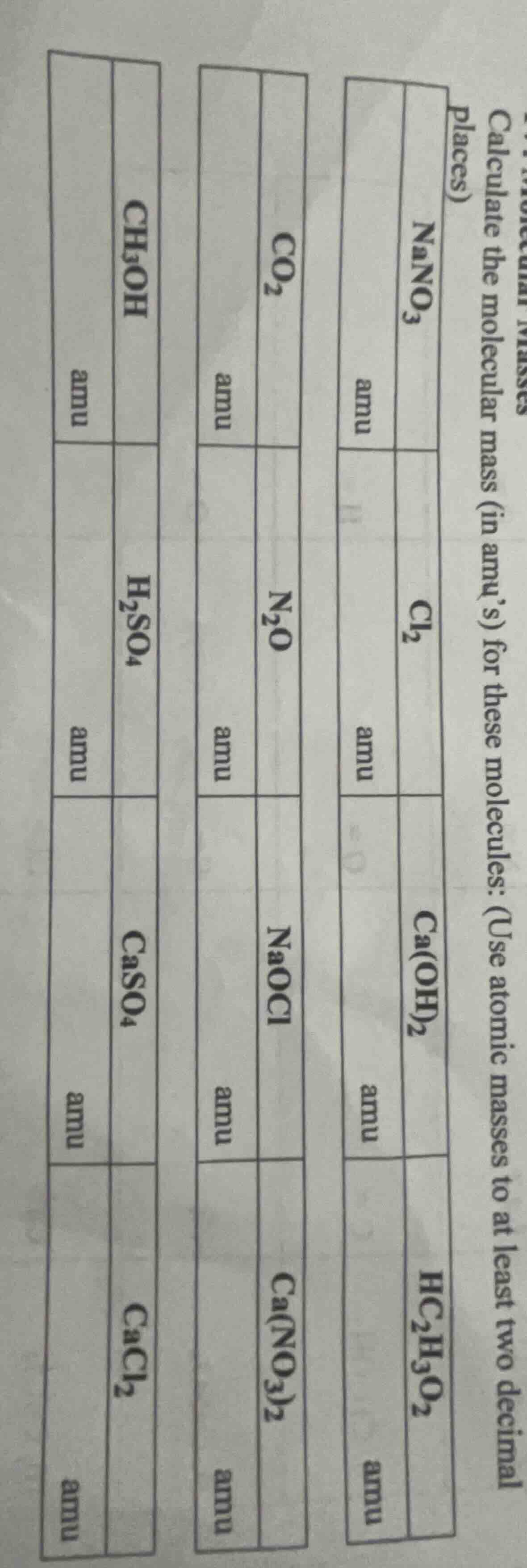
calculate the molecular mass (in amu’s) for these molecules: (use atomic masses to at least two decimal places)
nano₃ amu
cl₂ amu
ca(oh)₂ amu
hc₂h₃o₂ amu
co₂ amu
n₂o amu
naocl amu
ca(no₃)₂ amu
ch₃oh amu
h₂so₄ amu
caso₄ amu
cacl₂ amu
To solve for the molecular mass of each compound, we use the atomic masses (in amu) of the constituent elements: \( \text{Na} = 22.99 \), \( \text{N} = 14.01 \), \( \text{O} = 16.00 \), \( \text{Cl} = 35.45 \), \( \text{Ca} = 40.08 \), \( \text{H} = 1.01 \), \( \text{C} = 12.01 \), \( \text{S} = 32.07 \), \( \text{K} = 39.10 \) (if needed), etc. We calculate the sum of the atomic masses of all atoms in the molecule. Here are the calculations for a few examples (we'll do \( \text{NaNO}_3 \), \( \text{Cl}_2 \), and \( \text{Ca(OH)}_2 \) as samples; the rest follow the same method):
1. \( \text{NaNO}_3 \)
Step 1: Identify atoms and their counts
- \( \text{Na} \): 1 atom
- \( \text{N} \): 1 atom
- \( \text{O} \): 3 atoms
Step 2: Multiply each atomic mass by its count
- \( \text{Na} \): \( 1 \times 22.99 = 22.99 \)
- \( \text{N} \): \( 1 \times 14.01 = 14.01 \)
- \( \text{O} \): \( 3 \times 16.00 = 48.00 \)
Step 3: Sum the masses
\( 22.99 + 14.01 + 48.00 = 85.00 \) amu (wait, actually, more precisely: \( 22.9898 + 14.0067 + 3 \times 15.9994 \approx 22.9898 + 14.0067 + 47.9982 = 84.9947 \approx 84.99 \) amu if we use more precise atomic masses, but often rounded values are used. Let's use \( \text{Na} = 22.99 \), \( \text{N} = 14.01 \), \( \text{O} = 16.00 \) for simplicity here, but for accuracy, use the most precise values.)
2. \( \text{Cl}_2 \)
Step 1: Identify atoms and their counts
- \( \text{Cl} \): 2 atoms
Step 2: Multiply atomic mass by count
- \( \text{Cl} \): \( 2 \times 35.45 = 70.90 \) amu
3. \( \text{Ca(OH)}_2 \)
Step 1: Identify atoms and their counts
- \( \text{Ca} \): 1 atom
- \( \text{O} \): 2 atoms (from the two \( \text{OH}^- \) groups)
- \( \text{H} \): 2 atoms (from the two \( \text{OH}^- \) groups)
Step 2: Multiply each atomic mass by its count
- \( \text{Ca} \): \( 1 \times 40.08 = 40.08 \)
- \( \text{O} \): \( 2 \times 16.00 = 32.00 \)
- \( \text{H} \): \( 2 \times 1.01 = 2.02 \)
Step 3: Sum the masses
\( 40.08 + 32.00 + 2.02 = 74.10 \) amu
4. \( \text{HC}_2\text{H}_3\text{O}_2 \) (Acetic Acid, \( \text{CH}_3\text{COOH} \))
Step 1: Identify atoms and their counts
- \( \text{C} \): 2 atoms
- \( \text{H} \): 4 atoms (wait, \( \text{HC}_2\text{H}_3\text{O}_2 \) is \( \text{C}_2\text{H}_4\text{O}_2 \)? Wait, no: \( \text{HC}_2\text{H}_3\text{O}_2 \) is \( \text{H} + \text{C}_2\text{H}_3\text{O}_2 \), so total \( \text{C}: 2 \), \( \text{H}: 4 \), \( \text{O}: 2 \))
Step 2: Multiply each atomic mass by its count
- \( \text{C} \): \( 2 \times 12.01 = 24.02 \)
- \( \text{H} \): \( 4 \times 1.01 = 4.04 \)
- \( \text{O} \): \( 2 \times 16.00 = 32.00 \)
Step 3: Sum the masses
\( 24.02 + 4.04 + 32.00 = 60.06 \) amu (actual molar mass of acetic acid is ~60.05 g/mol, which matches)
5. \( \text{CO}_2 \)
Step 1: Atoms: \( \text{C}: 1 \), \( \text{O}: 2 \)
Step 2: Masses: \( 12.01 + 2 \times 16.00 = 12.01 + 32.00 = 44.01 \) amu
6. \( \text{N}_2\text{O} \)
Step 1: Atoms: \( \text{N}: 2 \), \( \text{O}: 1 \)
Step 2: Masses: \( 2 \times 14.01 + 16.00 = 28.02 + 16.00 = 44.02 \) amu
7. \( \text{NaOCl} \) (Sodium Hypochlorite)
Step 1: Atoms: \( \text{Na}: 1 \), \( \text{O}: 1 \), \( \text{Cl}: 1 \)
Step 2: Masses: \( 22.99 + 16.00 + 35.45 = 74.44 \) amu
8. \( \text{Ca(NO}_3\text{)}_2 \)
Step 1: Atoms: \( \text{Ca}: 1 \), \( \text{N}: 2 \), \( \text{O}: 6 \) (since 2 nitrate groups, each with 1 N and 3 O)
Step 2: Masses: \( 40.08 + 2 \times 14.01 + 6 \times 16.00 = 40.08 + 28.02 + 96.00 = 164.10 \)…

Snap & solve any problem in the app
Get step-by-step solutions on Sovi AI
Photo-based solutions with guided steps
Explore more problems and detailed explanations
To solve for the molecular mass of each compound, we use the atomic masses (in amu) of the constituent elements: \( \text{Na} = 22.99 \), \( \text{N} = 14.01 \), \( \text{O} = 16.00 \), \( \text{Cl} = 35.45 \), \( \text{Ca} = 40.08 \), \( \text{H} = 1.01 \), \( \text{C} = 12.01 \), \( \text{S} = 32.07 \), \( \text{K} = 39.10 \) (if needed), etc. We calculate the sum of the atomic masses of all atoms in the molecule. Here are the calculations for a few examples (we'll do \( \text{NaNO}_3 \), \( \text{Cl}_2 \), and \( \text{Ca(OH)}_2 \) as samples; the rest follow the same method):
1. \( \text{NaNO}_3 \)
Step 1: Identify atoms and their counts
- \( \text{Na} \): 1 atom
- \( \text{N} \): 1 atom
- \( \text{O} \): 3 atoms
Step 2: Multiply each atomic mass by its count
- \( \text{Na} \): \( 1 \times 22.99 = 22.99 \)
- \( \text{N} \): \( 1 \times 14.01 = 14.01 \)
- \( \text{O} \): \( 3 \times 16.00 = 48.00 \)
Step 3: Sum the masses
\( 22.99 + 14.01 + 48.00 = 85.00 \) amu (wait, actually, more precisely: \( 22.9898 + 14.0067 + 3 \times 15.9994 \approx 22.9898 + 14.0067 + 47.9982 = 84.9947 \approx 84.99 \) amu if we use more precise atomic masses, but often rounded values are used. Let's use \( \text{Na} = 22.99 \), \( \text{N} = 14.01 \), \( \text{O} = 16.00 \) for simplicity here, but for accuracy, use the most precise values.)
2. \( \text{Cl}_2 \)
Step 1: Identify atoms and their counts
- \( \text{Cl} \): 2 atoms
Step 2: Multiply atomic mass by count
- \( \text{Cl} \): \( 2 \times 35.45 = 70.90 \) amu
3. \( \text{Ca(OH)}_2 \)
Step 1: Identify atoms and their counts
- \( \text{Ca} \): 1 atom
- \( \text{O} \): 2 atoms (from the two \( \text{OH}^- \) groups)
- \( \text{H} \): 2 atoms (from the two \( \text{OH}^- \) groups)
Step 2: Multiply each atomic mass by its count
- \( \text{Ca} \): \( 1 \times 40.08 = 40.08 \)
- \( \text{O} \): \( 2 \times 16.00 = 32.00 \)
- \( \text{H} \): \( 2 \times 1.01 = 2.02 \)
Step 3: Sum the masses
\( 40.08 + 32.00 + 2.02 = 74.10 \) amu
4. \( \text{HC}_2\text{H}_3\text{O}_2 \) (Acetic Acid, \( \text{CH}_3\text{COOH} \))
Step 1: Identify atoms and their counts
- \( \text{C} \): 2 atoms
- \( \text{H} \): 4 atoms (wait, \( \text{HC}_2\text{H}_3\text{O}_2 \) is \( \text{C}_2\text{H}_4\text{O}_2 \)? Wait, no: \( \text{HC}_2\text{H}_3\text{O}_2 \) is \( \text{H} + \text{C}_2\text{H}_3\text{O}_2 \), so total \( \text{C}: 2 \), \( \text{H}: 4 \), \( \text{O}: 2 \))
Step 2: Multiply each atomic mass by its count
- \( \text{C} \): \( 2 \times 12.01 = 24.02 \)
- \( \text{H} \): \( 4 \times 1.01 = 4.04 \)
- \( \text{O} \): \( 2 \times 16.00 = 32.00 \)
Step 3: Sum the masses
\( 24.02 + 4.04 + 32.00 = 60.06 \) amu (actual molar mass of acetic acid is ~60.05 g/mol, which matches)
5. \( \text{CO}_2 \)
Step 1: Atoms: \( \text{C}: 1 \), \( \text{O}: 2 \)
Step 2: Masses: \( 12.01 + 2 \times 16.00 = 12.01 + 32.00 = 44.01 \) amu
6. \( \text{N}_2\text{O} \)
Step 1: Atoms: \( \text{N}: 2 \), \( \text{O}: 1 \)
Step 2: Masses: \( 2 \times 14.01 + 16.00 = 28.02 + 16.00 = 44.02 \) amu
7. \( \text{NaOCl} \) (Sodium Hypochlorite)
Step 1: Atoms: \( \text{Na}: 1 \), \( \text{O}: 1 \), \( \text{Cl}: 1 \)
Step 2: Masses: \( 22.99 + 16.00 + 35.45 = 74.44 \) amu
8. \( \text{Ca(NO}_3\text{)}_2 \)
Step 1: Atoms: \( \text{Ca}: 1 \), \( \text{N}: 2 \), \( \text{O}: 6 \) (since 2 nitrate groups, each with 1 N and 3 O)
Step 2: Masses: \( 40.08 + 2 \times 14.01 + 6 \times 16.00 = 40.08 + 28.02 + 96.00 = 164.10 \) amu
9. \( \text{CH}_3\text{OH} \) (Methanol)
Step 1: Atoms: \( \text{C}: 1 \), \( \text{H}: 4 \), \( \text{O}: 1 \)
Step 2: Masses: \( 12.01 + 4 \times 1.01 + 16.00 = 12.01 + 4.04 + 16.00 = 32.05 \) amu
10. \( \text{H}_2\text{SO}_4 \) (Sulfuric Acid)
Step 1: Atoms: \( \text{H}: 2 \), \( \text{S}: 1 \), \( \text{O}: 4 \)
Step 2: Masses: \( 2 \times 1.01 + 32.07 + 4 \times 16.00 = 2.02 + 32.07 + 64.00 = 98.09 \) amu
11. \( \text{CaSO}_4 \) (Calcium Sulfate)
Step 1: Atoms: \( \text{Ca}: 1 \), \( \text{S}: 1 \), \( \text{O}: 4 \)
Step 2: Masses: \( 40.08 + 32.07 + 4 \times 16.00 = 40.08 + 32.07 + 64.00 = 136.15 \) amu
12. \( \text{CaCl}_2 \) (Calcium Chloride)
Step 1: Atoms: \( \text{Ca}: 1 \), \( \text{Cl}: 2 \)
Step 2: Masses: \( 40.08 + 2 \times 35.45 = 40.08 + 70.90 = 110.98 \) amu
Summary of Molecular Masses (using rounded atomic masses for simplicity; for more precision, use the exact atomic weights from the periodic table):
| Compound | Molecular Mass (amu) |
|---|---|
| \( \text{Cl}_2 \) | 70.90 |
| \( \text{Ca(OH)}_2 \) | 74.10 |
| \( \text{HC}_2\text{H}_3\text{O}_2 \) | 60.06 |
| \( \text{CO}_2 \) | 44.01 |
| \( \text{N}_2\text{O} \) | 44.02 |
| \( \text{NaOCl} \) | 74.44 |
| \( \text{Ca(NO}_3\text{)}_2 \) | 164.10 |
| \( \text{CH}_3\text{OH} \) | 32.05 |
| \( \text{H}_2\text{SO}_4 \) | 98.09 |
| \( \text{CaSO}_4 \) | 136.15 |
| \( \text{CaCl}_2 \) | 110.98 |
To calculate each one precisely, follow the same steps: identify the number of each atom, multiply by its atomic mass, and sum. Use the most accurate atomic masses (e.g., from the IUPAC standard) for precise results (e.g., \( \text{Na} = 22.98976928 \), \( \text{N} = 14.0067 \), \( \text{O} = 15.9994 \), \( \text{Cl} = 35.453 \), \( \text{Ca} = 40.078 \), \( \text{H} = 1.00784 \), \( \text{C} = 12.0000 \), \( \text{S} = 32.06 \), etc.).