QUESTION IMAGE
Question
a monkeys choosing a circle from an array of geometric shapes in order to be rewarded with a banana exemplifies
a. stimulus habituation
b. stimulus discrimination
c. stimulus generalization
d. latent learning
- a person eats a hamburger at a restaurant and develops a very bad stomach ache after finishing eating. as a result of the sudden illness, the person cannot eat hamburgers anymore. just thinking about them makes the person feel sick to the stomach. this scenario best illustrates
a. taste aversion
b. insight learning
c. learned helplessness
d. instinctive drift
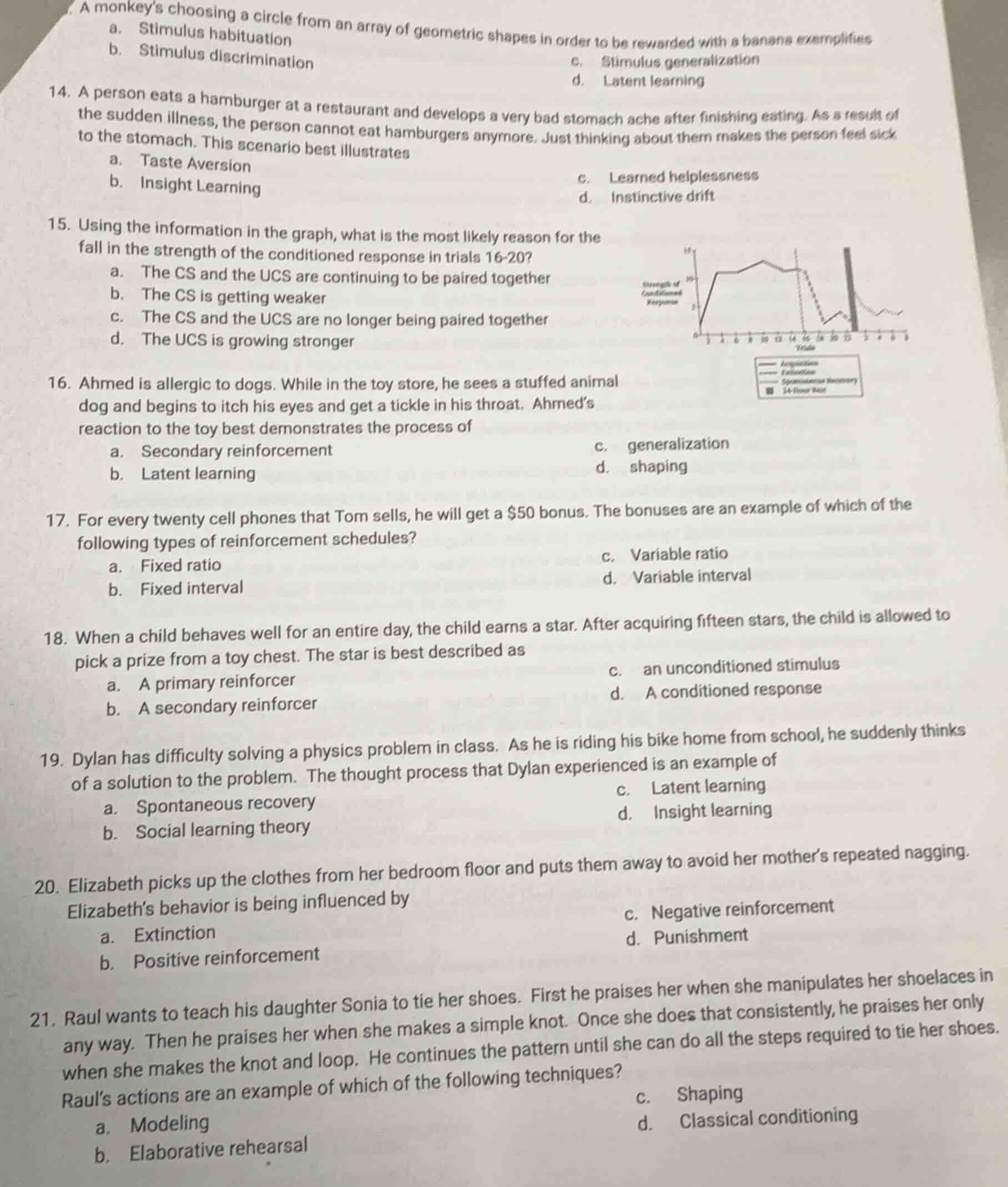
- using the information in the graph, what is the most likely reason for the fall in the strength of the conditioned response in trials 16-20?
a. the cs and the ucs are continuing to be paired together
b. the cs is getting weaker
c. the cs and the ucs are no longer being paired together
d. the ucs is growing stronger
- ahmed is allergic to dogs. while in the toy store, he sees a stuffed animal dog and begins to itch his eyes and get a tickle in his throat. ahmeds reaction to the toy best demonstrates the process of
a. secondary reinforcement
b. latent learning
c. generalization
d. shaping
- for every twenty cell phones that tom sells, he will get a $50 bonus. the bonuses are an example of which of the following types of reinforcement schedules?
a. fixed ratio
b. fixed interval
c. variable ratio
d. variable interval
- when a child behaves well for an entire day, the child earns a star. after acquiring fifteen stars, the child is allowed to pick a prize from a toy chest. the star is best described as
a. a primary reinforcer
b. a secondary reinforcer
c. an unconditioned stimulus
d. a conditioned response
- dylan has difficulty solving a physics problem in class. as he is riding his bike home from school, he suddenly thinks of a solution to the problem. the thought process that dylan experienced is an example of
a. spontaneous recovery
b. social learning theory
c. latent learning
d. insight learning
- elizabeth picks up the clothes from her bedroom floor and puts them away to avoid her mothers repeated nagging. elizabeths behavior is being influenced by
a. extinction
b. positive reinforcement
c. negative reinforcement
d. punishment
- raul wants to teach his daughter sonia to tie her shoes. first he praises her when she manipulates her shoelaces in any way. then he praises her when she makes a simple knot. once she does that consistently, he praises her only when she makes the knot and loop. he continues the pattern until she can do all the steps required to tie her shoes. rauls actions are an example of which of the following techniques?
a. modeling
b. elaborative rehearsal
c. shaping
d. classical conditioning
- Stimulus discrimination is distinguishing a specific stimulus (circle) to earn a reward, matching the scenario.
- Taste aversion is a learned avoidance of a food after it causes illness, which matches the person's reaction to hamburgers.
- Extinction (fall in conditioned response) occurs when the conditioned stimulus (CS) and unconditioned stimulus (UCS) are no longer paired.
- Stimulus generalization is reacting to a similar stimulus (stuffed dog) the same way as the original (real dogs that cause allergies).
- Fixed ratio reinforcement rewards after a set number of responses (20 cell phones sold for a bonus).
- Secondary reinforcers (stars) gain value from association with primary reinforcers (toys from the chest).
- Insight learning is a sudden realization of a solution after struggling with a problem, matching Dylan's experience.
- Negative reinforcement involves removing an unpleasant stimulus (nagging) by performing a behavior, which drives Elizabeth's action.
- Shaping is reinforcing successive approximations of a desired behavior (steps to tie shoes) until the full task is mastered.

Snap & solve any problem in the app
Get step-by-step solutions on Sovi AI
Photo-based solutions with guided steps
Explore more problems and detailed explanations
- b. Stimulus discrimination
- a. Taste Aversion
- c. The CS and the UCS are no longer being paired together
- c. generalization
- a. Fixed ratio
- b. A secondary reinforcer
- d. Insight learning
- c. Negative reinforcement
- c. Shaping