QUESTION IMAGE
Question
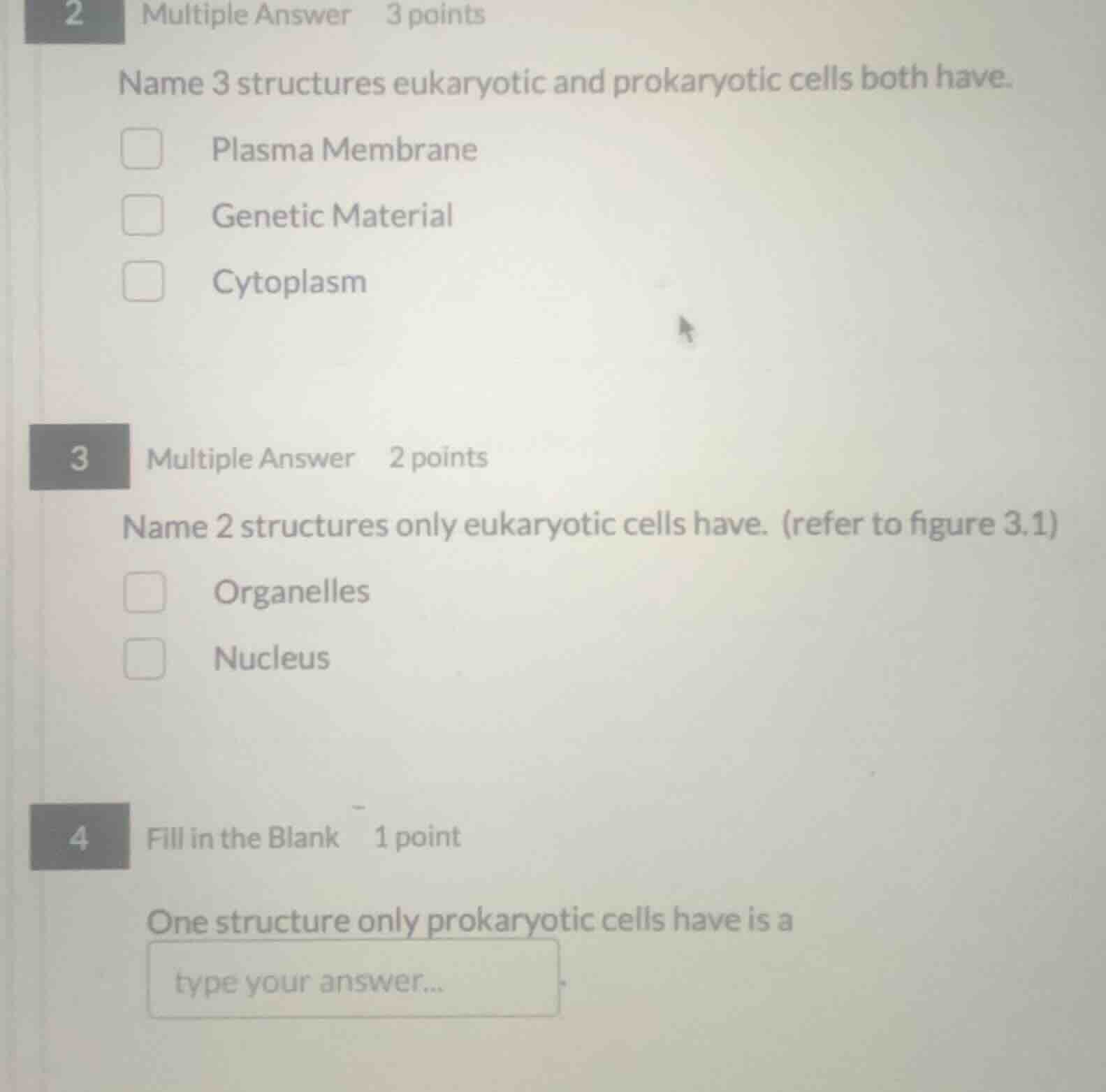
2 multiple answer 3 points
name 3 structures eukaryotic and prokaryotic cells both have.
plasma membrane
genetic material
cytoplasm
3 multiple answer 2 points
name 2 structures only eukaryotic cells have. (refer to figure 3.1)
organelles
nucleus
4 fill in the blank 1 point
one structure only prokaryotic cells have is a
type your answer...
For question 2: All three listed structures are shared by both eukaryotic and prokaryotic cells; the plasma membrane forms the cell boundary, genetic material stores genetic information, and cytoplasm is the internal fluid-filled space.
For question 3: Eukaryotic cells have a membrane-bound nucleus (which prokaryotes lack) and membrane-bound organelles (prokaryotes only have non-membrane-bound ribosomes, not true organelles as defined here).
For question 4: Prokaryotic cells have a cell wall (in most cases) or a nucleoid, but the most distinct structure unique to most prokaryotes is a cell wall (or more specifically, a peptidoglycan cell wall, but the common answer is cell wall, or nucleoid region). The most standard unique structure is the nucleoid, or cell wall (though some eukaryotes have cell walls, prokaryotic cell walls have a unique composition; the most definitive unique structure is the nucleoid, a region where genetic material is concentrated without a membrane).

Snap & solve any problem in the app
Get step-by-step solutions on Sovi AI
Photo-based solutions with guided steps
Explore more problems and detailed explanations
- Question 2:
A. Plasma Membrane
B. Genetic Material
C. Cytoplasm
- Question 3:
A. Organelles
B. Nucleus
- Question 4: Nucleoid (or Peptidoglycan Cell Wall)