QUESTION IMAGE
Question
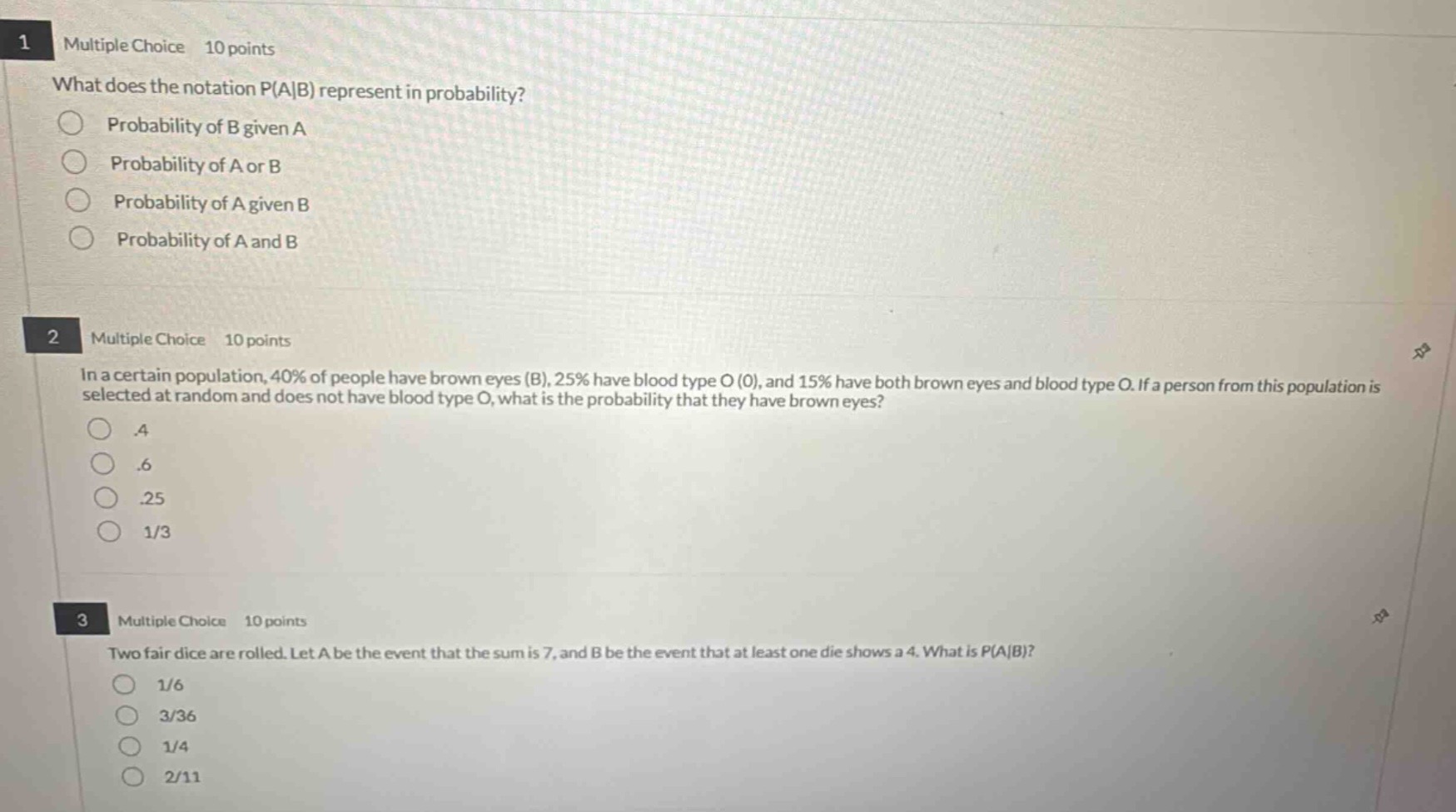
1 multiple choice 10 points
what does the notation p(a|b) represent in probability?
- probability of b given a
- probability of a or b
- probability of a given b
- probability of a and b
2 multiple choice 10 points
in a certain population, 40% of people have brown eyes (b), 25% have blood type o (o), and 15% have both brown eyes and blood type o. if a person from this population is selected at random and does not have blood type o, what is the probability that they have brown eyes?
- .4
- .6
- .25
- 1/3
3 multiple choice 10 points
two fair dice are rolled. let a be the event that the sum is 7, and b be the event that at least one die shows a 4. what is p(a|b)?
- 1/6
- 3/36
- 1/4
- 2/11
Question 1
In probability, the notation \( P(A|B) \) is defined as the conditional probability of event \( A \) occurring given that event \( B \) has already occurred. Let's analyze each option:
- "Probability of B given A" would be \( P(B|A) \), not \( P(A|B) \).
- "Probability of A or B" is denoted as \( P(A \cup B) \).
- "Probability of A and B" is denoted as \( P(A \cap B) \) or \( P(AB) \).
- "Probability of A given B" matches the definition of \( P(A|B) \).
Step 1: Recall the formula for conditional probability
The formula for conditional probability is \( P(A|
eg B)=\frac{P(A\cap
eg B)}{P(
eg B)} \). First, we need to find \( P(
eg O) \) (probability of not having blood type O) and \( P(B\cap
eg O) \) (probability of having brown eyes and not having blood type O).
Step 2: Calculate \( P(
eg O) \)
We know that \( P(O) = 0.25 \), so \( P(
eg O)=1 - P(O)=1 - 0.25 = 0.75 \).
Step 3: Calculate \( P(B\cap
eg O) \)
We know that \( P(B) = 0.40 \) and \( P(B\cap O)=0.15 \). Using the formula \( P(B)=P(B\cap O)+P(B\cap
eg O) \), we can solve for \( P(B\cap
eg O) \):
\( P(B\cap
eg O)=P(B)-P(B\cap O)=0.40 - 0.15 = 0.25 \).
Step 4: Calculate \( P(B|
eg O) \)
Using the conditional probability formula \( P(B|
eg O)=\frac{P(B\cap
eg O)}{P(
eg O)} \), substitute the values we found:
\( P(B|
eg O)=\frac{0.25}{0.75}=\frac{1}{3}\approx0.333... \)? Wait, no, wait. Wait, 0.25 divided by 0.75? Wait, no, wait, 0.4 - 0.15 is 0.25? Wait, 0.4 (brown eyes) minus 0.15 (both) is 0.25 (brown eyes and not O). And \( P(
eg O) \) is 1 - 0.25 = 0.75. Then \( 0.25 / 0.75 = 1/3 \approx 0.333 \), but wait, the options have 1/3. Wait, let's check again. Wait, 40% have brown eyes, 15% have both. So brown eyes only (brown and not O) is 40% - 15% = 25% (0.25). Not O is 100% - 25% = 75% (0.75). Then the probability is 0.25 / 0.75 = 1/3.
Step 1: Recall the formula for conditional probability
The formula for conditional probability is \( P(A|B)=\frac{P(A\cap B)}{P(B)} \). So we need to find the number of outcomes in \( A\cap B \) and the number of outcomes in \( B \).
Step 2: Find the sample space for event B (at least one die shows a 4)
When rolling two dice, the total number of outcomes is \( 6\times6 = 36 \). The event B (at least one 4) can be calculated by: number of outcomes with at least one 4 = total outcomes - outcomes with no 4s. Outcomes with no 4s: each die has 5 options (1,2,3,5,6), so \( 5\times5 = 25 \). Thus, \( n(B)=36 - 25 = 11 \).
Step 3: Find the number of outcomes in \( A\cap B \) (sum is 7 and at least one die shows a 4)
The event A (sum is 7) has the following outcomes: (1,6), (2,5), (3,4), (4,3), (5,2), (6,1). Now, from these, we need to find the outcomes where at least one die is 4. The outcomes are (3,4) and (4,3). So \( n(A\cap B)=2 \).
Step 4: Calculate \( P(A|B) \)
Using the formula \( P(A|B)=\frac{n(A\cap B)}{n(B)}=\frac{2}{11} \) (since when dealing with equally likely outcomes, \( P(A\cap B)=\frac{n(A\cap B)}{N} \) and \( P(B)=\frac{n(B)}{N} \), so the \( N \) cancels out, and we can use counts).

Snap & solve any problem in the app
Get step-by-step solutions on Sovi AI
Photo-based solutions with guided steps
Explore more problems and detailed explanations
C. Probability of A given B