QUESTION IMAGE
Question
multiple choice
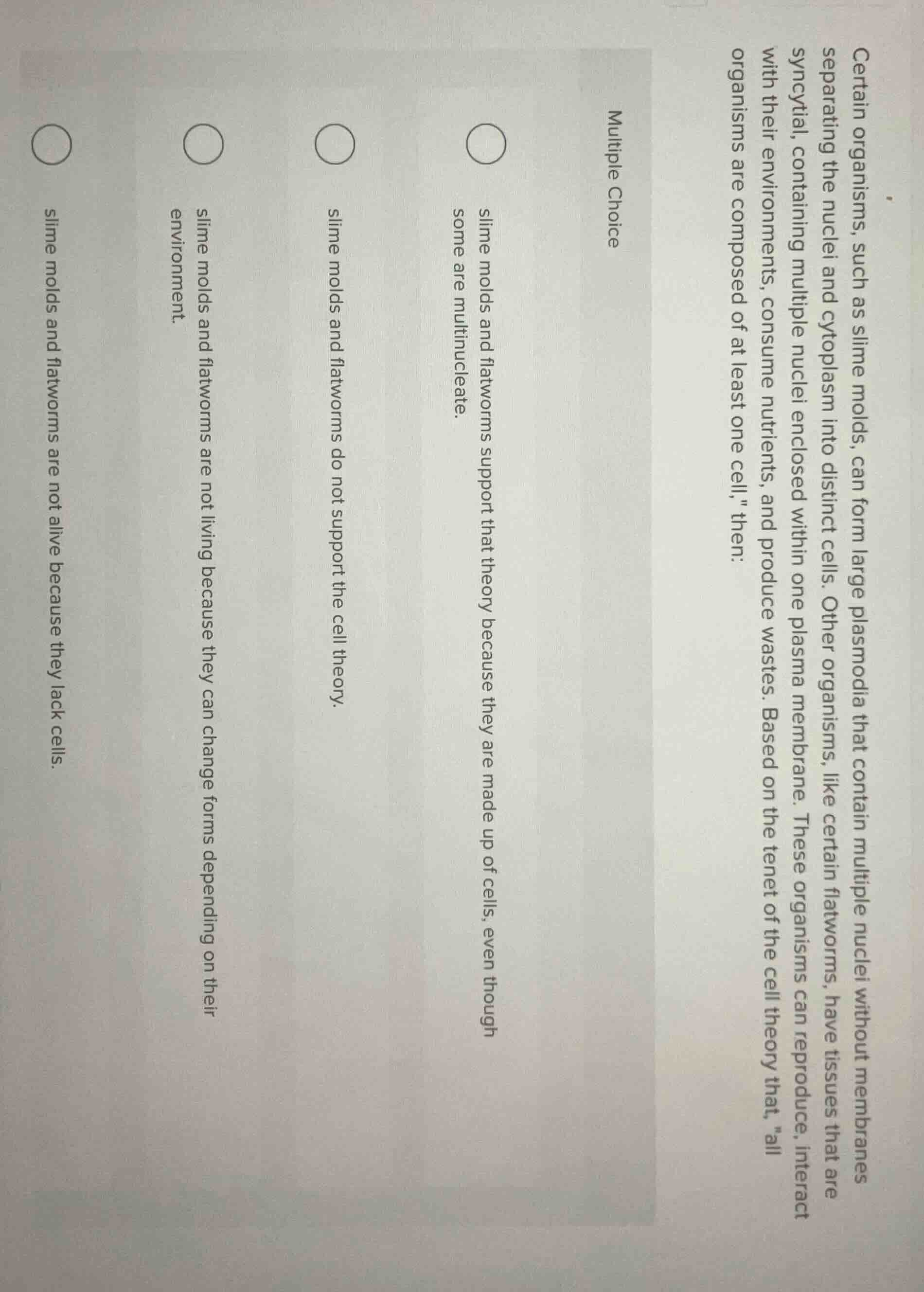
certain organisms, such as slime molds, can form large plasmodia that contain multiple nuclei without membranes separating the nuclei and cytoplasm into distinct cells. other organisms, like certain flatworms, have tissues that are syncytial, containing multiple nuclei enclosed within one plasma membrane. these organisms can reproduce, interact with their environments, consume nutrients, and produce wastes. based on the tenet of the cell theory that, \all organisms are composed of at least one cell,\ then:
○ slime molds and flatworms support that theory because they are made up of cells, even though some are multinucleate.
○ slime molds and flatworms do not support the cell theory.
○ slime molds and flatworms are not living because they can change forms depending on their environment.
○ slime molds and flatworms are not alive because they lack cells.
The cell theory states all organisms are composed of at least one cell. Slime molds (plasmodial form is a multinucleate single cell) and flatworms (multicellular, with syncytial tissues that are still part of cellular structures) are made of cells, even if some are multinucleate. They do not contradict cell theory, as they are cellular organisms.

Snap & solve any problem in the app
Get step-by-step solutions on Sovi AI
Photo-based solutions with guided steps
Explore more problems and detailed explanations
slime molds and flatworms support that theory because they are made up of cells, even though some are multinucleate.