QUESTION IMAGE
Question
multiple choice 4 points
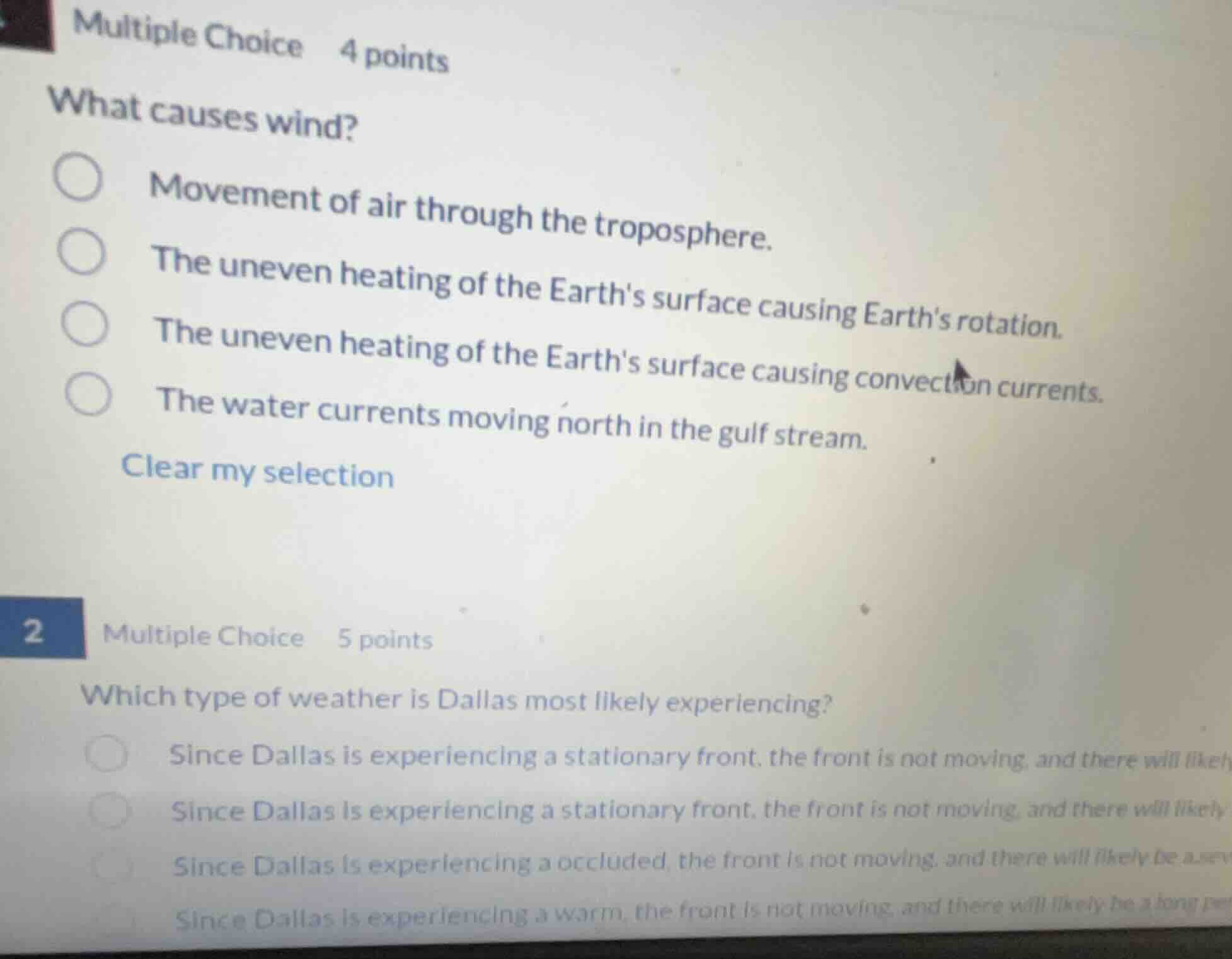
what causes wind?
movement of air through the troposphere.
the uneven heating of the earths surface causing earths rotation.
the uneven heating of the earths surface causing convection currents.
the water currents moving north in the gulf stream.
clear my selection
2 multiple choice 5 points
which type of weather is dallas most likely experiencing?
since dallas is experiencing a stationary front, the front is not moving, and there will likely
since dallas is experiencing a stationary front, the front is not moving, and there will likely
since dallas is experiencing a occluded, the front is not moving, and there will likely be a sev
since dallas is experiencing a warm, the front is not moving, and there will likely be a long pe
Question 1: What causes wind?
- Option 1: Movement of air through the troposphere describes wind's path, not its cause.
- Option 2: Uneven heating causing Earth’s rotation is incorrect; Earth’s rotation affects wind direction (Coriolis effect), not its cause.
- Option 3: The uneven heating of the Earth’s surface creates temperature differences, leading to pressure differences. Air moves from high to low pressure, driven by convection currents formed from uneven heating. This is the correct cause of wind.
- Option 4: Water currents in the Gulf Stream relate to oceanography, not wind formation.
- Stationary fronts occur when a warm and cold front meet and neither moves. They bring prolonged, steady weather (rain, clouds). Warm fronts move (so saying a warm front is "not moving" is incorrect). Occluded fronts involve three air masses and move. So options with stationary front (first two, assuming their weather description is correct for stationary fronts) are valid.

Snap & solve any problem in the app
Get step-by-step solutions on Sovi AI
Photo-based solutions with guided steps
Explore more problems and detailed explanations
The uneven heating of the Earth's surface causing convection currents.