QUESTION IMAGE
Question
multiple-choice question chlorophyll a reflects ______ light (select all that apply) orange yellow blue violet green
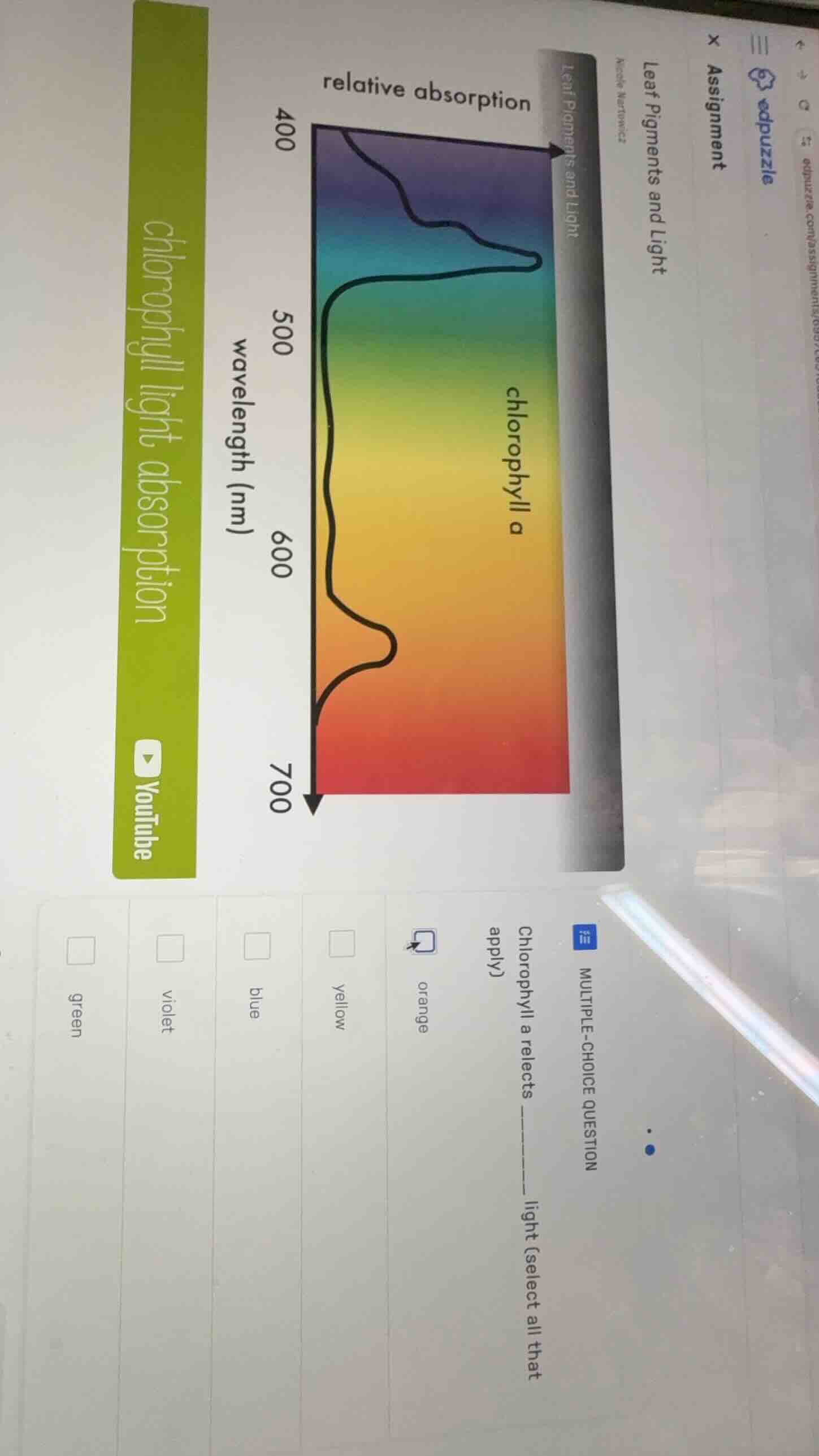
To determine which light chlorophyll a reflects, we analyze the absorption spectrum. Chlorophyll a absorbs light strongly in the violet - blue (around 400 - 500 nm) and red (around 600 - 700 nm) regions. The wavelengths it reflects are those with low absorption. The green region (around 500 - 600 nm) has relatively low absorption, so chlorophyll a reflects green light. Also, looking at the spectrum, the yellow - green - green range (including green) is reflected. Among the options, green is the main color reflected, and also, the absorption in the yellow - green area is relatively low, so yellow and green are reflected? Wait, no, the key is that chlorophyll a appears green because it reflects green light. Wait, let's re - examine: the absorption peaks are in blue - violet and red. So the wavelengths between, like green (and maybe yellow - green) are reflected. But the options are green, violet, blue, yellow, orange. Violet and blue are absorbed (high absorption), orange and red? Wait, the red region: the absorption at 600 - 700, the graph shows that at 600 - 700, the absorption has a dip? Wait, no, the y - axis is relative absorption. At 400 - 500 (violet - blue), absorption is high. At 500 - 600 (green - yellow), absorption is low. At 600 - 700 (orange - red), there is a peak? Wait, no, the graph: the top line (leaf pigments and light) and chlorophyll a. Wait, the chlorophyll a curve: at 400 - 500, it's high, then drops at 500 - 600 (low absorption), then rises again at 600 - 700? Wait, no, the x - axis is wavelength (nm) from 400 to 700, increasing downwards. The y - axis is relative absorption. So at 400 (top), absorption is high, then at 500, it drops, then at 600, it drops more? Wait, no, the curve for chlorophyll a: starts high at 400, decreases until around 500, then has a small increase, then decreases again? Wait, maybe I misread. But the key concept is that chlorophyll a reflects green light (so green is reflected). Also, the yellow - green area: since absorption is low there, yellow and green are reflected? Wait, the options are green, violet, blue, yellow, orange. Violet and blue are absorbed (high absorption), so not reflected. Orange: the red - orange region, is absorption high? Wait, the graph at 600 - 700: the chlorophyll a curve, at 600 - 700, the absorption is lower than at 400 - 500, but higher than at 500 - 600? Wait, maybe the correct approach is: chlorophyll a reflects green and yellow - green light. So among the options, green and yellow are reflected? But the question says "select all that apply". Wait, the options are checkboxes: green, violet, blue, yellow, orange. So:
- Violet: absorbed (high absorption) → not reflected.
- Blue: absorbed (high absorption) → not reflected.
- Yellow: the wavelength around yellow (550 - 600 nm) has low absorption → reflected.
- Green: the wavelength around green (500 - 550 nm) has low absorption → reflected.
- Orange: the wavelength around orange (600 - 650 nm) – let's see the chlorophyll a curve. At 600 - 700, the absorption is higher than at 500 - 600 but lower than at 400 - 500? Wait, maybe orange is also reflected? No, the main reflection is green, and also yellow. Wait, the standard knowledge: chlorophyll a reflects green and yellow - green light. So the correct options are green and yellow? Wait, but the graph: at 500 - 600 (yellow - green - green), absorption is low. So yellow (around 550 - 600) and green (around 500 - 550) are reflected. Also, maybe orange? No, orange is closer to red, which is absorbed more. Wait, maybe the answer is green, yellow, and maybe orange?…

Snap & solve any problem in the app
Get step-by-step solutions on Sovi AI
Photo-based solutions with guided steps
Explore more problems and detailed explanations
green, yellow