QUESTION IMAGE
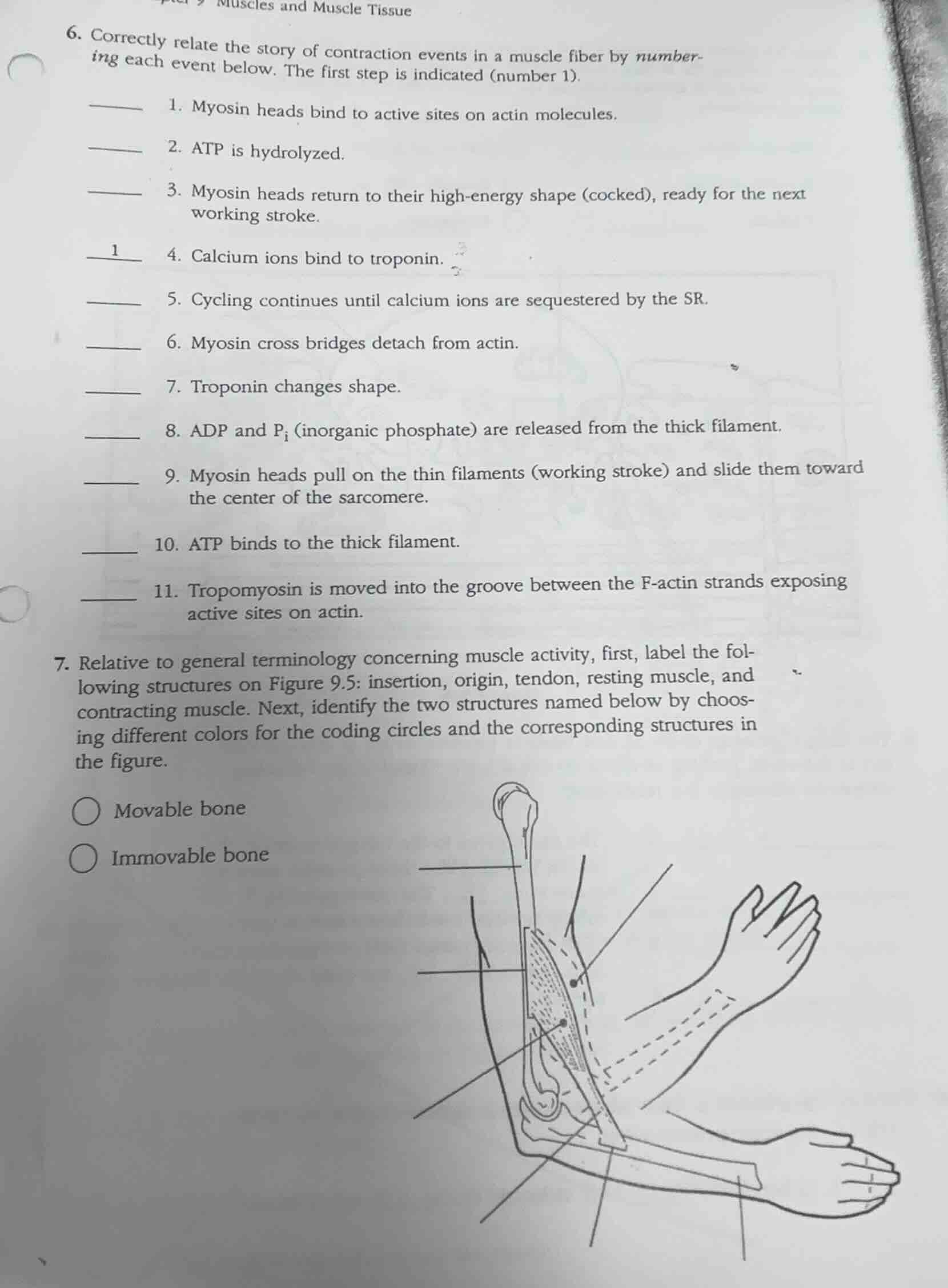
Question
muscles and muscle tissue
- correctly relate the story of contraction events in a muscle fiber by numbering each event below. the first step is indicated (number 1).
______ 1. myosin heads bind to active sites on actin molecules.
______ 2. atp is hydrolyzed.
______ 3. myosin heads return to their high - energy shape (cocked), ready for the next working stroke.
__1_ 4. calcium ions bind to troponin.
______ 5. cycling continues until calcium ions are sequestered by the sr.
______ 6. myosin cross bridges detach from actin.
______ 7. troponin changes shape.
______ 8. adp and $p_i$ (inorganic phosphate) are released from the thick filament.
______ 9. myosin heads pull on the thin filaments (working stroke) and slide them toward the center of the sarcomere.
______ 10. atp binds to the thick filament.
______ 11. tropomyosin is moved into the groove between the f - actin strands exposing active sites on actin.
- relative to general terminology concerning muscle activity, first, label the following structures on figure 9.5: insertion, origin, tendon, resting muscle, and contracting muscle. next, identify the two structures named below by choosing different colors for the coding circles and the corresponding structures in the figure.
$\bigcirc$ movable bone
$\bigcirc$ immovable bone
Question 6 (Muscle Contraction Event Ordering)
Step 1: Recall the Sliding Filament Theory Steps
The correct order of muscle contraction events (after step 1: Calcium ions bind to troponin) is based on the sliding filament theory. Let's list the correct sequence:
- Calcium ions bind to troponin (given as step 4, number 1).
- Troponin changes shape (step 7).
- Tropomyosin is moved to expose active sites on actin (step 11).
- Myosin heads bind to actin active sites (step 1).
- ADP and \( P_i \) are released (step 8).
- Myosin heads pull (working stroke, step 9).
- ATP binds to myosin (step 10).
- Myosin cross - bridges detach (step 6).
- ATP is hydrolyzed (step 2).
- Myosin heads return to cocked position (step 3).
- Cycling continues until \( Ca^{2+} \) is sequestered (step 5).
Now let's number each event:
- Event 1: Myosin heads bind to active sites on actin molecules. → 4 (after step 11)
- Event 2: ATP is hydrolyzed. → 9 (after step 10)
- Event 3: Myosin heads return to their high - energy shape (cocked), ready for the next working stroke. → 10 (after step 9)
- Event 4: Calcium ions bind to troponin. → 1 (given)
- Event 5: Cycling continues until calcium ions are sequestered by the SR. → 11 (last step)
- Event 6: Myosin cross bridges detach from actin. → 8 (after step 10)
- Event 7: Troponin changes shape. → 2 (after step 4)
- Event 8: ADP and \( P_i \) (inorganic phosphate) are released from the thick filament. → 5 (after step 4)
- Event 9: Myosin heads pull on the thin filaments (working stroke) and slide them toward the center of the sarcomere. → 6 (after step 5)
- Event 10: ATP binds to the thick filament. → 7 (after step 6)
- Event 11: Tropomyosin is moved into the groove between the F - actin strands exposing active sites on actin. → 3 (after step 2)
So the correct numbering from 1 - 11 (with step 4 as 1) is:
- Calcium ions bind to troponin. → 1
- Troponin changes shape. → 2
- Tropomyosin is moved into the groove between the F - actin strands exposing active sites on actin. → 3
- Myosin heads bind to active sites on actin molecules. → 4
- ADP and \( P_i \) (inorganic phosphate) are released from the thick filament. → 5
- Myosin heads pull on the thin filaments (working stroke) and slide them toward the center of the sarcomere. → 6
- ATP binds to the thick filament. → 7
- Myosin cross bridges detach from actin. → 8
- ATP is hydrolyzed. → 9
- Myosin heads return to their high - energy shape (cocked), ready for the next working stroke. → 10
- Cycling continues until calcium ions are sequestered by the SR. → 11
Question 7 (Muscle Terminology and Bone Labeling)
- Movable bone: The insertion of a muscle is on the movable bone. So the movable bone is associated with the insertion of the muscle. In the context of muscle action, when a muscle contracts, the movable bone moves.
- Immovable bone: The origin of a muscle is on the immovable bone. The immovable bone provides a fixed point for the muscle to act from.
For the labeling:
- Movable bone: The bone to which the muscle's insertion is attached (the bone that moves when the muscle contracts, e.g., in the arm, the radius/ulna during elbow flexion is the movable bone relative to the humerus).
- Immovable bone: The bone to which the muscle's origin is attached (the bone that does not move much during the muscle's contraction, e.g., the humerus in elbow flexion).

Snap & solve any problem in the app
Get step-by-step solutions on Sovi AI
Photo-based solutions with guided steps
Explore more problems and detailed explanations
(Question 6):
The correct numbering of the events is:
- Myosin heads bind to active sites on actin molecules. → \(\boldsymbol{4}\)
- ATP is hydrolyzed. → \(\boldsymbol{9}\)
- Myosin heads return to their high - energy shape (cocked), ready for the next working stroke. → \(\boldsymbol{10}\)
- Calcium ions bind to troponin. → \(\boldsymbol{1}\)
- Cycling continues until calcium ions are sequestered by the SR. → \(\boldsymbol{11}\)
- Myosin cross bridges detach from actin. → \(\boldsymbol{8}\)
- Troponin changes shape. → \(\boldsymbol{2}\)
- ADP and \( P_i \) (inorganic phosphate) are released from the thick filament. → \(\boldsymbol{5}\)
- Myosin heads pull on the thin filaments (working stroke) and slide them toward the center of the sarcomere. → \(\boldsymbol{6}\)
- ATP binds to the thick filament. → \(\boldsymbol{7}\)
- Tropomyosin is moved into the groove between the F - actin strands exposing active sites on actin. → \(\boldsymbol{3}\)